
Acne-faced, my stomach growling, and a heavy grocery bag struggling over my shoulder, I was trying to out-walk my hunger on a busy Montreal street. I had just moved to Montreal from Pakistan.

I was simultaneously doing tasbeeh—Hasbunallahu wa ni‘mal Wakeel (Sufficient is Allah for me!). My fingers were quickly rolling over rosary beads in a short wird. I had just met a social worker at L'Hirondelle Services d'Accueil et d'Intégration des Immigrants, an institute working for the integration of economic immigrants. She wanted to help me with Quebec job prospects and Canadianize my CV for the local job market.

Apparently, my “third-world” experience and educational degrees might not fetch me the job prospects my potential demanded.

I was trotting down the familiar route. Snaking my way down Parc Avenue Extension towards Jean-Talon. A cheaper district with many desis flocking around.

Hasbunallahu wa ni‘mal Wakeel, a regular unvoiced chant, was subconsciously counted on each rosary bead.

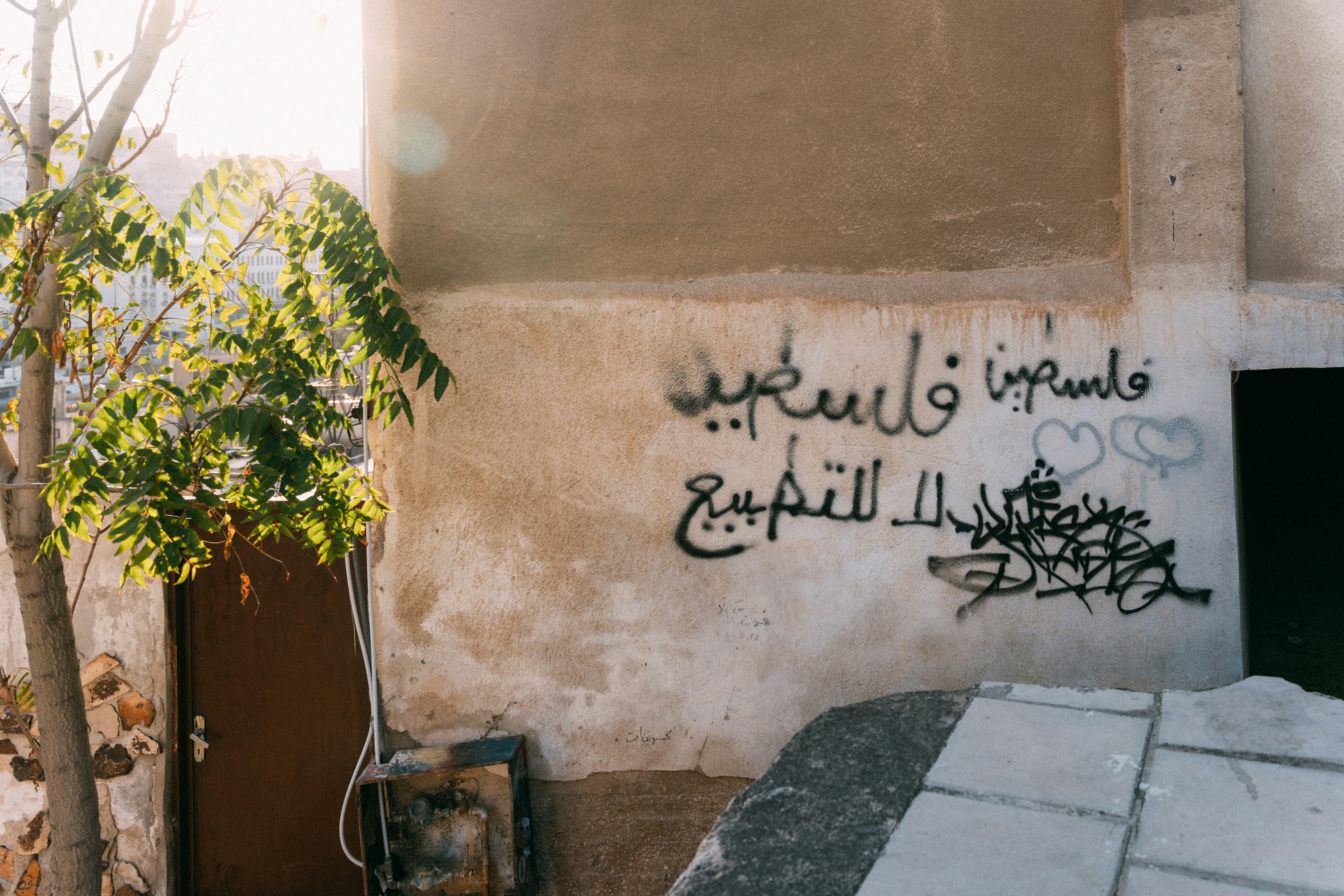
I came across graffiti openly condemning the Zionist atrocities in Gaza.
Montreal's graffiti in streetscaping allowed self-expression beyond the suffocating confines of a feared government.
A liberating practice, contrary to the authoritarian tendencies of my homeland government.

Here, the walls speak truths that news anchors fear.

I was gliding my way through Orthodox Jewish quarters, bypassing their synagogues and residential area.
Watching with curiosity the homogeneity in their attire.
Their ladies were draped in long black skirts, skin-tone leggings, and black shoes, while men adorned black suits with a particular form of cap.
A religious signifier, easily distinguished from a distanced spectacle.

Normally I would map my migrant experience,
Of walking, city culture, and emotional anxieties.

I wanted to pen down my pedestrian interaction with city graffiti.

A strong voice within me censored my writing impulse, disguising itself as “rationality.”
It was a strategic silence—not political silence. Like a stern, aged teacher, it strictly preached to me.
That Western survival silence!

Voicing opinions on anti-Zionist graffiti might not land you a “prestigious” job.
You want to belong—
You want to become a part of social prestige here!
Something you are striving for in this Western city.
Maybe you can put a story on Instagram which will vanish after 24 hours.

This way you can channel your self-expression. At the same time, avoid unnecessary controversy or social banishment from a strong Zionist lobby, shield yourself from a never-vanishing digital footprint and a hyper-surveilled digital Zionist gaze.

That voice wore the mask of reason.
But it was fear.
It was cowardice dressed in strategy.

The solo conversation was happening in my head while my hands were unconsciously rolling tasbeeh.

Suddenly my further musings slapped my pseudo “rational” voice.

How dare you feel ashamed of writing on issues that are on Haqq.

Isn't Islam about protecting the oppressed against the tyrants?
Does Islam teach you to be selective about your conscience and moral choices where it suits you?
Did Nabi Mustafa (ﷺ) stop preaching the message of ultimate Truth when Qurayshi Meccan elites offered him bribes, coerced him into social banishment in the boycott of Shi'b Abi Talib, or waged wars against him?
Did Musa (as) stop voicing the Divine command when the Pharaoh employed magicians to “build a state narrative”?
Why was I afraid of modern-day Pharaohs who use magicians to reshape Haqq.
Did Musa stop at the Red Sea because it looked impossible?
No—he walked. And Allah parted it.

It was the sheer power of tawakkul that Musa heralded when he took his nation towards the sea.
There were disgruntled detractors, skeptics, and free-rider hypocrites who wanted freedom without demonizing the powerful Pharaoh in Musa's nation.

Musa persisted in his faith.
He blindly followed God's command.
God parted the sea for his nation.
The sea devoured the tyrants.
This is the power of Allah.
He says “kun fa-yakun”
(Be it—and it is!)

Why was I stooping so low?
Why was I unconsciously associating the power of human forces with Divine supremacy?
Why was I associating the omnipotence of Allah with the hyper-surveillance of biased, racist, flawed, capitalist social media unicorn giants?
Are the two equal?
Isn't that a huge sin—associating equals with the characteristics of Allah?
Why was I afraid of algorithms when I claim to trust the Creator of all code?
Why did I believe the myth that speaking truth means losing provision—when He is Ar-Razzaq?
When did I turn into such a huge errant sinner?
Didn't Allah cater to my needs?
Fulfilled my wishes without me asking!
Gifted me His blessings without me deserving!
How insolent of me!
How disgusting of me!
What is the point of me reciting Hasbunallahu wa ni‘mal Wakeel when I don't truly believe in it.

I was ashamed of my so-called “rationality.”
I became ashamed of my existence.
I felt sorry for myself—for tapping my lowest potential for these worldly self-interests which Allah has always satiated.

This guilt punished me for not showing enough remorse for the people of Gaza.

What will happen on the Day of Judgment when they recall my insouciance in front of Allah—
When they complain to the best-created man on this earth about my nonchalance?

Will Nabi allow me water from Hawḍ al-Kawthar during that terrible day to quench my thirst under the parching sun?

Will I get infinite pleasure from pleasing powerful authorities, from pleasing the people of this world?

Who am I?
An existence whose insolent self-interests weigh supreme over her religious duties.
I felt shame in my existence.

I was ashamed that I let their fear become my god.
I made an idol out of algorithm and approval.
When did I forget that Allah sees beyond the digital footprint?
I was afraid of algorithms.
I forgot the One who says kun fa-yakun.
But He hasn’t forgotten me.
Not while I’m still walking.
Not while I’m still whispering His name on a cold Montreal street.
Disclaimer: Material published by Traversing Tradition is meant to foster scholarly inquiry and rich discussion. The views, opinions, beliefs, or strategies represented in published articles and subsequent comments do not necessarily represent the views of Traversing Tradition or any employee thereof.
Photo by Jude Al-Safadi on Unsplash
Hajra Satti
Hajra Satti is a journalist, researcher, and former national TV presenter from Pakistan. She holds an MPhil in Peace and Conflict Studies and has presented work on Islamophobia, media narratives, and migration. Now based in Montreal, she writes about diasporic longing, faith, and moral resilience.
Leave a Reply