
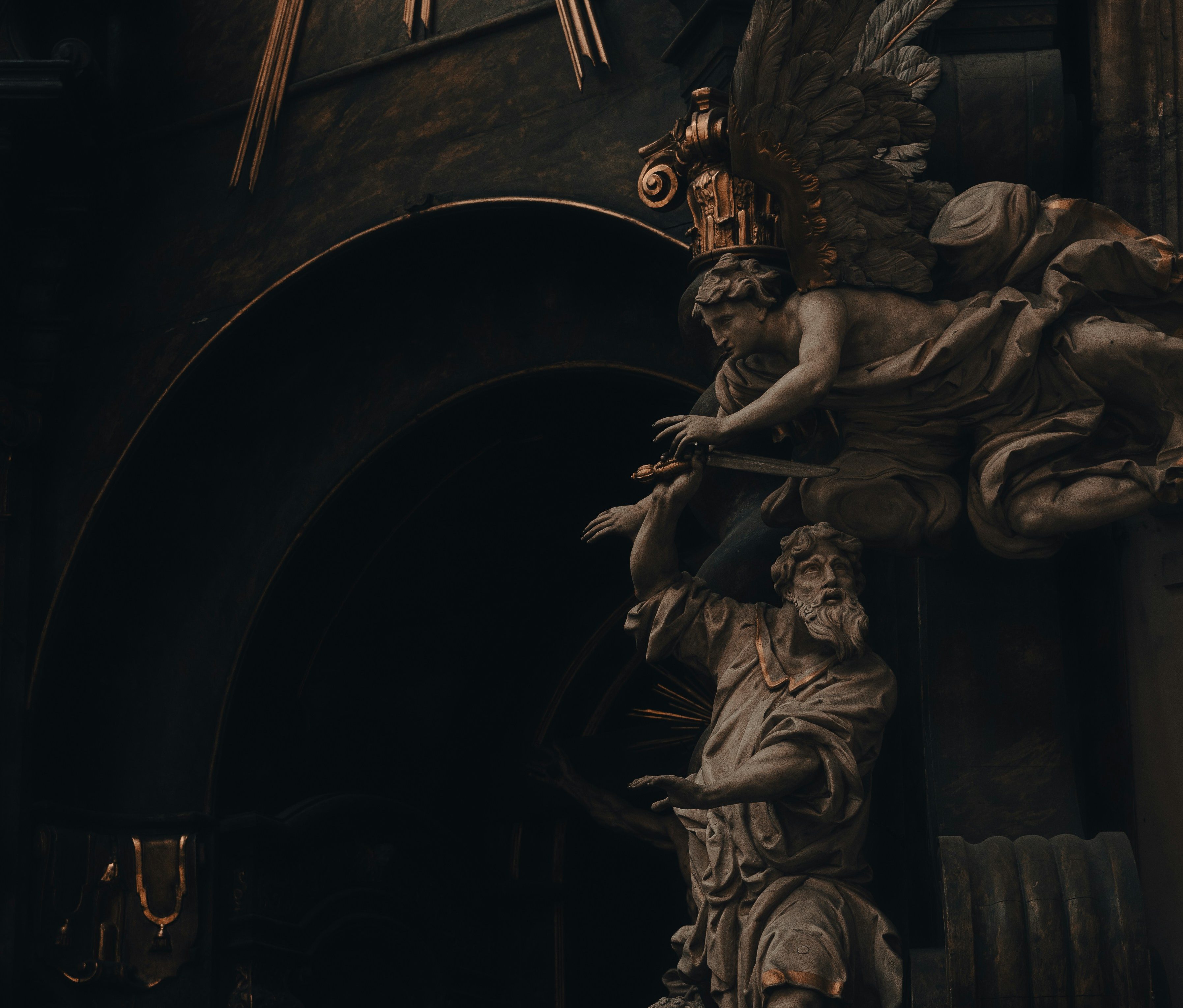
“How can I be substantial if I do not cast a shadow? I must have a dark side also If I am to be whole.”
-C.G. Jung, Modern Man in Search of a Soul
For millennia, the West has shown a tendency to configure and define itself in opposition to an Other. From Roman paganism to Islam, this phenomenon energizes tensions between groups, nations and religious systems, as well as directs on a psychological and mostly unconscious level what we could call the “Final Destiny” of entire societies.
The religion of Islam, in that sense, is now positioned as the Destiny of the West. The Fate of Europe.
Or that is, at least, the conclusion I come to in this article. What follows is the reasoning behind it and a brief analysis on the topic from the lens of analytical psychology.
Introduction
The study of ancient civilizations, when done through and from a psychological perspective (what in the analysis of historical figures is known as “psychohistory”) often reveals patterns that reflect the dynamics of forces beyond war, society and politics. Forces that, like threads behind the curtain of history, represent the workings of processes within what has been called “collective unconscious”, that vessel of primordial images of entire peoples, but also of deeply rooted psychological content that many a times direct their trajectories or, moreover, their “destinies”.
The historical relationship between Islam and Christendom that has (de)evolved into today’s secular and liberal Western Civilization is one of the latest examples of such dynamics in our recent history. A relationship marked by conflict, polemics, rivalry, propaganda and, ultimately, a reluctance to know anything certain about each other.
By the above I mean that the mere topic “Islam” awakens in the Western psyche a series of reactions (mostly emotional in nature) that, at least from the psychological point of view, are extremely fascinating. This is mainly the case because they are not as observed, or at least I do not observe them, with almost any other topic, group, religion or civilization.
But before talking specifically about Islam and the West, I’ll briefly explain this with previous examples of the same phenomenon.I will delve into the pattern that we can begin to see in the history of the Greeks, the Romans, European Paganism and Christianity and key remarks by the analyst Marie Louise Von Franz in this regard.
Greece, Rome, and Ares
If I am to define human personality from a theoretical standpoint, I can summarize it as the conglomerate of characteristics, traits, and particular ways of thinking, feeling, acting, reacting, and relating to oneself and the world of a person that grants him a sense of individuality and identity.
At the individual level, this personality provides both strengths and weaknesses or areas in need of development and expansion as the clinical psychologist Jonathan Shedler states:
“Our best and worst qualities are often cut from the same psychological cloth.”1
That psychological fabric has a collective equivalent, beyond the individual, that could be understood as the “character” of entire peoples or populations. After all, the collective and the individual are two different objects of study and their behaviors can show great differences, especially when it comes to the behaviour of “the crowd”. This implies that in communities, societies, and entire civilizations we can find the same phenomenon: qualities, strengths, defects, and areas in need of development which, if neglected, disregarded or repressed, will go on to direct from the unconscious the trajectory of these societies or, as Jung would say, their “destiny.”2
In analytical psychology, the concept that helps to understand the above, among other things, assumes the name of “Shadow”: that region of the individual and collective unconscious where it resides all that which for one reason or another we have not integrated into our consciousness and which, leaving aside the usually negative character that the name tends to convey because of the “evil” traits that can be found there, it also represents the potential of the individual or society in question.
To better illustrate this, it’s important to explore what that “destiny” ended up being in Ancient Greece in its encounter with the Romans.
The Fall of a People
It is well known that although the Greek civilization left us as a legacy, a wealth of knowledge at the level of western philosophy, mythologies, and the seeds of our basic and fundamental scientific concepts in the western hemisphere, it is not known for its warlike power or strength, or its military dominance.
In our imagination, Greece is associated more with the arts, the humanities, literature and philosophy, not with strength, military discipline and masculinity represented by the archetype of Mars or Ares. They “discovered” pure philosophy and, through figures such as Plato and Socrates, gave free rein to the intellectual with denoted success. But in matters of physical, military and material willpower they left their ideas in the theoretical without really passing them on to the practical.
Other civilizations, such as the Romans, the Egyptians and the later Arab or Islamic empires, had to take on the task left unfulfilled by the Greeks: to put these ideas to the test of reality. In other words, to move from the speculative to the experimental. In the case of Islam, such ideas would be filtered through the lens of the Last Revelation to mankind, proving what was true and what was untrue in it.
In archetypal terms, as well as in a religious and idolatrous sense, one could assert that the ancient Greeks paid pronounced worship to Apollo and Athena. That is, to the cultivation of the mind and beauty through the arts, architecture, craftsmanship, letters and philosophy, disavowing and consequently neglecting the cult or worship of Ares or the masculine qualities as specifically manifested in terms of physical prowess, dominance, combat, and determination.
The Greeks had Ares or Mars “in shadow” and never integrated it. A decision that ultimately proved to be key in the cause of their fall from grace and ultimate end.
Von Franz says about this:
“Their science remained purely speculative, even in its most beautiful forms, and with it came the endless division of the small Greek cities and the tragic decline of Greek civilization. As soon as they faced a nation with masculine and military self-discipline – the Romans – the Greeks were lost. Thus, although they were the great philosophical fertilizers of the Mediterranean world, they themselves were unable to pursue their own attempts creatively because they never understood the riddle of the Sphinx. They thought that the intellectual answer was the solution, an illusion for which they paid.”
From this I derive a key essential assertion: If you don’t integrate unconscious content buried deep in the “Shadow”, on an individual or collective level, you are going to pay for it.
The Greeks were not spared this essential feature of the processes of our individual and collective psyche and they had to pay the price.
But they were not the only ones.
The Pagan and the Shadow of the Great Other
The historical development of Christianity and the Catholic Church within Roman lands need not be traced in detail here. Instead, the focus shifts to a parallel dynamic—what happened between the Greeks and the Romans but in relation to Christianity, Paganism and then the Material World.
Europe, and what we know today as the West or Western Civilization, has had for centuries a tendency to define itself in terms of a Great Other or Dark Other. In ancient times and during the first centuries of Christianity, this Other assumed the face and form of Roman polytheistic religion and paganism in its various presentations, whether in Rome or in other lands of Eastern and Western Europe, where Christian missionaries and preachers travelled to spread the Gospel.
With the collapse, almost total extirpation and integration of certain elements of the Roman Pagan Ethos to the Corpus of Christianity, the new faith and the new faithful at the psychological and social level would need a new actor to replace the previous one and exercise the same function.
The corporal, mundane, sensual and sexual, the world of the passions and the senses and whatever is carnal were the new candidates and the new elements to conform this new Other.
In general terms, the body and nature should now be considered as the receptacle and vessel for sin and damnation. Since the origins of the corruption of the human being (and of the world in and of itself) are postulated in the doctrine of Original Sin, the traditional Christian psychology would be inclined to assume that the natural inclination of man is towards sin and perdition, towards evil and everything that is condemnable in Nature itself.
For those that have been born within the western hemisphere, their psyches shaped by the particular climate of it developed throughout centuries, the notion of a “fallen world” and we as fallen or condemned creatures as a result of the error of our ancestors are deeply rooted and embedded.
The soul would thus become the most relevant, transcendent, and valuable thing within the Christian framework; that which was to be saved and that not even upon resurrection would the body have any true redeemable quality, one of the reason as to why anti-Islam polemics have focused in the “sensual” element of the Islamic Heavenly reward.
It is stated, implicitly or explicitly, that everything that was in opposition, or threatened to disrupt this mission of saving the soul of man from itself and from the world would then become new content in Shadow. This is how this dichotomy (later dualism) came to be configured between the Body, lost, condemned and therefore in need of purification, and the Soul in need of salvation through Christ.
This new tension and uneasy relationship between the body and soul for the Christian reaches a high point with regard to sexuality, where even the sexual act within the confines of marriage has historically been perceived and held in the collective imagination as something that is accepted but with conditions. and, one might propose by way of subtext, almost grudgingly, especially when it comes to the enjoyment of the mere act of the physical union between spouses not motivated by the desire to procreate.
The subsequent revived interest in pre-Christian or pagan traditions that we see in our current era reflects the desire among a certain sector of the European, and in particular the English, population to return to a “world” in which this was not the case. A world before Christianity represented the termination of this harmonious relationship with Nature, where the body was not rejected but rather celebrated, and where nature was posited and felt as a sacred element to be approached and not as the potential arena for man’s downfall.
A world in which, it is assumed, we were in more harmony and synchronization with the body, the cycle of the seasons and the universe in this constant “Eternal Return” as Eliade formulated it, in contrast to that one that “lost its color” not only as a consequence of modernity but also, they would assert again, because of Christianity.
As a side note, this tension between the two spheres has endured ever since and has been frequently dramatized and represented in numerous artistic and architectural productions of Christian Europe.
Now, for the purposes of the history of modern psychology and our psychological state, it was precisely this tension and the phenomena it went on to engender and produce what was at work behind the curtain of the Victorian Era, allowing it to eclipse at that time a process that as we have seen had been going on throughout the Christian era, and particularly since the Enlightenment.
If one follows the trajectory of the development of Western art, for example, one will find a pattern that begins with an emphasis on the Spirit, then moves to the Mind and finally to the Body and its fluids. In that sense, the decline of Christianity in the Western world emulates the decline of the Greeks in their encounter with the Romans with the addition that, instead of the warrior aspect in Ares, what we might understand archetypally as Venus was what ended up indeed being banished to the Shadow.
The particular pathologies and disorders related to the body and sexuality that Sigmund Freud faced and wrestled with in the late nineteenth and early twentieth centuries, far from being merely something stemming from his own unresolved issues, are a reflection of this.
One might think that this would be the end, and that now all that remains is to work to reintegrate the traditions into our new modern ethos. But that is not what is happening in its entirety. On the contrary, there is an added actor on stage, for in this dichotomizing process of defining oneself in terms of an Other, we were not limited in European and Western history to the Pagan Other or to the Carnal or Mundane. On the contrary, the same process occurred in parallel with the next great civilization and force in the religious and spiritual panorama of the world:
Islam.
The Cross at the Shadow of the Moon
“Whether we realize it or not, most of us define ourselves by opposing rather than by favoring something or someone. To put it another way, it is easier to react than to act. Nothing arouses a passion for dogma more than a good antagonist. And the more unlikely the better.” -Carlos Ruiz Zafón, The Angel’s Game3
Civilization and Western Europe owe their origins and sense of identity, in the least at least in part, to Islam.
If the above sounds somewhat far-fetched, unacceptable or implausible, allow me to expound the following:
“Even those who postulate the origins of the European idea in the time of Charlemagne cannot ignore the role of Islam. In this regard, Henri Pirenne had declared: “The conquest of Spain and Africa by Islam had made the king of the Franks the master of the Christian West. . . . . It is therefore strictly correct to say that without Muhammad Charlemagne would have been inconceivable.” This also applies to those who attribute the origins of Europe to the unifying quest of Christendom, which developed through the Crusades, and which ultimately failed to dislodge the Muslims from the “Holy Land.” It also applies to those who consider 1492, the year of the Conquest of the Americas and the contemporaneous Reconquista over the remaining presence of Muslims and “Islam” in Spain, as the inaugural moment of the invention of Europe. Whatever the chosen point of origin for the history of Europe to begin, “Islam” seems to have a foundational role throughout.”
-Joseph A. Massad4
Returning to the above about this European dichotomizing tendency to postulate itself in contrast to a Dark Other, we see again how the same history and pattern repeats itself, but now with Islam and Islamic Civilization as a whole as the actors playing an already old role.
Not for nothing, for authors and historical figures who consider Islam as a Christian heresy, it has also been categorized as “The Ishmalite Other” and has also been portrayed in European art as this split between Sarah and Hagar and ultimately between Isaac and Ishmael.
The first considered as the son of the covenant or of the promise, and the other as the son of nature who has to be expelled or banished to the desert, without ever seeing him again as it happens in the biblical canon and which establishes again this tension between the Soul and Nature, as can be observed here:

The difference in this case, compared to what happened with the Pagan and the Mundane, is an essential detail:
This relationship, this role, is neither consciously acknowledged nor accepted. On the contrary, it is something that is denied, disavowed, and rejected with an intensity unmatched in recent centuries.
Regarding Paganism, there is a historical connection and a legacy that is still appreciated. From ancient kings and warlords, to the aesthetics and notion (even if not historically accurate) that surrounds them and gives credence to a cultural legacy in the Celtic, the Norse, or the Norman, the Aboriginal, and so on.
But with Islam, this is not the case. Rather, it is seen as something that should never have existed. Something that should never have happened. A complete threat. An enemy to be eradicated and, for some, a “mistake” of God.
To support this type of assessment, I rely not only on the very likely emotional reaction that many of those reading this moment experienced upon reading the above words, but also on the fact that even among well-read and educated figures in a variety of fields of knowledge, one can observe how things about Islam are held up as truths that not only run counter to all available historical evidence and are at best half-truths, but are also, in the worst cases, the product of intellectual dishonesty, willful ignorance, outright distortions, lies, hoaxes, propaganda, deception, and unconscious processes defending themselves, as they often do, against things that cause disruption.
This is easily observable to any sincere scholar who studies this religion and then compares their findings with the most popular Western sources (particularly “Orientalist” sources or those in the same vein as figures like Robert Spencer). This difference is later eventually found and attested to among their colleagues and friends.
Such distortions or claims are too numerous to address here, but a typical one that serves to illustrate this point can be placed in relation to its main figure, the Prophet Muhammad (ﷺ).
“All we know about him is thirdhand gossip,” Barceló said. “When everyone insists on painting someone as a monster, one of two things can happen: either he was a saint, or they’re not saying much.”
-Carlos Ruiz Zafón, The Shadow of the Wind5
The perceptions that have been woven around the figure of the Last Prophet (ﷺ) help us glimpse the same process of definition based on an opposite that has characterized the hemisphere for the past 2,000 years.
From condemning him for his assumed insincerity and immoral character in his private life, to his actions in the field of armed defense and struggle motivated, according to this perception, by nothing more than ambitions for power, conquest, and domination over others.
Given this panorama, it is not alarming to say that we have so deeply rooted in our collective imagination and consciousness the belief of the worst about this historical figure and, consequently, about his followers, even though we objectively know and understand very little.
This difference between reality and fiction, or between what is projected and the truth, becomes acute in academic studies on Islam, since these perceptions are almost non-existent among Western intellectuals and historians who have approached it in the most objective way possible, aware of their biases and prejudices and in a sincere effort to get as close to the truth of the facts as possible, without being Muslims themselves or professing any particular affection towards the religion (many, on the contrary, complete their studies preserving their Christian identity and faith).
Many could be cited, but perhaps the most emblematic, for having been among the first to challenge the Orientalist legacy of the 19th and early 20th centuries, and for the purposes of this article, are Thomas Carlyle and William Montgomery Watt in their respective books On Heroes and Hero Worship and Muhammad at Mecca:
“Our current assumption about Muhammad, that he was a scheming impostor, a falsehood incarnate, that his religion was a mere mass of charlatanism and fatuity, is beginning to become truly untenable for anyone. The lies that well-intentioned zeal has heaped around this man are a disgrace only to ourselves.”
“It goes quite contrary to the impostor theory that he lived in this completely blameless, completely quiet, and commonplace manner until the heat of his years was over. He was forty years old before he spoke of any mission from Heaven. All his irregularities, real and supposed, date from after his fiftieth birthday, when good Khadijah died. His entire “ambition,” apparently, had been, until then, to live an honest life; his “fame,” the mere good opinion of the neighbors who knew him, had been sufficient until then. It was not until he was already growing old, the shameless heat of his life had died away, and peace was becoming the main thing this world could give him, that he began the “race of ambition”; and, belying all his past character and existence, he was going to set himself up as a miserable, empty charlatan in order to acquire what he could no longer enjoy now! For my part, I have no faith in it.”
-Thomas Carlyle6
“His readiness to undergo persecution for his beliefs, the high moral character of the men who believed in him and looked up to him as leader, and the greatness of his ultimate achievement— all argue his fundamental integrity. To suppose Muhammad an impostor raises more problems than it solves. Moreover, none of the great figures of history is so poorly appreciated in the West as Muhammad. Western writers have mostly been prone to believe the worst of Muhammad, and, wherever an objectionable interpretation of an act seemed plausible, have tended to accept it as fact. Thus, not merely must we credit Muhammad with essential honesty and integrity of purpose, if we are to understand him at all; if we are to correct the errors we have inherited from the past, we must in every particular case hold firmly to the belief in his sincerity until the opposite is conclusively proved; and we must not forget that conclusive proof is a much stricter requirement than a show of plausibility, and in a matter such as this only to be attained with difficulty.”
-William Montgomery Watt7
Perhaps what is most striking about the above excerpts is the recognition of the existence, among other colleagues, of this unjustified willingness to affirm and assume what has no historical basis or conclusive evidence in relation to Muhammad (ﷺ), as well as the quickness to affirm as fact the worst possible interpretation over a less condemnable and, at the same time, more plausible one.
The same pattern appears once again, and is repeated again and again around the two main areas of violence and sexuality.
This tendency, this almost instinctive rejection, often without experience or in-depth academic study to justify it, is nothing other than the result of dichotomizing and antagonistic processes in the collective unconscious of the West and reveals a specific connection with its own Shadow.
Von Franz says about how to detect that this is the phenomenon we are facing:
“We all have our favorite enemy, our best enemy, so to speak. That’s usually our Shadow. If someone gets on your nerves for no reason… If someone harms you, then you can say it’s natural that you hate them, but if someone doesn’t harm you in any way and you just get really irritated, and every time that person comes into the room you could spit on them, then you can be sure that’s the Shadow. The best way, then, is to sit down and write down that person’s characteristics on a small piece of paper, and then look at it and say, ‘That’s me.’
It’s a real shock to see one’s Shadow.”8
If we as Westerners, whether converted to Islam or not, sit down and think about religion, most of us will likely begin to realize that we harbor deeply held beliefs about it, both passionately defended and challenged at the slightest question. Most, if not all, are negative in many cases, unable to explain where they come from, where they were learned, or why they were taken for granted.
If anyone wonders what’s wrong with this, I would say that, more than “bad,” it’s very dangerous. In the absence of the Pagan Other, the West has used Islam as a mirror and a shadow to cast all its flaws and vices in the hope of no longer seeing them, much less recognizing them and doing something about them, with all the real political and social consequences this would entail.
The shock of realizing this, that everything dark and negative about ourselves has been projected onto more than a billion human beings, is of a magnitude and degree unknown to other religions or civilizations.
It is something very particular and I would say unique, about the Western psyche toward Islam and Muslims, who have now become sacks and reservoirs into which all the darkness of the West has sunk.
And if anyone feels the urgent need to refute my previous point, just think for a moment if there is any crime, any ignominy, any immorality, or evil that cannot be attributed to Islam, and not so much as a secondary feature, or as a consequence of some progressive degradation or corruption caused by social and political processes, but as part and parcel of its core, its foundation, its essence.
Anti-Semitism, genocide, violence, plagiarism, deception, misogyny, pederasty, lust, perversion, pedophilia, sexual abuse, mistreatment of women, oppression, religious persecution, religious wars, religious intolerance.
There is virtually no sin of which “The East” and “The Saracen” or “The Moor” are not accused.
But, and here lies the irony, at the same time there is no sin of which the West is not equally guilty, to a lesser, equal, or greater degree depending on what is being discussed. But underlying psychological processes prevent us from realizing this on an emotional rather than an intellectual level.
That more often than we would like to admit, an accusation is a partial confession, and that we only recognize in the Other what we carry within.
They prevent, in other words, from saying, even in the dark and in a low voice:
“That’s me.”
As British scholar and convert to Islam Charles le Gai Eaton would say in relation to specific accusations of anti-Semitism in Islam:
“The misfortunes of the Jews as a ‘race’—the pogroms and the Holocaust itself—were certainly not the fault of Muslims. Europe’s guilt is Europe’s fault, and they don’t see why they shouldn’t be expected to suffer for it.”9
Perhaps it’s not visible, or they don’t see it, precisely because of this sense of collective guilt, but one could also say it’s due to pride. After all, that is one of the great tendencies, pathologies, and, if I may use religious terminology, sins of the Western Hemisphere:
Pride.
Conclusion
I know very well that more than one person among those who visit this post will be able to argue against me, and I welcome that.
The above is not intended as an unfair, biased, or malicious condemnation of the West or Christianity, although it is certainly uncomfortable.
It is, ultimately, simply the formulation of a pattern I have observed; one that did not begin with Muslims or Islam but continues with them, and which I contemplate daily with interest not only for its social and political repercussions, but also for what they teach and reveal in their psychological content.
What I am doing with this particular topic is highlighting the old warning not to throw stones from a glass house. And also, to expose the workings of unconscious processes, no longer at the individual level but at the civilizational level.
For when you convince yourself that an entire people, or religion, constitutes an existential threat, it becomes extremely easy not only to justify whatever you might end up doing to them but also to learn nothing substantial about them.
It justifies believing the worst and clinging to those beliefs and to what you think and feel you know about them because now basically your entire sense of identity depends on that being the case.
And boy, is it hard to let go of that.
Boy, it is hard, despite its consequences, something that anyone who observes how the encounters between the Greeks and the Romans, the Romans with the “barbarians,” the Germans with the Jews, the Christians with their own passions, and now the European and the Westerner with the Muslim can amply attest to.
It is one of the great laments of this species that identity depends on one being right and the Other wrong, that one is Y while They are X.
For the purposes of our time, that identity depends on maintaining the belief that the Westerner can be many things but never a Moor or a Mohammedan, hating, distrusting, and despising them by default after having constructed your own opinion, your own ghost, your own villain, your own shadow.
Is there some kind of foundation? Yes, of course, but I’m not so much interested in foundations as in the use to which they are put.
It is no coincidence that the so-called “Fall of the West” and the disintegration and fragmentation of its societies is unfolding in our time, right now, and not only as a consequence of the collapse of Christianity and the irresponsible way we have managed our achievements in “progress,” technology, and science, but also of this new encounter with Islam and “The Orient.”
Much more to say, but that will be for another occasion.
In the end, taking the example of the civilizations that preceded us as an example, all that remains is to remember a lesson that emerges from their histories and endings, as well as from a principle in analytical psychology that, in my opinion, will sooner or later eclipse, whether in my lifetime or later:
A shadow not worked on becomes destiny.
Disclaimer: Material published by Traversing Tradition is meant to foster scholarly inquiry and rich discussion. The views, opinions, beliefs, or strategies represented in published articles and subsequent comments do not necessarily represent the views of Traversing Tradition or any employee thereof.
- Shedler, J. (2022). The personality syndromes. In R. E. Feinstein (Ed.), Personality disorders (pp. 3–31). Oxford University Press. [↩]
- Jung, C.G. (1933). Modern Man in Search of a Soul. United Kingdom: Taylor & Francis. [↩]
- Ruiz Zafón, C. (2009). The Angel’s Game. New York: Random House. [↩]
- Massad, J. A. (2015). Islam in Liberalism. Chicago: University of Chicago Press [↩]
- Ruiz Zafón, C. (2005). The Shadow of the Wind. New York: Penguin Press. [↩]
- Carlyle, T. (2013). On Heroes, Hero-Worship, and the Heroic in History. New Haven: Yale University Press. [↩]
- Watt, W. M. (1953). Muhammad at Mecca. Oxford: Clarendon Press. [↩]
- Franz, M. v. (1994). The way of the dream: conversations with Marie-Luise von Franz. Colorado: Shambhala Publications. [↩]
- Eaton, C. L. G. (1985). Islam and the Destiny of Man. Albany: George Allen & Unwin. [↩]
A. Alejandro Espinoza
Psychologist and university professor based in Caracas, Venezuela. Besides clinical work, he teaches basic courses in methodology and research in psychology for first and second semester psychology students.
Leave a Reply