
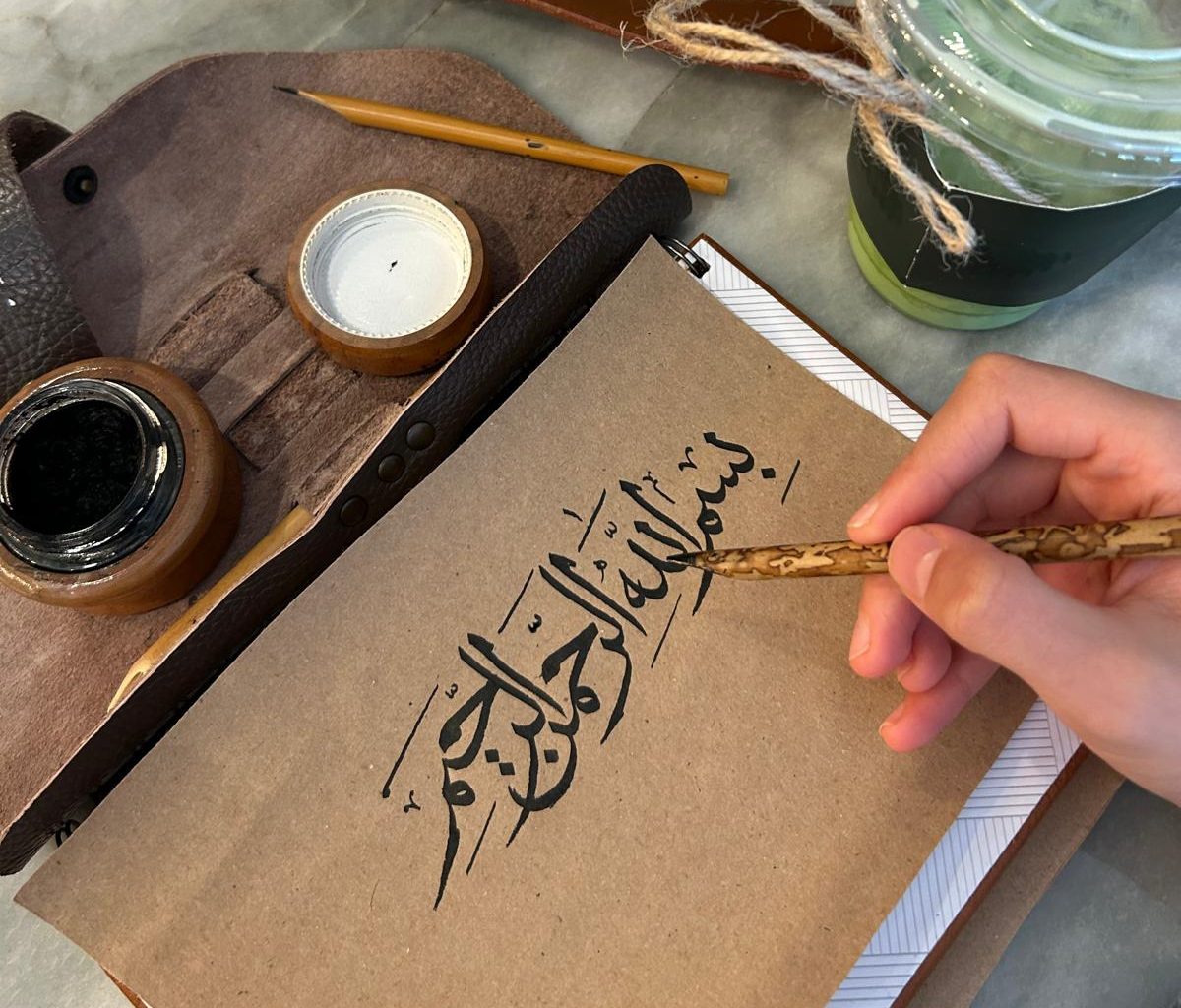
Traversing Tradition has been delighted to interview Zahra Abdulameer, the founder of Ihsan Design Studio. She is a student of Arabic calligraphy based in Dearborn, Michigan, U.S. You can follow her on Instagram here.
Al-salām ʿAlaykum, peace be upon you. As mentioned, I’m Zahra, the founder of Ihsan Design Studio, where I explore the intersection of faith, creativity, and tradition through Arabic calligraphy, painting, and design.
With Iraqi roots, a childhood shaped by Colorado, and a current home in Michigan, my work is influenced by layers of culture, language, and identity. Ihsan Design Studio was born from a desire to create with sincerity and purpose, drawing from the Islamic principle of iḥsān. My creative journey has taken many forms, but what grounds me most is Arabic calligraphy. It has become a deeply spiritual and meditative practice, one that allows me to connect to the language of the Qur’an; from the Word of God, to God.
1. What is Arabic calligraphy, and how would you describe its significance to someone unfamiliar with the art form?
Arabic calligraphy is the art of writing the Arabic language in a way that brings out its beauty, depth, and rhythm. It’s not just about forming letters, but about honoring the meaning behind them. Its significance begins with the Qur’an. As the word of Allah was revealed in Arabic, calligraphy became a sacred way to preserve and beautify those verses. Over time, it grew into a central part of Islamic culture, appearing in architecture, decoration, and daily life.
More than just an art form, Arabic calligraphy is a form of devotion, reflection, and connection to the language of the Qur’an. Unlike other traditions, such as Christianity or Hinduism that often depict sacred figures in human form, Islamic art took a different path; one that privileges abstraction, geometry, and script over figural representation.
This is not due to a lack of imagination like many oriental scholars historically thought (and continue to think), rather due to a strong theological commitment: to reflect the transcendence of God and protect the sanctity of the sacred. Palestinian-American scholar Dr. Ismail al-Faruqi (d. 1986), wrote that Islamic aesthetics arise from tawḥīd, the Oneness of God, shaping an art that reflects “order, harmony, and integration” without violating the boundaries of the unseen.1 Arabic calligraphy, in this sense, is the highest visual expression of Islamic spirituality where it’s not merely beautiful writing but what Seyyed Hossein Nasr calls “the crystallization of the spiritual realities (al-ḥaqāʾiq)” contained in the revelation itself.2
Rather than confining art to a single form, Islam nurtured a constellation of styles and techniques from Spain to China, each grounded in religious virtues and local culture. Arabic calligraphy is not the only monolithic “Islamic Art,” it’s one of many aesthetic traditions animated by faith, adapted across time and geography. Though I believe calligraphy remains its beating heart.
2. What are the different styles or schools of Arabic calligraphy, and which one(s) does your studio specialize in?
The various styles of Arabic calligraphy traces its origins to the early centuries after the time of the Prophet (saw), beginning with the Kufic script, which adorned the earliest Qur’anic manuscripts and architectural inscriptions with bold, angular slant.
As the Islamic world expanded, so too did its scriptural styles: Ruqʿah, Naskh, Nastaʿlīq, and Diwani to name a few. Ruqʿah is the most commonly used in everyday handwriting because it’s suited for clarity and efficiency in speed over ornamentation. Naskh, by contrast, is highly legible yet elegant, now favored for printing the Qur’an and widely taught to beginners for its balanced proportions. Nastaʿlīq is recognized by slanted forms and dramatic curves, and it became the signature script of Persianate cultures. Some Indo-Iranian languages like Urdu use this script. Diwani script is an ornate and developed in the Ottoman court, known for its dense composition.
The style I currently focus on at Ihsan Design Studio is Thuluth.

Thuluth has always stood out to me—it’s the one I found most visually captivating. It’s known as the “king of Arabic scripts” for its complexity and majestic flow. It emerged during the early Abbasid period in the 9th century CE and reached its full artistic maturity under the Ottomans, who elevated it into a central script for mosque inscriptions and imperial decrees. Master calligraphers like Ibn al-Bawwab and later Şeyh Hamdullah refined its structure, making it a cornerstone of classical Islamic calligraphy. Its name, meaning “one-third”, refers to the proportion of the pen’s nib used, allowing for its signature fluidity and ornamental richness. I love how the curves of each letter come together, how connected the forms are, and how much movement and life the script holds. Every letter feels alive, and that makes it especially meaningful to study and practice. While I hope to explore and learn more scripts in the future, I’m currently dedicating my time to mastering Thuluth. Although it’s a challenging script, it’s one that’s taught me patience and discipline and to appreciate the precision in every stroke.
3. What tools and materials do Arabic calligraphers traditionally use, and how have those evolved today?
Traditionally, Arabic calligraphers use a few essential tools: a wooden qalam (pen), usually made from bamboo or palm branches, ink, an ink jar with likka (a silk thread to control ink flow), and paper, which was once made from natural materials like papyrus or handmade from plants and fibers.

These tools have been used for centuries and they’re still at the heart of the practice today. But over time, there’s been some evolution. While many artists still use the traditional qalam, we now also have metal-tipped pens, chiseled markers, and manufactured papers that make the practice more accessible for beginners and modern creatives. The digitization of art has also made digital calligraphy possible for graphic designers
What hasn’t changed is the intention: to slow down, connect with the letters, and write with care (which Generative AI and other tools can’t quite capture). Whether using traditional tools or modern ones, the spirit of the art remains the same.
4. How does Arabic calligraphy differ from Western forms of typography or hand-lettering?
As mentioned earlier, Arabic calligraphy is more than just writing in an aesthetic way because it emerged as a spiritual tradition. While Western hand-lettering and typography often focus on creativity, aesthetics, and personal style, Arabic calligraphy is tied to the Islamic faith, discipline, and reverence. Its very essence is spiritual, as it usually is used to write Qur’anic verses, duas, or other sacred texts and sayings.
Additionally, Arabic calligraphy, like other Islamic sciences in the traditional pedagogical tradition, is passed down from master to student, demanding years of practice and repetition. A student must receive an ijazah (formal permission to teach) from their master, and even after that, the learning never really ends. While accessibility and the modern convenience of remote learning is certainly a discussion to be had, the point is that there is an unbroken chain of knowledge that appreciates the time and patience of calligraphy as a serious study. The letters are studied with care and love until the practice becomes something of a soul connection.
In terms of tools, Arabic calligraphy typically uses a chiseled, angled nib, which creates distinct contrast in stroke thickness and gives the script its signature flow and elegance. Western calligraphy, on the other hand, often uses a flat nib, producing a different rhythm and style in the writing. The tools themselves shape the character of each tradition, as well as reflect the underlying philosophies: Western calligraphy tied to symmetry and individual expression, Arabic calligraphy tied to geometry, rhythm, and the harmony between form and meaning.
5. Tell us about the origin story of your studio. What inspired its founding? Do you view your studio as more of a design house, a cultural preservation effort, or something else entirely?
Like many creatives, I’ve always had a range of artistic interests. Painting and drawing have been a part of my life since I was a little girl. After graduating college, I found myself drawn to graphic design, branding, and web design, until more recently, when I fell in love with Arabic calligraphy.
Ihsan Design Studio was born from a desire to bring all of these creative passions together in one space. It reflects in the services I offer: calligraphy, painting, graphic design, and web design. All of this is rooted in the intention to create with ihsan, meaning excellence, sincerity, and beauty. Hence the name of the studio!
While most of what I share right now centers on Arabic calligraphy, since it’s the craft I’m currently most focused on.,But moving forward, Ihsan remains open and flexible. It’s a space that allows me to experiment and grow, wherever creativity leads.
To me, Ihsan Design Studio is more than a design house. It’s a place to share meaningful art, especially as a Muslim woman. It’s a place to honor beauty, preserve culture, and create work that feels purposeful and alive. It was also important to me to build a community around the things I share. While many creatives, without casting judgment on their intentions, focus on the outward Islamic aesthetic, my goal is to ensure that Ihsan Design Studio reflects Islamic values not only in its visual identity but in how I conduct business, communicate, market, and uphold ethical integrity and our deen’s principles, inshaAllah. Many of my followers are on their own creative journeys, especially with calligraphy, and it’s incredibly fulfilling to know I can help in any way. I love connecting with others, sharing what I’m learning, and growing alongside a community that finds joy and meaning in this art too.
6. How does being based in Dearborn, home to one of the largest Arab-American communities in the U.S., shape your work and your audience?
I feel very blessed to be based in Michigan. Being here reminds me that art can serve as a means of connection and expression of faith and culture. With its long history of Arab-American migration and civic engagement, Dearborn offers a unique environment where Islamic and cultural expressions are both visible and valued. It reinforces the idea that Islamic culture in the West doesn’t need to replicate models from abroad. Instead, it can develop organically, drawing from core Islamic values while engaging with the specific social, historical, and cultural contexts we live in here. That balance between tradition and locality is something I try to reflect in both my creative work and how I operate as a business.
Of course, the large Muslim and Arab-American community here is truly vibrant and a gift. It’s allowed me to build real, intentional connections with people who understand and appreciate the significance of Arabic calligraphy and Islamic art. Many calligraphy masters, such as Hajji Noor Deen from China, have come here to hold workshops and classes. That sense of shared identity and cultural pride inspires me deeply and keeps me grounded in why I create.
7. In a world driven by speed and technology, what role does a slow, meditative art like calligraphy play?
This is honestly one of my favorite parts of practicing calligraphy – the chance to slow down. It’s a quiet, grounding experience that connects me to something deeper, especially when I’m writing the words of Allah (ﷻ). There’s a spiritual stillness in it that is rare at a time when visual content is constantly produced, consumed, and discarded within seconds. This connects to the earlier point on generative AI, while it has made design more accessible, it’s also exposed the limitations of soulless replication, reminding people of the weight and meaning behind handcrafted work. There’s a growing recognition that real art carries the trace of the artist, their hand, their pauses, even their imperfections. In a tech-saturated world, that kind of slowness feels increasingly radical.
At the same time, I’m grateful for the role certain technologies have played in my journey. Without social media, I wouldn’t have been able to connect with a global community or grow my business in the way I have. It’s been such a valuable tool beyond networking but also in building meaningful relationships with others on similar paths. So my stance towards technology isn’t to disregard all of it, but to be intentional.
8. Arabic script has religious and historical roots. For example, different Muslim empires have incorporated it in different ways in local architecture. How do you navigate between tradition and innovation?
Too often people assume, especially in art, that tradition is ossified and what successors must do is mimicry. But think about it this way: there have been so many points in history where we took something new, made it our own, and now it’s ubiquitous as tradition. The dome, now iconic in mosque architecture, was originally borrowed from Byzantine churches; arabesque and geometric patterns often evolved through dialogue with pre-Islamic and regional motifs; calligraphic styles like Nastaʿlīq emerged in response to Persian literary culture and weren’t part of the earliest Islamic scripts. When guided by clear principles, tradition can be dynamic.
In my work, I look to master calligraphers like Hasan Çelebi (d. 2025), a famous Turkish student of Hamid Aytaç, and Mohamed Zakariya, an American revert, whose work preserves the integrity and soul of classical scripts. Following traditional styles helps keep that spiritual and historical depth alive. At the same time, there’s absolutely room for innovation and experimentation. For example, I love incorporating calligraphy into logo design, which requires new mediums and methods. As it’s still connected to traditional principles of calligraphy, though its expression is different, I still find it to be within the realm of traditional Arabic calligraphy. It’s just an extension of it into our current era.
My advice for those looking to start is that it’s important to first understand the letters, the proportions, and the traditional rules of composition. Don’t skip over this. Master it. Once that foundation is there, your own touch will naturally develop. I’m still in that learning process myself, refining my letters and growing with each piece.
Photo Credits: Zahra Abdulameer
Disclaimer: Material published by Traversing Tradition is meant to foster scholarly inquiry and rich discussion. The views, opinions, beliefs, or strategies represented in published articles and subsequent comments do not necessarily represent the views of Traversing Tradition or any employee thereof.
- Al-Faruqi, Ismail Raji. Al-Tawhid: Its Implications for Thought and Life. International Institute of Islamic Thought, 1992. [↩]
- Nasr, Seyyed Hossein. Islamic Art and Spirituality. State University of New York Press, 1987. [↩]
Zahra Abdulameer
A multidisciplinary designer and student of Arabic calligraphy based in the U.S. She is of Iraqi origin and is a founder of Ihsan Design Studio.
Leave a Reply