
Note: This article was originally adapted from a transcript of a lecture delivered by the author in 2021. It has since been substantially revised to reflect more recent research, yet much of the original content remains relevant and indicative of the worsening condition and silence from the global community.
Introduction
In 2019, my father and I sat down together at our kitchen table and began writing out a list. One by one, we documented the names of our relatives, anyone we knew who had disappeared or been detained in East Turkistan. East Turkistan is the homeland of the Uyghurs and other Turkic peoples, occupied by the Chinese Communist Party since 1949.
For each person, we took note of their name, their city of origin, approximate age, their relationship to us, and any other detail we could remember—if any could even be guessed. Often, the only entry we could make was that there had been no contact, and that the individual was missing.
At first, it was just a few names. But the list kept growing and we eventually made an Excel sheet of 93 people, a number never meant to be comprehensive. It was simply what we could remember before grief and exhaustion overtook us. In the absence of death certificates, court records, or even confirmation of imprisonment, these names became our archive and a personal record of a genocide that the world still struggles to name.
It has now been eight years since the Chinese regime began its mass internment campaign against Uyghurs and other Turkic peoples in East Turkistan. Since then, even the most conservative estimates suggest that at least 1.8 million individuals have been detained—either in so-called “reeducation” camps or transferred to prisons where sentences often range from several years to life. The majority remain unaccounted for, their fates still unknown.
This essay is both historical and personal. As an Uyghur in diaspora, I write this as a testament and witness of the global outcry in the years 2017-2020, when media outlets were dashing with headlines that “up to one million Uyghurs are in re-education camps.”1 Now, it appears that the fight for Uyghurs has dwindled through sporadic du’a, occasional press releases, and protests—mainly performed by impacted Uyghurs and not the global community—almost as if the world has moved on with their lives. Even amongst Muslim circles, if the topic does find its way in a conversation, I find myself circling back to the same summary of what is happening to my people, with little to no understanding of the magnitude of our oppression, let alone that we are an occupied people.
I am writing to document what has happened, and is still happening, in East Turkistan: a campaign of mass internment, forced sterilization, torture, and cultural erasure that meets the legal definition of genocide under international law.
Another central argument advanced here is that the persecution of Uyghurs must not be understood in isolation; rather, it constitutes a colonial project of dispossession and domination. In what follows, I trace the historical roots of East Turkistan, the Islamic and cultural heritage of the Uyghur people, the rising repression under Chinese rule and the mechanisms of state terror that have transformed an entire region into a surveillance state and open-air prison. I also examine how the Chinese regime justifies its actions, how denialism persists, and what is (and isn’t) being done to stop the genocide.
What is Turkistan?
Turkistan is a historic region in Central Asia traditionally inhabited by various Turkic groups, including the Uyghur, Uzbek, Kazakh, and Kyrgyz people. During the 19th century, colonial expansion divided the region: the western portion came under Russian, and later Soviet, control, while the eastern portion—known as East Turkistan—fell under Qing rule and subsequently Chinese administration. Today, the Uyghurs remain the largest ethnic group in East Turkistan, despite significant state-sponsored Han migration into the region.

Naming Conventions of the Land
Before proceeding, it is necessary to clarify the naming conventions used for East Turkistan, the homeland of Uyghurs and other Turkic peoples, including Kazakh, Kyrgyz, Uzbek, etc. Most academic and media outlets refer to the region as Xinjiang, a Mandarin term meaning “new territory,” a name given by the Chinese occupation. This nomenclature carries overt colonial connotations, implying both conquest and rightful possession by the Chinese state. For many Uyghurs in the diaspora, including myself, the term is offensive. Referring to East Turkistan as “Xinjiang” is akin to legitimizing the abduction of a child by discarding their given name and imposing a label such as “new property” in the abductor’s tongue.
Few would consider referring exclusively to Tibet as Xi Zang, the name imposed by Chinese rule. In parallel, Uyghurs and other Turkic people argue that East Turkistan is the proper designation for their homeland. It reflects both historical continuity and cultural rootedness. As an Uyghur, I will continue to use East Turkistan throughout this article and encourage others who seek to uplift Uyghur narratives to do the same.

Terminological distinction goes beyond just the name of the land. Often in Muslim or non-Muslim circles I hear Uyghurs being referred to as “Chinese” or as the “Muslims in China.” Although Uyghurs are officially classified as Chinese nationals, this framing is deeply problematic, as it reinforces the misconception that Uyghurs are linguistically and culturally Chinese—or merely an ethnic minority within China that happens to face persecution. In reality, Uyghurs constitute a nation with a distinct historical homeland, with its own cultural and linguistic Turkic roots—far from Chinese culture. Within East Turkistan, Uyghurs are not a minority population exercising rights in their own land. Rather, they have been a people subjected to occupation and genocide.
Nonetheless, due to decades of state-led migration of Han Chinese into the region—intensified by the current campaign of genocide—Uyghurs and other Turkic peoples are being actively transformed into a demographic minority in their homeland.
The National Flag of East Turkistan

The national flag of East Turkistan is absent from public life within the occupied region and throughout China proper. The Chinese state classifies the flag as a symbol of “three evil forces”: separatism, extremism, and terrorism—terms the Chinese Communist Party (CCP) frequently employs interchangeably to delegitimize expressions of independence or self-determination. Even the label “separatist” is problematic, as it presupposes that East Turkistan has always been an integral part of the Chinese state. Historically, however, the region possessed its own periods of sovereignty prior to Chinese occupation. Thus, the contemporary struggle of Uyghurs and other Turkic peoples can be more accurately understood as an effort to restore sovereignty or independence, rather than to secede from an entity to which they did not originally belong.2
Geography, Resources, and Demographic Engineering
East Turkistan encompasses approximately 642,800 square miles, a landmass equivalent to nearly four times the size of California. Beyond its sheer scale, the region holds immense strategic and economic significance. An estimated 84 percent of China’s cotton and nearly 20 percent of the world’s cotton originate from East Turkistan.3 In addition, the region possesses vast reserves of oil, coal, and other minerals. According to a 2016 U.S. Congressional report, East Turkistan contains the second-largest natural gas reserves and the largest proven oil reserves of any province-level jurisdiction in China, producing more than 30 billion cubic meters of natural gas in 2015.4
The wealth extracted from East Turkistan sustains the machinery of the Chinese economy, while the displacement and erasure of the Turkic people serve the state’s broader project of domination.
One Chinese government white paper claimed that the Uyghur and other ethnic minority populations in Xinjiang have grown substantially since 1949, ostensibly undermining allegations of forced sterilizations, birth control, and population suppression.5 Critics—including historians and Uyghur activists—say the report is misleading: it obscures declining growth rates since 2017, overlooks missing demographic data, and omits acknowledgment of policies like forced sterilization and mass internment. Many assert the white paper is part of a broader propaganda campaign by Beijing to deflect accusations of genocide and human rights abuses, using statistics selectively to bolster its narrative.
The manipulation of census data to artificially increase population figures functions as a deliberate tactic. It minimizes international scrutiny, obscures the scale of demographic change, and undermines Uyghur claims to peoplehood, independence, and survival.
Brief History
The Islamic Conversion of the Turkic people
The Uyghurs’ Islamic identity is central to their cultural and historical experience. Conversion to Islam began during the rule of the Qarakhanid dynasty in the 10th century. The Qarakhanids, a Turkic Muslim dynasty, governed parts of Central Asia and played a pivotal role in introducing and consolidating Islam among Turkic peoples. Their embrace of Islam marked a decisive transformation of Uyghur society, embedding Islamic law, learning, and cultural practices into daily life.6
The most significant moment of this transition is associated with Sultan Satuq Bughra Khan, the first Turkic ruler to adopt Islam in the mid-10th century. His conversion, followed by the widespread acceptance of Islam among his subjects, marked the beginning of the Uyghurs’ enduring relationship with the faith.
By the 11th and 12th centuries, Islamic learning flourished in East Turkistan. Institutions such as madrasas (Islamic schools) produced scholars, poets, and jurists who contributed not only to regional but also to global Islamic thought. The famed scholar Maḥmūd al-Kashgarī, for example, produced the Dīwān Lughāt al-Turk (“Compendium of the Turkic Dialects”) in the 11th century, a seminal work of linguistic and ethnographic scholarship written for the Abbasid caliph in Baghdad.7 Another towering figure was Yūsuf Khāṣṣ Hājib, whose work Kutadgu Bilig (“Wisdom of Royal Glory”) combined Islamic ethical teachings with political philosophy and remains one of the most important literary works of the Turkic-Islamic world.
Throughout the medieval period, cities such as Kashgar, Yarkand, Turpan and Hotan became vital centers of Islamic scholarship, art, architecture, and trade. Mosques and shrines dotted the landscape, serving not only as religious institutions but also as cultural and political hubs.
This rich Islamic heritage continues to shape Uyghur identity today, despite the Chinese state’s attempts to sever the connection between Uyghurs and their religious past. The suppression of prayer, fasting, and religious education is not only an assault on spiritual practice but also an attack on centuries of intellectual and cultural continuity. The deliberate targeting of mosques and religious scholars in contemporary times must therefore be viewed in light of this deep history, making the present campaign not only a genocide but also an erasure of one of the most vibrant chapters of the Islamic intellectual tradition.
Political Independence and Chinese Occupation
The Uyghurs experienced centuries of political independence and cultural flourishing prior to Chinese conquest and occupation. They played central roles in the establishment of multiple khanates, such as the Gansu Uyghur Kingdom and the Idikut State. During the Mongol Empire, Uyghurs retained a degree of autonomy and contributed actively to governance. Genghis Khan, for instance, adopted the Uyghur script for administrative purposes and incorporated elements of the Uyghur Yassa legal code.
The region was first invaded by the Manchu Qing Empire in 1759. Following the collapse of the Qing dynasty in 1911, the emergence of Nationalist China marked what many historians regard as the first formal Chinese invasion of East Turkistan in 1912.
This invasion set in motion a series of rebellions, culminating in the establishment of the First East Turkistan (Turkic Islamic) Republic on November 12, 1933 in Kashgar. Although short-lived and suppressed in April 1934, it marked a bold assertion of Uyghur and Turkic sovereignty. The republic’s downfall was brought about by Chinese warlords and Hui (Chinese Muslim) forces, aided in part by Soviet military intervention on behalf of allied factions.
Resistance persisted, and in November 1944 the Second East Turkistan Republic emerged amid the Ili Rebellion in northern East Turkistan. While its formal political structures were transformed by 1946 under Chinese and Soviet pressures, the memory and influence of the republic persisted until Communist occupation in 1949.
By late 1949, the People’s Liberation Army entered East Turkistan and the region was effectively brought under the control of the People’s Republic of China, with many of the ETR’s leaders killed, persecuted, or co-opted.

Credit: https://east-turkistan.net/first-east-turkistan-republic-1933-1934/
Since the fall of the Second Republic, the region has remained under Communist Chinese control. The decades that followed were marked by intensifying repression, most notably during the Cultural Revolution of the 1960s and 1970s, under the authoritarian rule of Mao Zedong. These cycles of suppression highlight both the persistence of Uyghur resistance and the continuity of state-driven efforts to erase their sovereignty and cultural identity.
Present Day (2017 Onwards)
Concentration Camps, Oppression, and Erasure
Fast-forwarding to the present: we have now witnessed the construction and operation of an extensive system of concentration camps, prisons, and state-driven mechanisms designed to erase the Uyghur and broader Turkic population both physically and culturally. The camps and prisons are widely regarded as the largest system of mass internment since the Holocaust.8
By 2017, China had detained hundreds of thousands of Uyghurs, Kazakhs, and other Turkic people—rapidly increasing its number to 1-2 million detainees.9 Deaths in custody have been frequently dismissed, and detention has been carried out under conditions of indefinite confinement, often without trial. As of 2020, a report by Xinjiang Victims Database indicated that “while many of the reported concentration camps have been de-securitized and/or closed, prisons have not—with old facilities expanding and new facilities being constructed.”10
The report gives a rough estimate of between 50 and 100 prison facilities in East Turkistan, many of them built in the past 15 years. The authors state that the facilities “represent the most damaging form of detention — not only because of the great number of people that they hold, but also because of the incredibly long sentences that many have been given, often ranging from 10 to 20 years.”10 The Chinese government refers to these concentration camps as “vocational training” or “reeducation” centers, though such terminology is misleading and a euphemism for the ethnic cleansing of Uyghurs. These “facilities are de facto concentration camps, given their incarceration of predominantly ethnic-minority groups for “transgressions” that do not constitute actual crimes, the total absence of due process, and the compulsory 24/7 confinement.”10 The stated purpose of these facilities is to “transform” detainees through ideological indoctrination coercing Uyghurs and other Turkic peoples to assimilate into a singular Chinese identity in culture, thought, and expression.

The scale of these facilities is staggering. As of 2020, satellite imagery had confirmed the presence of more than 380 camps across the region.11 One such camp, long visible via Google Earth, had expanded dramatically in recent years. As of 2021, the facility covered approximately 5.6 million square feet (roughly 519,000 square meters), making it capable of holding thousands of detainees at a single site. Satellite updates show significant new construction, with entire sections added to the complex.
In one personal observation, I entered the coordinates of this facility into Google Earth and noted its expansion over time. What was once already a massive complex had more than doubled in size, with visible construction extending outward. The discovery underscored in stark, visual terms what reports and testimonies already confirmed: this system of repression is not static but actively growing, with limited scrutiny and public outcry.
When mass incarceration accelerated, the Chinese government could not construct new facilities quickly enough. Instead, it began repurposing existing infrastructure. Schools, hospitals, office buildings, and other public institutions were forcibly converted into detention sites. In one case, a middle school was transformed within a year from a standard campus—with a soccer field—into a high-security detention center.

In 2018, researchers had documented at least 24 detention centers.12 In Kashgar, historically the capital of the Karakhanid Empire in the 10th century, over 37 camps and prisons had been identified. The rest of the region reflects similar saturation (see below):

Overwhelming, corroborated evidence lays bare the reality inside these vast facilities. Survivor testimonies have consistently reported torture, indoctrination, forced labor, and sterilization.13 Second, Chinese state procurement records confirm the purchase of equipment used for coercion and control—including police batons, electric cattle prods, handcuffs, pepper spray, and surveillance infrastructure.14 Additional records reveal acquisitions of stun guns, spiked clubs, and other instruments of violence.14 These materials, combined with evidence of comprehensive surveillance systems, demonstrate the camps’ dual role as prisons and indoctrination sites.

The internal layout of these facilities reflects that dual purpose. There are prison-like zones with dormitory-style barracks, on-site police stations, and restricted “visitation” areas. Detainees are held indefinitely, often without trial or legal recourse. Adjacent to these are factory-style zones, where detainees are subjected to forced labor under harsh conditions.15

This system of coerced labor has global economic implications. Investigations have linked forced labor in East Turkistan to international supply chains, implicating major global brands such as Nike, Gap, North Face, Puma, Adidas Group, and Marks & Spencer.16 Some companies issued public statements of denial, others pledged transparency, and a few offered apologies. However, independent audits remain limited, and many observers remain skeptical of corporate claims. Nike, for example, has denied complicity, yet questions persist regarding the credibility of its supply-chain oversight.16
Conditions in Concentration Camps and Prisons
***Warning: the following content contains graphic and distressing information.***
Camp survivors and former political prisoners have described systematic torture and inhumane treatment.17 Former detainees recount being bound or shackled to tiger chairs (metal restraints) for long hours; subjected to electric shocks, beatings, starvation, and sleep deprivation; and confined in solitary cells as a means of punishment and coercion.18 Survivors have also reported forced injections, unknown medications, rape, sexual assault, and threats against their families.19 Uyghur women, in particular, have testified about forced sterilizations, birth control procedures, and other forms of reproductive violence intended to suppress the population.18
Conditions inside these camps and prisons are dehumanizing—overcrowded cells, contaminated food, poor sanitation, and minimal medical care are the norm.20 Detainees are constantly monitored, forced to memorize Communist Party slogans, renounce their faith, and learn Mandarin under threat of torture or extended detention.21 Those who fail to comply are often beaten, restrained, or transferred to higher-security prisons. Outside the camps, Uyghurs continue to face pervasive surveillance, checkpoints, biometric data collection, and forced labor programs that extend the system of control far beyond prison walls.22 Human rights organizations and the United Nations have concluded that these widespread and systematic abuses likely amount to crimes against humanity.23
The following testimony comes from Adil Abdulghufur, an Uyghur former political prisoner who spent a total of 18 years in Chinese prison and shared his story with me during an interview in 2016 in Istanbul, Türkiye.

“Prison life— now this, no matter how specific I get, it won’t be enough because this is a long process. Here, the Chinese, if there’s a prison, they hide everything from the public; everything is a secret. In order to get rid of the Uyghur population, everything they can’t do outside, the bloody massacres, they do in the prisons. If I explain my experiences, my tongue would probably be weak…it will be a very tragic story.”

1) Crackdown on religion: “Practicing Islam is not allowed. One time I apparently said “Bismillah” out loud in my sleep… they woke me up by dragging me out of bed, to the prison office, where I got beaten until I passed out. They asked me what I said in my sleep. I said I didn’t know what I said and that I was probably just blabbering. They put a 25 kg cement block attached to a thin wire around my neck and I had to wear it for one month. The block read, ‘This belongs to the one who refuses to bow down to Chinese rule.’”
2) Lack of hygiene: “We were only allowed to use the bathroom every 12 hours. Many of us often had diarrhea and would not be able to wait to use the bathroom – so many of us ended up defecating in our pants. They would not give us anything to clean ourselves… for the first nine months we were unable to shower. We had to eat steamed dough with our dirty, feces-ridden hands.”
3) Lack of medical attention: “There was one man, Abdulrahman Qadir, from Hotan, whose hands and feet got infected from getting beaten. Since his feet and hands were infected, instead of amputating them, they let the infection go up his body, up to his waist. His feet looked like the shell of a corn plant. Dried up, there was no meat on his lower body. His bones were crumbled. A bunch of insects covered his whole waist and lower body. He died in the prison.”
4) Forced assimilation: “They say we are not allowed to use the Uyghur language in the prison. So they make us memorize Chinese poems. If we can’t memorize [the Chinese texts], they open the lid of the tub where 20 people had used the bathroom with, and we have to bend down and immerse ourselves in it. Since there were several times where I didn’t bend my head down, they would grab my feet and flip my whole body inside. Once I come out, my ears, eyes, and nose would be filled with feces. If I shake my head, the feces splatters everywhere. They didn’t let me use my hands to wipe it off. My eyes were shut closed. Normally, our mouths would be filled with everything. I would think to myself, “Nothing happens to humans when we eat our own waste…”
The prison conditions described by Adil Abdulghufur are only a fraction of what he shared with me, yet they echo the accounts of countless other camp survivors since 2017. These facilities were deliberately engineered for suffering. One can only imagine the scale of agony endured by the hundreds of thousands still languishing in Chinese prisons—guilty of no crime other than being Uyghur.
The commodification of detainees further underscores the brutality in these facilities. In 2020, CNN reported on the export of human hair products sourced from Uyghur detainees.24 The listing for “human, dark brown virgin Xinjiang hair” illustrates how the state profits from stripping prisoners of their bodily dignity.

Widespread organ harvesting also reveals the commodification of Uyghur lives.25 Researchers and activists have documented that organs from live Uyghur prisoners are sold internationally, often to wealthy clients from Gulf states.
Leaked Government Documents: the Xinjiang Police Files
In 2022, a massive cache of internal Chinese police documents known as the Xinjiang Police Files was leaked to international media and researchers.26 These files, hacked directly from police servers in the region, provide some of the clearest and most undeniable evidence of the Chinese government’s campaign of mass incarceration and systemic abuse against Uyghurs and other Turkic peoples in East Turkistan.
The files contained over 2,800 mugshots of Uyghur detainees, some as young as 15 years old, alongside classified speeches and policy directives from top security officials. These speeches included chilling orders to “shoot to kill” anyone attempting to escape from camps and to treat religious practice, beard-growing, or veiling as signs of “extremism.”

The leak also included hundreds of internal spreadsheets, documenting tens of thousands of detainees, their family backgrounds, and the “reasons” for their internment. Many of these so-called “reasons” were as trivial as attending a religious study group, traveling abroad, or having more children than state policy allowed.
These files are significant because they strip away any pretense of “vocational training” or “anti-terror” measures, revealing instead the Chinese state’s clear intent to control, assimilate, and erase the Uyghur identity. Internationally, these documents were published by outlets like ICIJ, fueling further recognition of China’s crimes as possible genocide and crimes against humanity.For Uyghurs in the diaspora, the faces in those mugshots are not faceless statistics. They could be neighbors, cousins, or classmates. Years have passed since my father last heard the voice of his sisters; their fate remains unknown—whether they are imprisoned, detained in a camp, or deceased. In August 2018, one officer in Onsu county claimed that 30,000 from one county, or about 16 percent of the county population, were in some form of detention or imprisonment.27
Reasons for Detention or Imprisonment
Reports and testimonies indicate a wide range of “offenses” that warrant detention or imprisonment.28 Some include:
- Praying
- Fasting
- Wearing a hijab
- Attending a mosque
- Having gatherings of more than a few people in a home
- Owning a tent
- Stockpiling food
- Contacting family or friends abroad
- Telling someone not to sin
- Refusing to allow officials to collect DNA
- Using WhatsApp
- Accessing the internet with a VPN
- Having “too many” children, or resisting sterilization or state-imposed birth control
- Having a history of international travel
- Having multiple kitchen knives
- Having a Muslim name, like Muhammad or Fatima
- Downloading a Quran audio file on one’s phone
To emphasize the arbitrary reasons one could be detained or imprisoned, I would like to point out a few examples from my exhaustive list of missing relatives. Below is an extended uncle of mine, Akram Islam. He was a respected middle school teacher in the city of Ürümqi. In this photograph, he is shown being publicly recognized as a model teacher—awarded by the Chinese government for his excellence in education.

The text on the sash he is wearing is in Mandarin, translating to “outstanding educators,” confirming his commendation and social status. Nonetheless, this recognition did not shield him from persecution. In 2018, he was sent to a “reeducation” camp. Although the Chinese state never provided a formal reason for his detention, his family believes it was because he prayed five times daily and regularly attended Friday prayers—practices deemed sufficient to warrant detention or imprisonment.
Later, Akram was transferred from the camp to prison, where he was sentenced to twenty years as a so-called political prisoner. The exact charge remains unclear, but this label has become the standard pretext used to move detainees from extrajudicial detention into the formal prison system—imposing harsh sentences without evidence, without due process, and without access to legal counsel.
These stories are not exceptional. They reflect broader patterns of repression across East Turkistan, where ordinary men and women are criminalized for their identities, religious practices, and overseas connections.
Compounding this is China’s criminalization of contact with individuals abroad. Communication platforms such as WeChat are heavily surveilled. A phone call or message to a family member overseas can serve as sufficient pretext for an individual to be accused of “terrorist activity” or of having ties to “diaspora terrorist organizations.”29 Such accusations often result in disappearance into camps or prisons. Within our community, we have documented cases of individuals detained for no reason other than speaking with relatives abroad.
The Chinese state’s reach extends even to Uyghur public figures. For instance, Ablajan Ayup, a celebrated pop singer sometimes called the “Uyghur Justin Bieber,” was detained in February 2018 despite avoiding political themes in his music. His disappearance demonstrated that even Uyghurs who sought harmony with Han Chinese society were not spared.30

The vast range of these actions illustrates that the true goal of the system is not rehabilitation or security but the criminalization of identity itself.
How China Justifies Its Crimes
China has used the global “War on Terror” as a pretext to commit its atrocities. By portraying ordinary Uyghurs as extremists and framing repression as a form of national security, China gets away with its mass incarceration, Orwellian surveillance, and genocidal tactics to lower the Turkic population, promoting the region as a “safe, exotic tourist destination.”31
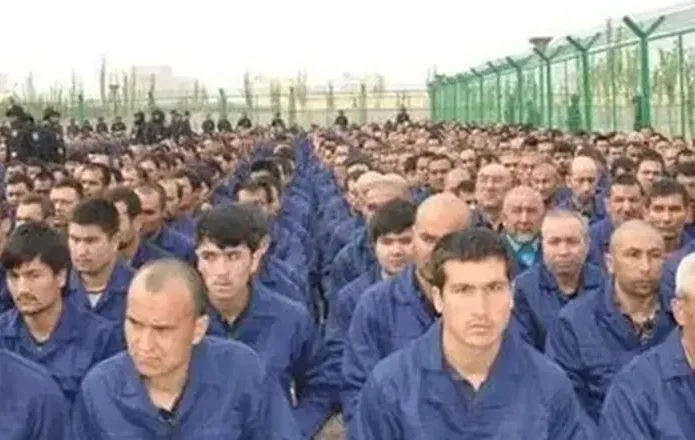
The below image was posted to the WeChat account of the Xinjiang Judicial Administration, showing “Uyghur detainees listening to a ‘de-radicalization’ speech at a camp in Hotan (Hetian, in Chinese) prefecture’s Lop county April 2017.”29 Here, the CCP is boasting of its mass detention of Uyghurs by claiming, in simple words, to protect society from dangerous men.

Chinese state discourse consistently equates Islamic practice with pathology. Religious expression is treated as an “illness,” and repression is described in clinical terms. One state document warned:
“If we do not eradicate religious extremism at its roots, violent terrorist incidents will grow and spread like an incurable malignant tumor.”32
The statement goes onto describe the camps as “re-education hospitals,” places where detainees could be “treated and cleansed of the virus in their brain” and “restored to a normal state of mind.”32 These statements predate the COVID-19 pandemic; the “virus” they referred to was Islam itself.
Forced Sterilization and Population Control
China has systematically deployed forced sterilization as a method to erase future generations of Uyghurs and other Turkic ethnic groups in East Turkistan. This policy has been acknowledged even in official Chinese statements. In December 2020, the Chinese Embassy in Washington, D.C. shared an article on X (formerly Twitter) that openly defended these practices.33 The tweet read:
“…in the process of eradicating extremism, the minds of Uyghur women in Xinjiang were emancipated, and gender equality and reproductive health were promoted—making them no longer baby-making machines. They are more confident and independent.”33
Following international outcry, Twitter (now X) removed the tweet.34 But its language is telling. The Chinese government was not denying the sterilization of Uyghur women—it was justifying it, framing the denial of reproductive rights as a form of “emancipation.”

This statement echoes the findings of scholars and human rights organizations. In one report, researcher Adrian Zenz documented widespread use of forced IUD insertions, sterilizations, and abortions among Uyghur women, concluding that the policies are designed to prevent births within the group.35
The demographic effects are already visible. Between 2015 and 2018, growth rates fell by 84 percent in the two largest Uyghur prefectures.36 Across East Turkistan, statistics showed birth rates continued to drop to 24% in 2019, compared to 4.2% across China. Such drastic declines cannot be explained by voluntary family planning alone. They reflect a haunting and relentless state policy intended to reduce the Turkic population.
The report further exposes the CCP’s acknowledgment that breaching birth control regulations can result in extrajudicial detention within so-called “training” camps. This corroborates evidence from the leaked Karakax List, which showed that such violations were the most common reason for internment.37 The campaign of forced sterilization directly fulfills one of the five criteria outlined in the United Nations Convention on the Prevention and Punishment of the Crime of Genocide: “imposing measures intended to prevent births within the group.”38 In this sense, the policy is not only a human rights violation but also legal evidence of genocide.
What Is Happening Is Genocide
Some commentators describe the repression in East Turkistan solely as a “cultural genocide.” While this term highlights the assault on Uyghur identity, it is incomplete. Genocide in East Turkistan is not limited to culture; it is also physical, evidenced by killings in camps and prisons, forced sterilization in mass numbers, and the widespread disappearance of individuals. Reducing the situation to cultural genocide risks obscuring the totality of what is happening and the mass suffering of millions of Uyghur families separated, destroyed, and rotting in prison cells.
The crimes unfolding in East Turkistan meet all five criteria for genocide as defined by the United Nations Convention on the Prevention and Punishment of the Crime of Genocide (1948).39
- Killing members of the group.
- Reports document killings and mass deaths inside camps and prisons,40 as well as death sentences for prominent Uyghur leaders.41 Survivors describe the deaths of detainees denied medical treatment or subjected to torture.
- Reports showing mass forced abortions and infanticide.
- Leaked CCP documents revealing the “shoot to kill” policy for any detainees who attempt to escape detention or prison facilities.42
- Organ harvesting from live Uyghur prisoners has also been widely reported.25
- Causing serious bodily or mental harm to members of the group.
- Torture, sexual violence, forced medication, and psychological abuse are systematically inflicted on detainees.43 Survivors consistently describe severe physical abuse and long-term trauma. Families of detainees endure severe trauma and must live in an open-air prison, while keeping silent.
- Another striking example is China’s mass DNA collection. The state claimed this was part of a “public health initiative,” yet the scale of surveillance and the lack of transparency reveal otherwise. By 2017, biometric data—including DNA samples, iris scans, and voiceprints—had been collected from millions of Uyghurs.44
- Deliberately inflicting conditions calculated to destroy the group in whole or in part.
- Such conditions include: mass surveillance, mass incarceration, forced sterilization, forced labor, criminalization of daily religious practices, destruction of religious and cultural sites, and all efforts to eradicate Uyghur identity and society.
- Such conditions include: mass surveillance, mass incarceration, forced sterilization, forced labor, criminalization of daily religious practices, destruction of religious and cultural sites, and all efforts to eradicate Uyghur identity and society.
- Forcibly transferring children of the group to another group.
- In 2020, estimates suggested that up to 900,000 Uyghur children, including infants, had been separated from their detained parents and placed in state-run “orphanages.”45 Recent findings reveal that China has expanded many of these facilities.46 In these institutions, children are indoctrinated to reject their faith and culture, forced to speak Mandarin, and subjected to physical and psychological abuse.
- In 2020, estimates suggested that up to 900,000 Uyghur children, including infants, had been separated from their detained parents and placed in state-run “orphanages.”45 Recent findings reveal that China has expanded many of these facilities.46 In these institutions, children are indoctrinated to reject their faith and culture, forced to speak Mandarin, and subjected to physical and psychological abuse.
- Imposing measures intended to prevent births within the group. As noted earlier, mass sterilization, forced IUD insertions, and coerced abortions are widely documented.30 Between 2015 and 2018, growth rates fell by 84 percent in the two largest Uyghur prefectures. Across East Turkistan, statistics showed birth rates continued to drop to 24% in 2019, compared to 4.2% across China.30
Across East Turkistan, neighborhoods have been depopulated in large numbers. Bazaars once filled with commerce now stand empty, not due to economic downturn, but because their residents have been imprisoned or disappeared.

Between 2017-2018, reports indicated rapid construction of crematoria in the region, a means of covering up the extent of mass deaths from the detention facilities. These crematories obscure the number of bodies leaving the camps, while simultaneously violating Islamic burial traditions, which require the preservation and burial of the body.47
The evidence is clear: what is happening in East Turkistan is not simply cultural repression. It is a coordinated effort to destroy a people in whole or in part—meeting the definition of genocide.
The Destruction of Uyghur Identity
The destruction of Uyghur culture, particularly any symbols of Islam, remains a central component of the genocide. As of 2020, over 16,000 mosques had been destroyed or repurposed since 2017, representing roughly 65 percent of all mosques in the region.48 Kashgar alone has lost approximately 6,000 mosques. Many have been replaced with propaganda centers, shops, or—in some cases—bars.49


Source: Anonymous tour guide.
A striking example is the Keriya Id Kah Mosque, the largest mosque in East Turkistan, constructed in 1200 CE/600 AH and could hold up to 12,000 worshippers. It was demolished to the ground in 2018.


Source: Uyghurism.com


“At the moment Kashgar is a surreal and scary place. An unending montage of the same five propaganda shots of Xi JinPing beam from screens. Powerful cameras with GPUs and shining barbed wire accent shabby public facilities.”
-Paul Mozur, New York Times Reporter covering tech in Asia, 2021
Forced Assimilation of Uyghur Children
Children separated from their parents in East Turkistan are subjected to systematic brainwashing. According to research, up to 900,000 were living in state-run boarding schools or orphanages as of 2019, often while both parents linger in some form of incarceration.45 In these facilities, Uyghur children are subject to forced assimilation, abuse, and long term family separation. They are forced to speak Mandarin, forget their native tongue, and endure severe emotional duress.

Responding to Denialism
One of the most persistent challenges in raising awareness about East Turkistan is denialism. A common refrain is: “Isn’t it all a hoax or exaggerated propaganda?” Such claims are deeply frustrating, especially when they come from fellow Muslims, including folks otherwise outspoken on issues of oppression elsewhere.
My response is simple: listen to Uyghurs themselves. Too often, those who dismiss the genocide have never spoken to an Uyghur person, never engaged with the diaspora, and never read the testimonies of survivors. There are ongoing archives like the Xinjiang Victims Database, which has, as of October 2025, documented more than 90,698 individuals reported missing, detained, or imprisoned, and that number cannot account for the other hundreds of thousands disappeared in East Turkistan.49 These are detailed case files submitted by families and friends who risk reprisal by speaking publicly.
The Chinese government itself has provided evidence of its crimes, whether through leaked documents, official speeches, or procurement records as shown earlier through the Xinjiang Police Files. State-run media has even published articles justifying sterilization campaigns, describing Uyghur women as “liberated” from being “baby-making machines.”50 Such admissions cannot be brushed aside as western propaganda.
Satellite imagery provides further confirmation. The Australian Strategic Policy Institute (ASPI), for example, has tracked the expansion of more than 380 internment camps using open-source data.11 Even independent observers initially skeptical of Western reporting confirmed what they witnessed. Dr. Olsi Jazexhi, an Albanian academic, toured East Turkistan in 2019 expecting to debunk the reports. Instead, he saw staged performances in camps—Uyghurs singing and dancing for visiting journalists—while detainees admitted they were imprisoned for praying or studying Arabic. He later acknowledged publicly that the “cover-up” itself confirmed the truth.51 Another Turkish journalist Taha Kilinc also documented the horrors he witnessed during his latest trip to East Turkistan in June 2025.52
It is also exhausting to encounter the lazy accusation that Uyghurs speaking out are “CIA puppets.” This narrative erases a long history of colonial domination in East Turkistan. My own father, for instance, came to the United States in the 1980s and dedicated his life to raising awareness of Chinese occupation decades before the world began talking about concentration camps. To reduce our struggle to a geopolitical proxy war is both historically inaccurate and profoundly dismissive.
In confronting denialism, then, the burden of proof does not rest on Uyghurs. It rests on those who refuse to engage with overwhelming evidence—from survivors, leaked state documents, satellite data, and even the Communist Chinese Party’s own confessions. Denialism is not skepticism, but rather complicity.
What Is (and Isn’t) Being Done to Stop the Genocide
Despite overwhelming evidence, global responses to the Uyghur genocide have been slow and fragmented. As of 2021, only a handful of countries—including the United States, the United Kingdom, Canada, the Netherlands, and Lithuania—had formally recognized China’s actions as genocide.52
Notably, no Muslim-majority country has issued such recognition, reflecting the depth of economic and political ties that bind many governments to Beijing. In June 2022, sixty countries—including Muslim-majority states like Pakistan and Saudi Arabia—signed a statement urging the UN human rights chief to treat issues related to East Turkistan as “China’s internal affairs” and declaring their opposition to the “politicization of human rights.”
One important legislative step is the Uyghur Genocide Accountability and Sanctions Act of 2025, introduced in the U.S. Congress to hold China accountable for forced sterilizations and other genocidal practices. While legislative action is vital, much more is needed at the global level.
Universities also play a large role. Many Western institutions maintain financial and institutional ties with China, including partnerships through Confucius Institutes. During my own time at Duke University, I observed how these ties shaped what could or could not be said. Duke Kunshan University (Duke’s campus in China), for instance, operates under strict censorship. I once lectured to a class based in Kunshan where even the professor refrained from attending out of fear. This personal experience illustrated how deeply China’s influence penetrates academia and silences discussion of atrocities, making universities like Duke complicit.
Activism also extends to direct action. Protests outside Chinese embassies, pressure campaigns on corporations benefiting from Uyghur forced labor, and calls to boycott the 2022 Beijing Olympics are examples of grassroots mobilization. These tactics not only raise awareness but also challenge the normalization of China’s crimes in global forums.
Muslim-majority countries hold a special responsibility. Historically, Türkiye voiced solidarity with Uyghurs; President Erdoğan even called China’s actions “genocide” in 2009 after visiting Ürümqi.53 But in recent years, Türkiye’s economic dependency on China has muted its official stance. Although Türkiye hosts a large Uyghur refugee community, Turkish state media has suppressed reporting critical of Beijing. I experienced this firsthand in 2018 while working at TRT World. After weeks of preparing a short documentary on Uyghurs, I was told it could not air because of likely pushback from the Chinese embassy.
Another example is Pakistan, whose previous Prime Minister Imran Khan responded the following when asked about Pakistan’s stance on the Uyghurs:
“China has been one of the greatest friends to us in our most difficult times. When we were really struggling, our economy was struggling, China came to our rescue. So we respect the way they are.”
-Former Prime Minister of Pakistan Imran Khan
This is what I call blood money: economic ties forged at the expense of human suffering. China uses its economic leverage to purchase silence from governments that might otherwise condemn its crimes.
For the Uyghur diaspora, the task ahead is twofold: survival and resistance. Survival means preserving language, culture, and faith in exile. Resistance means mobilizing allies, pressuring governments, and refusing to let denialism go unchallenged. Both are essential if our people are to endure.
Conclusion
In the face of so much loss, silencing, and erasure, it would be easy to believe that our voices cannot shift the tide. But history shows us otherwise. Even in the darkest moments, resistance—whether through storytelling, education, or advocacy—has kept our people’s truth alive. I hope a piece like this serves as a small form of resistance, a way to educate others on the basics of East Turkistan and ignite our communities to center the stories of our occupied nation.
The genocide in Gaza has been livestreamed before the world’s eyes, and it has taken decades of illegal occupation, massacres, deliberate starvation, and resilience for global consciousness to begin to awaken. East Turkistanis do not have the means to livestream their horrors. Their cries are muffled by walls of propaganda, censorship, and silence. And so it falls upon us to carry their stories forward and to make sure their reality cannot be denied or forgotten.
We cannot allow the suffering of our ummah to become background noise in an endless stream of horrors. We must keep our hearts alive, resisting the pull toward numbness. We must center East Turkistan in our conversations, our organizing, and our prayers.
May Allah grant freedom to East Turkistan, justice to all those oppressed, and steadfastness to all who stand in the face of tyranny. And may we never tire of telling the truth, until the world can no longer look away.
Disclaimer: Material published by Traversing Tradition is meant to foster scholarly inquiry and rich discussion. The views, opinions, beliefs, or strategies represented in published articles and subsequent comments do not necessarily represent the views of Traversing Tradition or any employee thereof.
Works Cited:
- https://www.amnesty.org/en/latest/news/2018/09/china-up-to-one-million-detained/. [↩]
- Gardner Bovingdon, The Uyghurs: Strangers in Their Own Land (New York: Columbia Press, 2010). [↩]
- Davidson, H. (2020, December 15). Xinjiang: More than half a million forced to pick cotton, report suggests. The Guardian. https://www.theguardian.com/world/2020/dec/15/xinjiang-china-more-than-half-a-million-forced-to-pick-cotton-report-finds. [↩]
- U.S. Congressional-Executive Commission on China. (2016). Annual Report 2016. https://www.cecc.gov/publications/annual-reports/2016-annual-report. [↩]
- Radio Free Asia. (2021, September 30). Uyghur population white paper. https://www.rfa.org/english/news/uyghur/population-white-paper-09302021162942.html. [↩]
- EBSCO. (n.d.). History: Qarakhanids convert to Islam. https://www.ebsco.com/research-starters/history/qarakhanids-convert-islam. [↩]
- Al-Kashgari, M. (1982). Dīwān Lughāt al-Turk (R. Dankoff, Trans.). Cambridge, MA: Harvard University Press. [↩]
- New Statesman. (2019, June). China’s Uyghur detention camps may be the largest mass incarceration since the Holocaust. New Statesman. https://www.newstatesman.com/world/asia/2019/06/china-s-uyghur-detention-camps-may-be-largest-mass-incarceration-holocaust. [↩]
- Radio Free Asia. (2019, November 23). Expert says 1.8 million Uyghurs detained. https://www.rfa.org/english/news/uyghur/detainees-11232019223242.html#:~:text=Expert%20Says%201.8%20Million%20Uyghurs,his%20assessment%20to%201.5%20million. [↩]
- Shahit Project. (n.d.). Xinjiang victims facilities. https://shahit.biz/xjvictims_facilities.pdf. [↩] [↩] [↩]
- Kuo, L. (2020, September 24). China has built 380 internment camps in Xinjiang, study finds. The Guardian. https://www.theguardian.com/world/2020/sep/24/china-has-built-380-internment-camps-in-xinjiang-study-finds. [↩] [↩]
- Agence France-Presse (AFP). (n.d.). Inside China’s internment camps: Tear gas, tasers, and textbooks. https://www.afp.com/en/inside-chinas-internment-camps-tear-gas-tasers-and-textbooks. [↩]
- International Consortium of Investigative Journalists (ICIJ). (2022, May 24). Xinjiang police files: Uyghur mugshots and detention records. https://www.icij.org/investigations/china-cables/xinjiang-police-files-uyghur-mugshots-detention/. [↩]
- International Consortium of Investigative Journalists (ICIJ). (2019, November 24). Chinese arms flow into the U.S. and other countries despite manufacturers’ alleged role in Xinjiang repression. https://www.icij.org/investigations/china-cables/chinese-arms-flow-into-the-us-and-other-countries-despite-manufacturers-alleged-role-in-xinjiang-repression/. [↩] [↩]
- Al Jazeera. (2022, August 18). Forced labour claims in China’s Xinjiang “reasonable”: UN expert. https://www.aljazeera.com/economy/2022/8/18/forced-labour-claims-in-chinas-xinjiang-reasonable-un-expert. [↩]
- Business & Human Rights Resource Centre. (n.d.). China: 83 major brands implicated in report on forced labour of ethnic minorities from Xinjiang. https://www.business-humanrights.org/en/latest-news/china-83-major-brands-implicated-in-report-on-forced-labour-of-ethnic-minorities-from-xinjiang-assigned-to-factories-across-provinces-includes-company-responses/. [↩] [↩]
- Human Rights Watch. (2021, April 19). Break their lineage, break their roots: China’s crimes against humanity targeting Uyghurs and other Turkic Muslims. Human Rights Watch. https://www.hrw.org/report/2021/04/19/break-their-lineage-break-their-roots/chinas-crimes-against-humanity-targeting. [↩]
- Human Rights Watch. (2021, April 19). Break their lineage, break their roots. [↩] [↩]
- United Nations Office of the High Commissioner for Human Rights (OHCHR). (2022, August 31). Assessment of human rights concerns in the Xinjiang Uyghur Autonomous Region, People’s Republic of China. https://www.ohchr.org/sites/default/files/documents/countries/2022-08-31/22-08-31-final-assesment.pdf. [↩]
- United Nations Office of the High Commissioner for Human Rights (OHCHR). (2022, August 31). Assessment of human rights concerns in the Xinjiang Uyghur Autonomous Region, People’s Republic of China. [↩]
- Council on Foreign Relations. (n.d.). China’s repression of Uyghurs in Xinjiang. https://www.cfr.org/backgrounder/china-xinjiang-uyghurs-muslims-repression-genocide-human-rights. [↩]
- Human Rights Watch. (2019, May 1). China’s algorithms of repression: Reverse engineering a Xinjiang police mass surveillance app. Human Rights Watch. https://www.hrw.org/report/2019/05/01/chinas-algorithms-repression/reverse-engineering-xinjiang-police-mass. [↩]
- Human Rights Watch. (2023, August 31). China: Unrelenting crimes against humanity targeting Uyghurs. Human Rights Watch. https://www.hrw.org/news/2023/08/31/china-unrelenting-crimes-against-humanity-targeting-uyghurs. [↩]
- CNN. (2020, October 8). China’s Xinjiang: Uyghur hair and forced labour investigation [Video]. https://www.cnn.com/videos/world/2020/10/08/china-xinjiang-uyghur-hair-forced-labor-watson-pkg-intl-hnk-vpx.cnn. [↩]
- United Nations Office of the High Commissioner for Human Rights (OHCHR). (2021, June). UN human rights experts alarmed by organ harvesting allegations in China. https://www.ohchr.org/en/press-releases/2021/06/china-un-human-rights-experts-alarmed-organ-harvesting-allegations. [↩] [↩]
- Xinjiang Police Files. (n.d.). https://www.xinjiangpolicefiles.org/. [↩]
- Hoshur, S., & Lipes, J. (2018, August 31). One in six Uyghurs held in political “re-education camps” in Xinjiang’s Onsu County. Radio Free Asia. [↩]
- Watson, I. (2020, February). Inside China’s “Karakax List.” CNN. https://www.cnn.com/interactive/2020/02/asia/xinjiang-china-karakax-document-intl-hnk/#:~:text=Chinese%20state%20media%20described%20it,allowed%20to%20leave%20their%20camp. [↩]
- Radio Free Asia. (2019, April 26). Camp photo reveals conditions in Xinjiang detention centers. https://www.rfa.org/english/news/uyghur/camp-photo-04262019171258.html. [↩] [↩]
- Zenz, A. (2021, March 17). Internment, sterilizations, and IUDs: Evidence of coercive population control in Xinjiang (revised edition). Jamestown Foundation. https://jamestown.org/wp-content/uploads/2020/06/Zenz-Internment-Sterilizations-and-IUDs-REVISED-March-17-2021.pdf. [↩] [↩] [↩]
- Associated Press. (2021, March 9). China accused of genocide over Uyghur camps and forced labour. https://apnews.com/article/coronavirus-pandemic-lifestyle-china-health-travel-7a6967f335f97ca868cc618ea84b98b9. [↩]
- Radio Free Asia. (2018, August 8). Uyghur inmates infected with diseases in Xinjiang detention centers. https://www.rfa.org/english/news/uyghur/infected-08082018173807.html. [↩] [↩]
- China Daily. (2021, January 7). China rebuts “forced labour” narrative. https://www.chinadaily.com.cn/a/202101/07/WS5ff6fb03a31024ad0baa134a.html. [↩] [↩]
- BBC/ABC News. (2021, January 11). Twitter removes Chinese embassy tweet about Uyghur women “baby machines.” https://www.abc.net.au/news/2021-01-11/twitter-removes-chinese-embassy-tweet-uyghur-women-baby-machines/13046494. [↩]
- Zenz, A. (2021, March 17). Internment, sterilizations, and IUDs: Evidence of coercive population control in Xinjiang (revised edition). Jamestown Foundation. https://jamestown.org/wp-content/uploads/2020/06/Zenz-Internment-Sterilizations-and-IUDs-REVISED-March-17-2021.pdf. [↩]
- Zenz, A. (2021, March 17). Internment, sterilizations, and IUDs: Evidence of coercive population control in Xinjiang (revised edition). Jamestown Foundation. https://jamestown.org/wp-content/uploads/2020/06/Zenz-Internment-Sterilizations-and-IUDs-REVISED-March-17-2021.pdf [↩]
- The Karakax List. (2020, February). Journal of Political Risk. https://www.jpolrisk.com/karakax/. [↩]
- United Nations. (1948, December 9). Convention on the Prevention and Punishment of the Crime of Genocide. https://www.un.org/en/genocideprevention/documents/atrocity-crimes/Doc.1_Convention%20on%20the%20Prevention%20and%20Punishment%20of%20the%20Crime%20of%20Genocide.pdf. [↩]
- Newlines Institute for Strategy and Policy. (2021, March). China’s breaches of the Genocide Convention: An assessment. https://newlinesinstitute.org/wp-content/uploads/Chinas-Breaches-of-the-GC3-2.pdf. [↩]
- U.S. Department of State. (2021). China (includes Hong Kong, Macau, and Tibet): Human rights report summary. https://www.state.gov/report/custom/547ad8e343#:~:text=Home%2C%20or%20Correspondence-,China%20(Includes%20Hong%20Kong%2C%20Macau%2C%20and%20Tibet),release%20from%20an%20internment%20camp. [↩]
- Davidson, H. (2021, April 9). China sentences Uyghur education directors to death for separatism. The Guardian. https://www.theguardian.com/world/2021/apr/09/china-uyghur-death-sentences-xinjiang-education-directors. [↩]
- UK Parliament. (2022, May 24). Xinjiang internment camps and “shoot-to-kill” policy. Hansard Parliamentary Debate. https://hansard.parliament.uk/commons/2022-05-24/debates/FCB750C1-EBD7-4D1F-A739-E5034666FDD5/XinjiangInternmentCampsShoot-To-KillPolicy. [↩]
- CNN. (2021, October 4). Xinjiang detective describes torture of detainees in China’s internment camps. https://www.cnn.com/2021/10/04/china/xinjiang-detective-torture-intl-hnk-dst#:~:text=%E2%80%9CUntil%20they%20kneel%20on%20the,and%20tell%20him%20to%20confess.%E2%80%9D [↩]
- Human Rights Watch. (2017, December 13). China: Minority region collects DNA from millions. Human Rights Watch. https://www.hrw.org/news/2017/12/13/china-minority-region-collects-dna-millions. [↩]
- Enos, O. (2023, May 8). The urgent need to defend Uyghur children and their families. Forbes. https://www.forbes.com/sites/oliviaenos/2023/05/08/the-urgent-need-to-defend-uyghur-children-and-their-families/. [↩] [↩]
- Radio Free Asia. (2025, January 16). Uyghur children forced into state boarding schools. https://www.rfa.org/english/uyghur/2025/01/16/children-boarding-schools/. [↩]
- Radio Free Asia. (2018, June 26). Authorities building crematoriums in Xinjiang. https://www.rfa.org/english/news/uyghur/crematoriums-06262018151126.html#:~:text=Authorities%20in%20northwest%20China%27s%20Xinjiang,and%20Construction%20Corps%20(XPCC). [↩]
- Australian Strategic Policy Institute (ASPI). (2020). Cultural erasure: Tracing the destruction of Uyghur heritage in Xinjiang. https://www.aspi.org.au/report/cultural-erasure/. [↩]
- Shahit Project. (n.d.). Xinjiang Victims Database (English Portal). https://shahit.biz/eng/. [↩] [↩]
- Davidson, H. (2021, January 10). Twitter removes Chinese embassy post saying Uighur women no longer “baby-making machines.” The Guardian. https://www.theguardian.com/world/2021/jan/10/twitter-removes-china-us-embassy-post-saying-uighur-women-no-longer-baby-making-machines. [↩]
- Voice of America (VOA). (2024). China inviting sympathetic foreign media to Xinjiang can backfire. https://www.voanews.com/a/china-inviting-sympathetic-foreign-media-to-xinjiang-can-backfire/7497258.html. [↩]
- Kashgar Times / Taha Kılınç. (2023). I’ll never forget the Uyghur children I met in Turkey. Kashgar Times Newsletter. https://kashgartimes.substack.com/p/taha-kilinc-ill-never-forget-the. [↩] [↩]
- Reuters. (2009, July 10). Turkish leader calls Xinjiang killings genocide. Reuters. https://www.reuters.com/article/world/turkish-leader-calls-xinjiang-killings-genocide-idUSTRE56957D/. [↩]
Aydin Anwar
Aydin Anwar is an Uyghur-American advocate and Senior Campaign Manager at MPower Change. With over 90 relatives missing in Chinese-occupied East Turkistan, her work focuses on amplifying Uyghur voices and advancing global awareness of their ongoing genocide.
Leave a Reply