
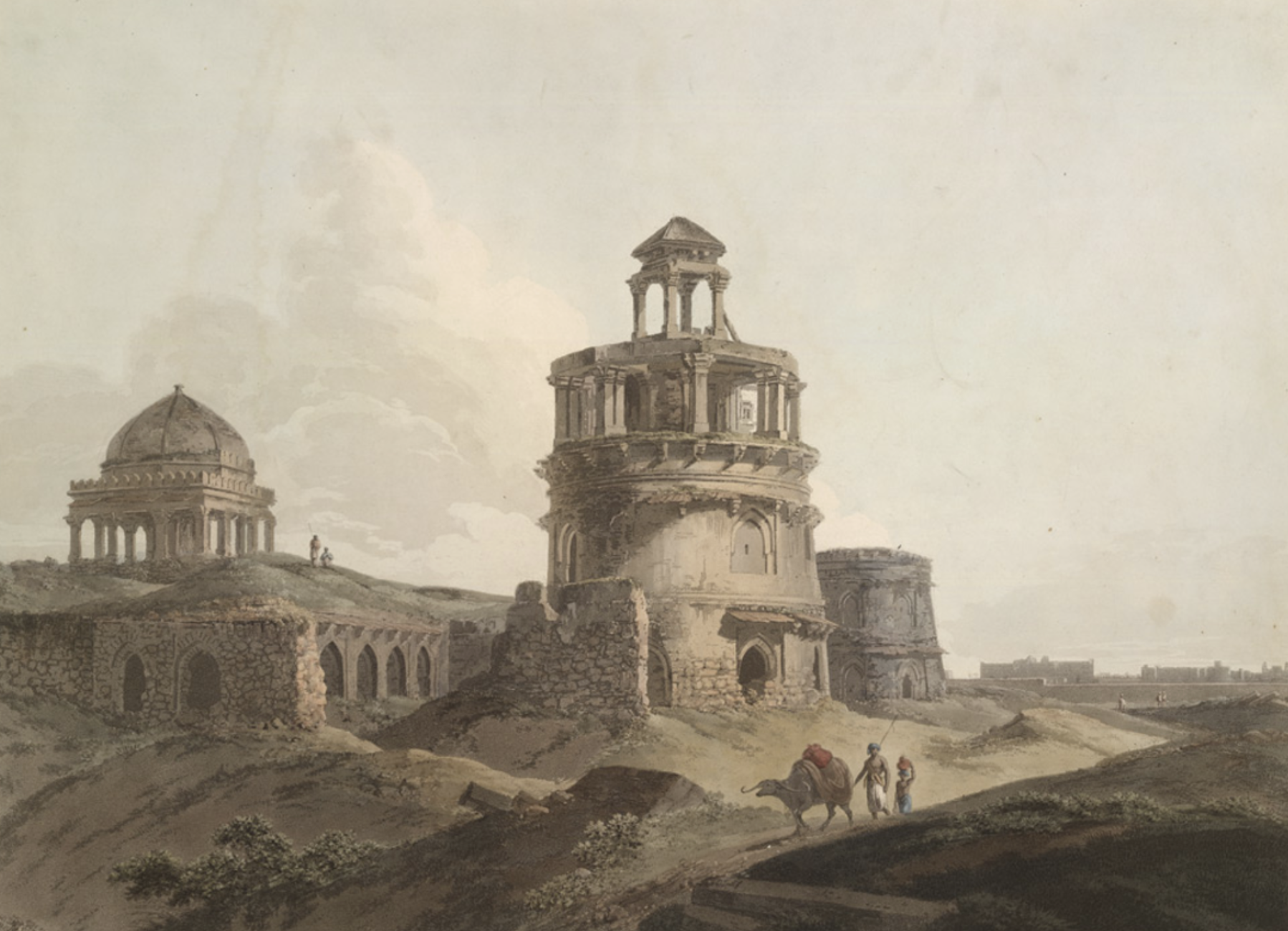
This essay charts both the life and the afterlife of Shāh Walī Allāh al-Dihlawī, the preeminent thinker of the late Mughal empire, whose synthesis of revelation, philosophy, and mysticism sought to rescue Islam’s intellectual tradition amid imperial decay. Set within the luminous yet collapsing world of eighteenth-century Delhi, it follows Walī Allāh’s education, his journeys to the Ḥijāz, his metaphysical meditations on wujūd and tajallī, and his attempt to reconcile Ibn ʿArabī’s visionary cosmology with Ibn Taymiyya’s sober scripturalism. His son, Shāh ʿAbd al-ʿAzīz al-Dihlawī, emerges as both heir and interpreter—translating his father’s vision into a theology of resistance and continuity that sustained Muslim thought through the first shocks of colonial rule. From this Mughal crucible, the essay traces the transmission of Walī Allāh’s legacy through Deoband’s seminaries to the modern American Midwest, culminating in the figure of Shaykh Amin Kholwadia, a British scholar who revives the vows of Walī Allāh in a new cultural setting, in the first decades of the twenty-first century. Through history, theology, and memory, the author portrays Walī Allāh not as a vanished relic but as the abiding intellect of the Mughal empire’s conscience—his light refracted across time, a lasting memorial to the intellectual culture of Mughal India.
Download the PDF to read in full. An excerpt is available below.
Devoted to the memory of my great-uncle Hamid Moizuddin.

فرستا صالح را به در، که متجرّیِ نامِ سردارِ مدینه است
چو مسیحنفس، کمکرده آید به دربارِ مدینهDispatch Saaleh to the gallows! For he has dared to say the Lord of Madina’s name For even the Messiah Jesus will halt his breath when he arrives in Madina
Prologue: The Gallows of Madina
Fresh out of completing the six canons of Ḥadīth—the qawānin of life—in South Africa, I migrate to Chicago to begin my master’s, pursuing some branded fusion of Persian literature, cultural anthropology, and Mughal history. Not even two weeks after moving to Hyde Park, I take a drab grey train—slightly more streamlined, steam-lined than BART—towards the pine tree-lined suburbs of Glendale Heights, where I would eventually live for three years amid the bolts of COVID. Entering the purple-inflected campus, I lilt towards the office where it was epigraphed, emblazoned Shaykh Amin Kholwadia, President and turn the metal handle.
I sit down before the Shaykh in taḥiyyāt position, life-gifting posture, as he holds a red-rotted powdery book, likely block-pressed in an old Indian publishing house in the 1940s that he had purchased in the village of Deoband. He eyes me, grins and says to read. I journey to the end of the Muqaddima, pausing once in the introduction as our author describes seeing the soul of His lordship, the Holy Prophet, in the Shāh Jahān-built Masjid of Delhi, lording over and commanding him to write the text, in the 1750s in the same moment as Lord Robert Clive, and after him, Lord Cornwallis, began to plunder into the territorial integrity of the sons of Tamerlane, dar arāzīy-I saltanat-I Taimuriyya. The Introduction comes to a completion, the Arabic of Walī Allāh suspended like applause before us. The Shaykh begins:
“And Shāh Walī Allāh of Mughal India…”
My head swirls to the moment that we sat on stage in Azaadville, the day of our ‘Ālimiyya graduation, when Shāh Walī Allāh’s name recited out in the metallic chain, with our Bukhārī purple-paged texts lapped open before us, the Qadīmī Kutub Khāna ink finally shining before our eyes, in the aftermath of the logos of the Lord of Prophets.

–-
In the late 1770s, for he was blind after, the grandfather of the founder of ‘Tablīghī Jam’at, Muftī Elāhī Bakhsh (in other accounts, his great uncle), records that once he was praying Tarāwīḥ behind Shāh ‘Abd al-‘Azīz, son of Walī Allāh, some years after Walī Allāh’s passing. A near-blacked-out prostitute saunters before the Shāh and begins to sing amid the recitation of the Quran amid Tarāwīḥ in the ancient Masjid of the Shāh Walī Allāh family, right across the castle and fort of Sultan Firoze Shāh. Shāh ‘Abd al-‘Azīz halts his voice and the courtesan can now be heard coughing out couplets of Lisān al-Ghayb, or Ḥāfez of Shiraz—the boy who memorized the Quran, who then became a drunk collapsing into the streets with liquor, and then a political diplomat amid the massacres of Tamerlane, and finally the spokesman of the Ghayb:
درکویِ نیکنامی مَرا گُذَر نَدَادَند
اگر تو نام نمیپسندی، تغیِیر کُن قَضا راThe high-reputationed didn’t permit us to enter into their courtyard
We’re here—if you don’t like it, change the fate of God!
Shāh ‘Abd al-‘Azīz, sitting before Shāh ‘Ismāīl and Shāh Muḥammad Isḥāq (of Delhi and Mecca!) and a Scottish Anglican Resident, the first two his grandson and nephew, repeats the couplet of the prostitute, of Ḥāfez. He closes out the Majlis, beckoning to the younger Shāhs that the Mahfil has ended—and to help the elderly blind Shāh stand upright and walk to his quarters in the Mehndiyan madrasa-complex. And before he closes the door, as noted in Kamālāt-i ‘Azīzi, he whispers a Quranic duah from his father Abraham (through sayyidunā ‘Umar):
“All praise is due to Allāh who has gifted me ‘Ismāīl and Isḥāq in my old age—wahab li ‘ala al-kibar ‘Ismāīl wa Isḥāq.”
The Walī Allāh Khāndān: son of Shāh Walī Allāh, a grandson of Shāh Walī Allāh, and a great-grandson of Shāh Walī Allāh, a lalahzar, amid the corporate regimes and the spectacle of the British Isles.

The Elders
Lounging in any Deobandi bayan, ‘Tablīghī, ‘Ilmi, or ‘Irfani, one hears mention of the word Buzurgān, or the Elders. The invocation of Elders ebbs and flows—in that in every generation the referent set seems to shift. In South Africa where I studied, it almost invariably meant Mawlānā Ashraf ‘Alī Thānwī, Mawlānā Rashīd Gangōhī, Mawlānā Ilyās Kandehlawī, Mawlānā Zakariyya and Muftī Maḥmūd al-Ḥassan (literally buried in South Africa)—for this was the flavor of Deoband that had commandeered the stripe of Islam in the southernmost tip of the continent. In Pakistan, the Elders may symbolize more Muftī Muḥammad Shafi, Muftī Rashīd Aḥmed and Shabbīr Aḥmed ‘’Usmānī, or in India it fixates on ‘Allāma Anwar Shāh Kashmir and Mawlānā Husayn Aḥmed Madanī (and of these are all sliding scales). But after pressing any Madrasa-graduate on where their tradition begins, they will say, sometimes with a smirk, but more often with a strike of humility and hopefully some arrogance and a lilted breath: Shāh Walī Allāh.
More than Mawlānā Thānwī, more than Mawlānā Qāsim, more than Mawlānā Rashīd, more than Muftī Shafi, more than Muftī Rashīd Aḥmed, more than Shaykh al-Hind, more than even Shāh ‘Ismāīl Shāhid and Anwar Shāh Kashmīrī, more than Mawlānā Aḥmed Reẓā Khān and Pir Mehr Ali Shāh and Sayyid Nazir Ḥussein Dihlavī, more than Shibli No’mani and Abd ‘al-Ḥayy al-Nadwī, nobody holds the title more pointedly and poignantly than Shāh Walī Allāh when the word Buzurgan is deployed—despite how unspoken this notion may be. Shāh Walī Allāh is buzurgvar-buzargan, the elder of elders.
What they are laboring to say is not that Sunni Islam began or reached its apogee with Walī Allāh (although many would agree), but that if anyone is to credit for their assimilation—their entombment—within Muslim scholarly sepulchers, within the semantic field of an ‘ālim, it is singularly Walī Allāh. If pushed further, they will say that Walī Allāh cargoed Ḥadīth to subcontinent and was the causa singulara for the casting of six prophetic canons (and the monarch of Ḥadīth, Imām Mālik) in South Asia, extending its tentacles to Bradford, Chicago, and Azaadville.
But did Walī Allāh have any value beyond the narration of Ḥadīth? That was he nothing save a vessel, allowing South Asian Muslims to ground their claims in Ḥanafī orthodoxy amid the besieging majānīq of the Salafi class, namely Ibn ‘Abd al-Wahhab and Shaykh al-Islam Ibn Taimiyya? (For we can only guess what would have remained of Ḥanafīsm had Muslims in Barr-i Saghir not had study of Ḥadīth and her asānid when the Salafiyya arrayed their siege-wagons before the castle-walls of Ẓāhir al-Riwaya). As the Aligarh historian, Khaliq Aḥmed ‘Nizāmī, once put it in his seminal article on Shāh Walī Allāh: “Shāh Walī Allāh has ushered in a new dawn in Islam.”
Walī Allāh and the Arkhes
Walī Allāh, without hyperbole, perches over the hierarchy of all sacred traditions in South Asia, whether of Deoband, of Barelwis, of Ahl-i Ḥadīth, of the literary school Nadwa, of the Hegelian-cum-Aristotelian-cum-Ḥāfezian Iqbāl, of the enlightened liberalism (rohsan khayali) of Sayyid Aḥmed Khān, and of the Florence-like humanitas of Shibli No’mani—of the exegetical grove of Hamiduddin Farahi (for there is no doubt his idea of the Nazm originates in Shāh ‘Abd al-‘Azīz’s Persian Fatḥ). Which is to say, to invoke God and his Prophet in the subcontinent, one was forbidden except by the name—by the musammā of Walī Allāh—and his sons, as one may not invoke Tasawwuf without Junaid al-Baghdādī and Bayazīd Bistāmī, the Arbāb-i Taṣawwuf, and especially the lord of saints, ‘Abd al-Qādir al-Jeelani.
Dr. Israr Aḥmed, the ex-Jamat-i Islami loyalist, famed for a breath of fresh air on the airwaves of Pakistan preceding the century-turn and his ability to have sincere discussions with Deobandis and Barelvis—when both were Tafsiq-ing each other—is an excellent point of arrival. You can see him, navy blue in the wall gushing out behind him, as he says Shāh Walī Allāh’s name: “In Barr-i Saghir, we have had no thinker who animated the Muslim tradition like him, surpassing Abū Hamid al-Ghazālī. Yes, I said it! Even outpacing Ibn Taimiyya!”
To love the Prophet in South Asia, one could only touch it, hold it, grapple and graze and grasp it by Walī Allāh’s Prophet-love.
Israr Aḥmed is perfectly apt to describe Walī Allāh as a Fātiḥ not in the Sultan Mehmet or Aurangzēb sense, but in the meaning of one who opens an era, Fātiḥ al-Dawr. As Ṣadr al-Sharī’ah said in his book on Astronomy many centuries before Walī Allāh: al-falak al-dawwar.
–-
ما بر در جاوید زدند بر لب بام بجز نوبت سلطانی نیست
We beat the ‘Ṣūfī’s drums on the gates of Eternity
On the roof’s lip, shouting:
“give us kingship- this is our demand!”
– Naziri Nishapuri (buried in Surat, Gujarat)
Hierarchy—a Greek dyad Walī Allāh would have loved—from hierarkhēs (ἱεράρχης) to mean a high priest, the first declension hieros, sacred, and arkhes (think of archaic), to mean ruler. A ruler of the sacred rites, a lord of sacrality, a fount of sacredness. Walī Allāh was the arkhes of the heiros in South Asia, in Afghanistan. As his three-hundred-year anniversary of journeying to the Hejaz approaches, what figure could possibly rival him in the past three hundred years—Muḥammad Iqbāl once asked this very question as he lectured to Muslims and Mawlānā Manazir Ahsan Gilani in Osmania University.
Yet, why do we hold him in such lofty measure if his sole virtue was the transmission of ḥadīth? Why not the same for Ibrāhīm ibn Aḥmad al-Tanūkhī or ʿAbd Allāh ibn Aḥmad al-Sarakhsī or anyone else in the chain? Most Deobandī graduates know so little about the figures of our Walī Allāh chain back to the Prophet—we all know of Ibn Ḥajar and Zakariyyā al-Anṣārī (yet try pressing a Deobandī graduate to name one work of Ibrāhīm al-Kurānī from his sixty-book oeuvre).
Yet, in Noʿmānī’s ʿIlm al-Kalām—the only Urdu book quoted in Muḥammad Iqbāl’s dissertation in Munich and Heidelberg—we see Walī Allāh at the end of a list that includes al-Fārābī, al-Jurjānī, al-Kindī, Ibn Rushd, Shihāb al-Dīn al-Suhrawardī al-Maqtūl, Mullā Ṣadrā, Bū ʿAlī Sīnā, al-Fārābī, Abū Ḥāmid al-Ghazālī (and the only Ḥanafī, Mawlānā Jalāl al-Dīn al-Rūmī) and Shaykh al-Islām Ibn Taymiyyah—all figures within the Islamic frieze, within the Islamic philosophical canon, but all personas that have shaped, directed, animated, hammered away and onto the Islamic tradition in extraordinary ways that no Muftī can claim (for the only four Muftīs who sit as proper ḥukamāʾ in the frieze of history are Ibn Taymiyyah, Mawlānā Rūmī, Shāh Walī Allāh and Mawlānā Qāsim Nānotwī).
Was Walī Allāh a philosopher? If so, what kind? The kind of Ibn Rushd or of Shaykh al-Islām Ibn Taymiyyah or of al-Maqtūl? If Shāh Walī Allāh was such an extraordinary ḥakīm, where and what is his ḥikmah, his ḥākimiyyah? Why don’t we know about it? Where would one be?
Disclaimer: Material published by Traversing Tradition is meant to foster scholarly inquiry and rich discussion. The views, opinions, beliefs, or strategies represented in published articles and subsequent comments do not necessarily represent the views of Traversing Tradition or any employee thereof.
Mollā Saaleh Baseer
Mollā Saaleh Baseer completed his Dars-i Niẓāmī in Azaadville, where he was authorized in Saḥīḥ al-Bukhārī by Mawlana Faḍl al-Raḥmān al-ʿĀẓamī and Mawlana Moosa Patel. He earned his bachelor’s in History from Columbia University. He spent three years writing Fatwas and studying the knowledge of the Hukama under Shaykh Amin Kholwadia’s supervision. He is a PhD candidate at Harvard, in the History Department, studying Islamic legal theory in the postclassical world, Akbarian political theory, and nineteenth-century American legal history. He hails from northern California as his ancestors belong to the Muslim polity of India, namely, Haiderabad of the Asaf Jah Khāndān.