
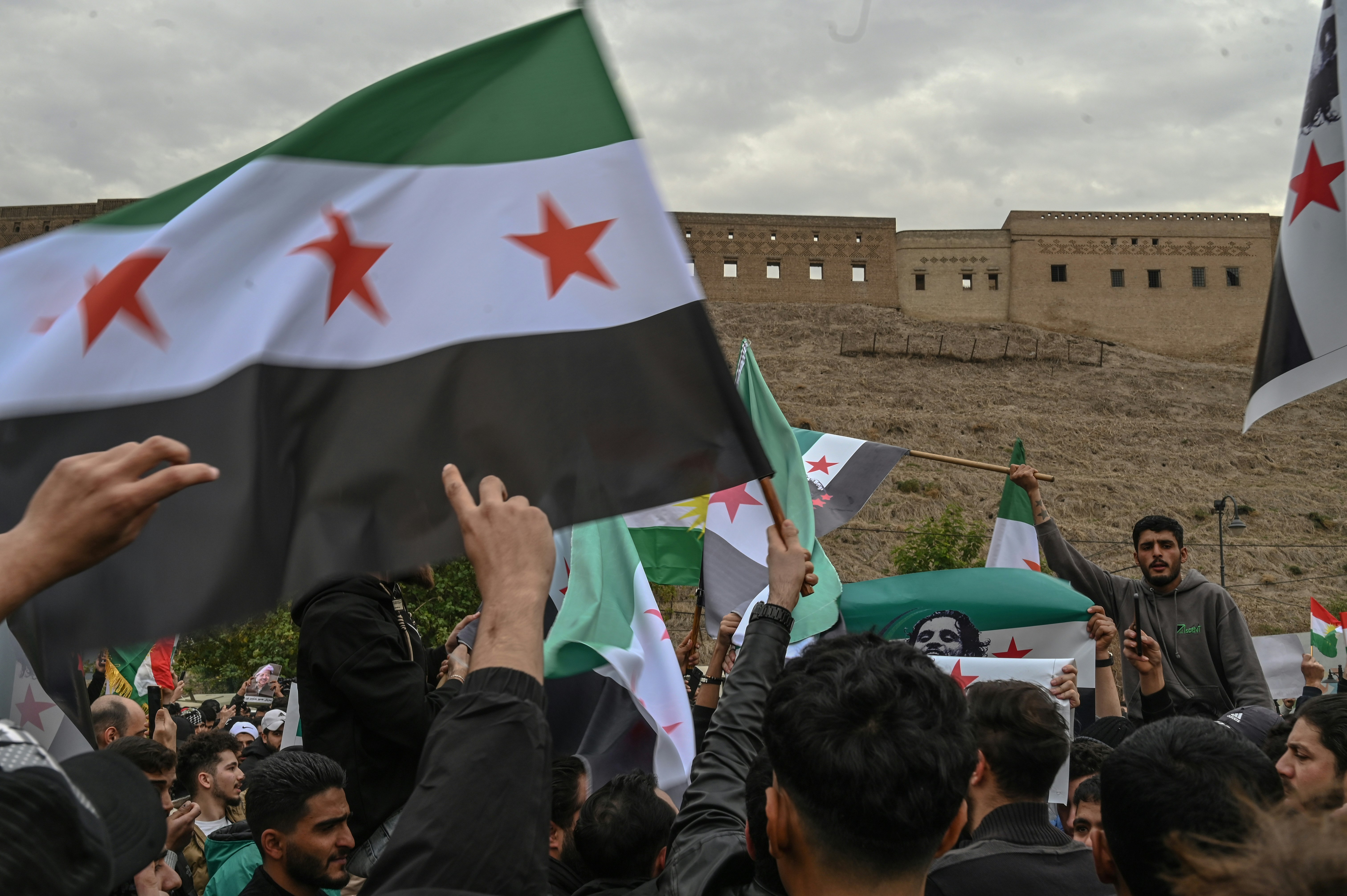
Last month, I heard that a cousin of mine was trying to get out of Syria. He was past due to signing up for his mandatory military service, and if by chance he was ever questioned about it on the street or the police decided to knock on his door, he’d be compelled to go with them, or else he’d face severe fines and jail time. This was two weeks before the regime collapsed.
He wasn’t alone or a rarity. Thousands of men across Syria (who themselves have become a hot commodity since the mass exodus and death of hundreds of thousands of them) were due for conscription into Assad’s forces. However, due to a combination of national poverty, bureaucratic fatigue, and the dull atmosphere of torpidity permeating the blessed land of al-Sham after its recent massacres, they were largely left alone. Everyone, from long-term regime loyalists to silent yet patient dissidents, were simply too exhausted. But as we know, mankind may tire, but Allah never does. Confined in a holdout, rebel city no more than nine square miles (23 square kilometers), the forces of a pseudo-state managed to break out and accomplish what everyone in the world thought was a ridiculous pipedream: the complete destruction of a fifty-year secularist, Alawite-led regime in less than two weeks, with negligible civilian casualties.
Before delving into further details, it is essential to mention the Muslim world’s utter and collective disillusionment with Syria as recently as one month ago. Among entire ranks of the most educated of us, the most pious and religiously learned, most had lost hope for a Sunni power taking the reins in Syria within the century. In the past five years, many scholars and imams, even, have been on record ridiculing the Syrian revolution for the bloodshed it incurred without yielding any results. Some who’ve done this still, somehow, persist in their skepticism, but the majority have shifted their stance to join the bandwagon while posturing as though they had supported the opposition (now the new government) all along.
This overwhelms us because its implications aren’t just political, militant, or social. To the believers paying attention, and who know their history well, the Levant (also known as Greater Syria, a more modern term) has been where Muslims across history fought their most decisive battles in defense of Islamic sovereignty. There’s a reason the Messenger of God (ﷺ) is recorded as having spoken of its plentiful blessings on various occasions.
“We were with the Messenger of Allah (ﷺ) collecting the Qur’an on pieces of cloth, so the Messenger of Allah (ﷺ) said: ‘Glad tidings for Al-Sham.’ So, we said: ‘Why is that O Messenger of Allah?’ He said: ‘Because the angels of the Most-Merciful spread their wings over it.’”1
For those with a broad historical perspective, there’s been a tendency to relate these recent events to the warfare the Levant has seen in pre-modernity, such as wars with the Crusaders and the Mongols. However, a critical difference between then and now is that past wars for the Levant were easy to surmise in an era where each side held a strong religious creed that defined their values and vision. The test of our predecessors was, for the most part, that of defending the lands of the Muslims in times of fragmentation against a foe with equal religious zeal in imposing their own beliefs. Today, however, the struggle of the Muslims of the Levant is besieged and gnawed at on multiple ends.
On one front, the coast of the Levant has been occupied for three-quarters of a century by a Zionist amalgamation—composed of both secular zealots and religious fanatics from a marginalized European minority with dubious ethnic claims to the Near East. This entity is rife with internal political discord, tearing itself from within, particularly over the question of dealing with the Palestinians they occupy. To Muslims, this is the easiest distinction in the world to make, and therefore they by and large support Palestine because of the clear split in worldview and values on each side. Syria, however, was a different story.
Over the past 150 years, the political application of Sunni Islam has splintered into two starkly contrasting avenues: a representative of downtrodden Muslims en masse with no political agency, or a hollow caricature embodied by a commercialized cartel of oil states more loyal to the idea of getting ahead of each other in real estate capital than accessing the spiritual pole of what it truly means to be a Muslim monarch. Look, for example, at the chronic suffering of Muslims in India and Kashmir, regularly abused in the subcontinent for decades. Meanwhile, nations like Pakistan and Egypt are hollow, military-run “Coal Republics” where rampant unemployment and an epidemic of emigration, as people seek to earn a basic living. These developments over the last two centuries, accelerated by the rotting and dissolution of Mughal India and the Ottoman caliphate, helped cement a global perception of Sunni Muslims as backward, destitute peoples destined for lives of historical irrelevancy or refugee status, where the best hope is to be “model minorities” in Western lands or contracted temporary workers in the Arab Gulf.
Amid this grim backdrop, the Palestinian cause remains central to Muslims worldwide, but Syria was (and remains) the far truer test of faith to the Sunni Muslim world. Syria’s struggle was not merely about Sunni exclusivism in practice, but the long-abandoned idea that Sunni Muslims have the right to self-governance in accordance with their spiritual mandate; to once again become the preeminent faction in the nation of Muhammad (ﷺ) in politics instead of mere quantity as the “majority.”
While the Assad regime was largely led by Alawites, a cultish minority sect that held no historical significance to the region before their artificial boost to power by the French colonialists,2 its defining feature was its commitment to secularism as a secular republic. This earned it admiration among American and European nationalists, who lauded its staunch anti-religious governance while ignoring the brutality underpinning this “stability.” The regime’s survival over the last decade was significantly aided by the Iranian-led Shia axis. The atrocities committed by Shia militias,3 including depopulating Syrian villages,4 and genocidal rhetoric, are well-documented.5
While Shia religious extremism played a role among the forces that sustained Assad’s regime over the past decade, this element was of little concern to the regime itself. Its core identity remained rooted in upholding a secular, anti-religious status quo that kept its Sunni majority tightly controlled. To this end, the regime incorporated many secular Syrians into their ranks. Over the past few decades, however, Syria has experienced a religious revival, due to the incredible work of Syria’s most eminent scholars––many of whom were martyred, may Allah widen and light up their graves. These efforts were a stark departure from the Cold War era, where the hijab was banned from all girls’ schools, and growing a beard or praying Fajr in the masjid risked disappearance to a nameless dungeon.6
Initially, when the Syrian Revolution started in 2012, it wasn’t framed as a“religious” uprising, but a demand for democracy and human rights as understood under a secular umbrella.7 As the conflict escalated and turned militant, the Sunni identity of those being targeted and massacred came under threat. This marked a test of loyalty as the complexities of the struggle exposed the secular authoritarianism pervasive across most Muslim-majority nations. Despite the romanticized perception of Muslim home countries as more “Islamic” than where the diaspora reside, many neighboring countries mirrored Assad’s regime—run by authoritarians defined by a secular stasis. Thus, supporting the Muslims of Syria was a much harder task for the nominal Muslim. Whereas most Muslims see the issue of Palestine as being that of us against a racially foreign foe supported by a Western coalition, the issue of Syria became a fight led by Sunni Muslims with a vision beyond the failures of the authoritarian secular state, against others who would rather destroy the country (epitomized by the infamous mantra, “Assad, or we burn the country!”) than see that vision become a reality.
Where are the “Sunni” officers loyal to Assad now? Where are the thousands of “Sunni” regime soldiers who calmly went home to their families after massacring masses of protestors and countryside villages with Russian air support? They have vanished, all gone in the wind, as they come to realize their allegiance was a failed gamble. “And when those who disbelieved plotted against you to restrain you or kill you or evict you, they planned, but Allah also planned. And Allah is the best of planners.” (Quran 8:30)
In the years prior to this recent victory, a coalition of supporters––ranging from nationalist pundits to foreign sympathizers with no religious or ethnic connection to Syria––peddled apocalyptic warnings about a Sunni-led Syria (derogatorily referred to en masse as all being “Al Qaeda” and “Sectarians”).8 They claimed it would devolve into sectarian chaos, with Alawites and Syrian Christians massacred, places of worship closed, women paraded as war trophies, and devolve into a war-torn land akin to Libya or Iraq (ignoring that Syria under Assad had already become like, if not worse than these countries.) Yet, weeks after Assad’s ousting, none of these dire predictions have materialized, much like many of the baseless fears stoked during the Taliban’s return to Afghanistan.
This narrative, promoted by both right-wing nationalists and leftist think tanks, remains a talking point for online figures (a loosely-tied patronage network from Silicon Valley tycoons to comedians-turned-political commentators) resentful of Muslim governance. They convinced large swaths of the intellectual and political classes in the West that Assad was a heroic leader who balanced two miraculous things at once: keeping Syria a “stable,” religiously diverse country as well as being part of a staunch resistance against Israel by keeping the supply lines from Iran to Hezbollah flowing. Framing Assad as an underdog attacked by American neoconservatives and the malevolent CIA/Mossad, they implied any opposition to his regime was clearly on the side of such powers.
Any serious, rational actor examining the facts surrounding Syria—before, during, and after the revolution—can recognize the narrative of its stability as a fabrication. There was nothing “stable” about Syria even pre-war. Many people—including some Syrians, unfortunately—romanticize pre-war Syria as a prosperous and peaceful nation. The reality was a nation scarred by decades of political oppression. They ignore the thousands of missing and murdered civilians,9 many of them apolitical, by the regime as far back as the 1980s. They ignore the 1982 Hama massacre, in which tens of thousands of civilians, according to eyewitness accounts, were bulldozed—some still alive—into mass graves with construction foundations poured over them. Syria as a secular, peaceful republic was an utter lie, a grotesque skinsuit of peace masking horrors we still don’t know the full extent of. It was already a horribly sectarian nation, filled with underground violence and resentment against its fearfully compliant Sunni majority.
Over the course of the war, the Syrian pound plummeted from less than 50 pounds per USD in 2011 to over 13,000 pounds per USD in 2023.10 In Damascus, it became common knowledge that filling a passenger vehicle’s gas tank required an entire month’s salary. When the rebels were largely driven out and ISIS was destroyed by the United States and Russia by 2016/2017, Assad tried to slowly “reopen” the country in the following years. This is despite the hundreds of thousands killed and millions displaced and missing, resulting in just a few Syrian cities becoming diaspora tourism hubs for the wealthiest in his family and elites connected to the regime. Meanwhile, Syria emerged as the leading narco-state in the MENA region, flooding neighboring nations with amphetamines. The regime’s defenders often blamed these dire conditions on U.S. sanctions, especially those imposed in 2019. However, evidence now reveals that Assad and his family were untouched by these restrictions. Videos circulating social media post-liberation feature dozens of luxury cars he’d left behind in his garage, his mansion’s kitchen stocked with products many Americans don’t even buy out of frugality. The sanctions were never the root of Syria’s suffering; instead, it was the regime itself—a cartel that looted the nation down to the last moment as it sank under its own weight.
Lastly, Assad’s so-called “resistance” against Israel has always been a sham, an empty narrative designed to bolster the credibility of his regime. Israel conducted plenty of airstrikes in Syria under Assad’s reign, but they were never met with retaliation. By allowing Hezbollah and Iran to use Syrian territory as a military corridor, Assad secured their indefinite support to come to his aid, but it did nothing for the Palestinian cause, especially during their greatest tribulation in recent memory. Over the past year, while Gaza faced relentless bombardment and devastating losses, Assad’s allies offered little of substance. Before Hezbollah’s military defeat before Israel in recent months, they were politically disgraced on the world stage for their actions in Syria. Nasrallah’s last contributions before his death were little more than empty theatrics: performative airstrikes and bombastic montage videos of him aggressively pointing on a map.
Yet, while the recent victory in Syria overjoys us, affirms our faith in Allah’s plans, and gives a glimmer of hope as the balance of powers in the MENA region shifts—caution is essential. Syrians have been energized by a renewed faith in standing firm by their identity, vindicated at last, but most Syrians younger than fifty never knew what life could be outside Baathism. This is all new to them—once the catharsis of letting out all repressed views and emotions has taken place, there can be no void left for them to wonder if their sacrifice withstood the test of time. This is an effort under the responsibility of not just the new government, but a combination of Syria’s elder religious leaders and its most aspirational youth. The ousting of Assad and his cronies was not the cure to the civilizational malaise affecting the Muslim Levant, but it was surely a precursor. One must continue to remember that these events are historical processes that take decades to yield the real fruits of, and not fall victim to the desire for instant gratification. The eschaton is close, but still far ahead. For now, we celebrate with our brothers and sisters in Syria, offering congratulations and prayers for what is to come.
Photo by Shvan Harki on Unsplash
Disclaimer: Material published by Traversing Tradition is meant to foster scholarly inquiry and rich discussion. The views, opinions, beliefs, or strategies represented in published articles and subsequent comments do not necessarily represent the views of Traversing Tradition or any employee thereof.
References:
- Jami` at-Tirmidhi 3954 [↩]
- Howse, C. (2011, August 5). Secretive sect of the rulers of Syria. The Telegraph. https://www.telegraph.co.uk/news/religion/8684113/Secretive-sect-of-the-rulers-of-Syria.html. [↩]
- https://x.com/xumas_iq/status/1837229561865478584 [↩]
- Syrian Network for Human Rights. (2015, March 15). Four years to harvest the most massacres in Syria. https://snhr.org/wp-content/pdf/english/Four_years_to_harvest_the_most_Majazrfa_Syria_en.pdf [↩]
- McEvers, K. (2012, June 5). Sectarian Syrian group blamed in Houla massacre. NPR. https://www.npr.org/2012/06/05/154335032/sectarian-syrian-group-blamed-in-houla-massacre [↩]
- https://youtu.be/eYfAi36cmZI?si=OaTqdW_fGtUuE33R&t=563 [↩]
- Encyclopaedia Britannica. (n.d.). Syrian Civil War. In Britannica.com. Retrieved December 20, 2024, from https://www.britannica.com/event/Syrian-Civil-War. [↩]
- Maté, A. (2023, April 23). In Syria dirty war, “our side” has won — and that’s why US won’t leave. Aaron Maté. https://www.aaronmate.net/p/in-syria-dirty-war-our-side-has-won. [↩]
- TRIAL International. (2020). In Switzerland, proceedings for war crimes against Rifaat al-Assad. Retrieved April 27, 2020, from Web Archive: https://web.archive.org/web/20200427002657/https://trialinternational.org/latest-post/in-switzerland-proceedings-for-war-crimes-against-rifaat-al-assad/. [↩]
- https://www.xe.com/currencycharts/?from=USD&to=SYP&view=10Y [↩]
Abdullah Yousef
Abdullah Yousef is a novelist, artist, and Editor in Chief of Qawwam Magazine, a literary publication for young Muslim men.
Leave a Reply