
In the age of automation and algorithmic governance, the question is no longer whether technology is neutral, but rather whose interests it serves and at what cost. Silicon Valley continues to posture itself as a beacon of human progress, championing ideals of ‘disruption,’ ‘innovation,’ and ‘inclusion.’ Yet behind this sanitized corporate rhetoric lies a darker reality: many of its most celebrated advancements are entangled with systems of surveillance, military aggression, and imperial geopolitics. This is nowhere more visible than in the context of the ongoing genocide in Gaza, where advanced artificial intelligence systems, predictive algorithms, and cloud infrastructure are being actively used to target and eliminate Palestinians under Israeli occupation.
Beyond the battlefield, another layer of violence unfolds—this time within the walls of the very companies building these tools. Muslim, Arab, and other pro-Palestinian employees who raise ethical concerns or express solidarity with the oppressed are increasingly viewed with suspicion or silenced altogether. The tech industry, once hailed as a meritocracy of ideas, is rapidly becoming a fortress against moral dissent, where corporate interests and political allegiances take precedence over justice and human dignity.
Wilāyah and the Ethical Obligation to Intervene
At the heart of Islamic governance and moral duty lies the concept of wilāyah — a term often translated as authority, guardianship, or ethical responsibility. Wilāyah, as articulated in Sunni theology and elaborated by scholars such as Shaykh Mohammed Amin Kholwadia and Dr. Ahsan Arozullah of Darul Qasim,1 is not merely the possession of power, but the divinely informed obligation to act on behalf of the good of others. In classical Māturīdī theology, one of the foremost schools of Sunni theology, wilāyah is both a structural and spiritual concept—involving levels of responsibility that correspond to one’s knowledge, position, and influence.1
The Qur’an affirms this in the command: “Let there arise from among you a group inviting to all that is good, enjoining what is right and forbidding what is wrong. It is they who will be successful” (Qur’an 3:104)[2]. Likewise, Allah says: “You are the best nation produced for mankind. You enjoin what is right and forbid what is wrong and believe in Allah.” (Qur’an 3:110).2 These verses articulate that moral authority, wilāyah, is not optional; it is woven into the very identity of the believing community.
This concept applies powerfully to the contemporary tech industry. A junior-level content moderator or machine learning engineer may not have corporate power, but they do have wilāyah in the form of moral witness—the duty to recognize harm and seek guidance from those more knowledgeable. Leads and mid-level managers possess greater access to decision-making processes and thus bear a heightened duty to investigate and resist complicity. Directors and vice presidents, whose influence shapes policy, carry wilāyah over entire systems and must establish ethical norms that prevent exploitation. At the highest level, CEOs and founders are entrusted with wilāyah al-ʿāmmah—a general authority over the institution’s direction—and will be held to account for the structures they create or enable.
While the Ashʿarī school emphasizes that only Divine revelation determines punishment or reward in the afterlife, the Māturīdī position—especially as presented by Shaykh Amin Kholwadia—holds that human reason can recognize benefit and harm in this world, even while ultimate judgment belongs to God. This perspective offers a framework where Muslim professionals can recognize their agency and moral responsibility in shaping the ethical impact of their work. The Atharī tradition, on the other hand, while prioritizing adherence to revelation in the primary authoritative texts over speculative theology, nonetheless affirms the binding duty and imperative to follow God’s commands—particularly the unequivocal call to stand against injustice.
Wilāyah is not abstract. It demands action—especially when technologies built in corporate boardrooms are facilitating the deaths of civilians. Muslim professionals in the tech world must realize that silence is not safety. As Shaykh Amin Kholwadia notes, even in the absence of political authority, believers are still required to exercise academic and moral wilāyah in their spheres of influence.1 This obligation transcends legality—it is an eschatological imperative.
The Machinery of Genocide: AI and the War on Gaza
The militarization of artificial intelligence has reached a new threshold with the deployment of systems like ‘Lavender’3—a tool reportedly used by the Israeli military to autonomously generate kill lists based on vague behavioral patterns and metadata.4 This system, according to whistleblower reports, has been used to mark over 37,000 individuals for targeted assassination, often with no more than 20 seconds of human review before execution. Such an approach erases any meaningful distinction between combatants and civilians and treats human life as a disposable variable.
The results have been catastrophic. Civilian homes, hospitals, and refugee camps have been destroyed en masse. As of early 2025, over 40,000 Palestinians, including thousands of children, have been killed in Gaza.5 6 UN experts have repeatedly warned that these acts may constitute genocide,7 yet tech companies continue to provide the computational backbone for these operations. Microsoft, Amazon, and Google—three of the largest tech giants—have become key partners in this digital war machine, supplying infrastructure and AI systems through contracts such as Project Nimbus.8 Alarmingly, some of these contracts prohibit employees from refusing work related to the Israeli military, effectively compelling participation in systems of violence.
Mustafa Suleyman and the Moral Collapse of Tech Leadership
Mustafa Suleyman stands as one of the most ethically troubling figures in the modern tech industry—not despite his Muslim background, but precisely because of it. As Microsoft’s AI CEO, Suleyman is not a peripheral figure but a central architect of the company’s expanding AI portfolio, which continues to play a material role in enabling Israel’s military capabilities during its ongoing assault on Gaza. Although Microsoft was not part of Project Nimbus—the $1.2 billion AI and cloud services contract awarded to Google and Amazon—investigations have shown that Microsoft significantly deepened its relationship with Israel’s defense establishment after October 7, 2023.9 While the initial surge in collaboration began before Suleyman officially assumed his role in March 2024, he has since presided over the continuation and likely expansion of this support.10 The Associated Press reported that Israeli military usage of Microsoft’s and OpenAI’s AI tools surged nearly 200 times higher following the start of the war on Gaza, with data stored on Microsoft servers doubling in the same period.10 Microsoft’s Azure cloud platform, along with access to powerful AI systems such as GPT-4, has been used by Israeli military intelligence and other agencies to process surveillance data, automate targeting, and streamline internal operations.11 In short, the technology Suleyman now oversees is actively servicing a military apparatus contributing to an ongoing genocide.
What renders his role even more disturbing is the symbolic betrayal it represents. Suleyman, whose name ironically means “man of peace,” in the diminutive form in the Arabic language and in the Islamic tradition, once identified strongly with his faith. Yet in a 2023 interview at the Economic Club of New York, he proudly stated: “I grew up as a very strict Muslim. And thankfully when I got to Oxford, I became an atheist quite quickly and had some really incredible moments studying human rights with a few of my professors”.12 The contradiction is glaring; after abandoning Islam and immersing himself in the secular language of human rights, Suleyman now oversees technology that facilitates systematic human rights abuses. His path reflects not just personal estrangement from faith, but a deeper philosophical shift—one that prioritizes corporate progress over prophetic justice, profit over moral clarity.
Suleyman’s ascent also reflects a broader crisis within the broader professional class, particularly in tech. There are many who convince themselves that by gaining influence within powerful institutions, they will one day be able to reshape them from the inside. But without grounding in community, ethical scholarship, or basic empathy for the oppressed, that logic often becomes a mask for assimilation. Slowly, and often imperceptibly, they begin to adopt the very logic they once claimed to oppose—until reform becomes rhetoric and complicity becomes career advancement. The concept of wilāyah—the binding moral-political allegiance to God, His Messenger ﷺ, and the oppressed—is replaced by a loyalty to the company, to institutional power, to empire itself. Suleyman is not an outlier in this sense; he is simply the most visible example of what happens when power is pursued without moral grounding, and when the language of justice is decoupled from the practice of it.
And when confronted—such as during Microsoft’s 50th anniversary celebration, when employee Ibtihal Aboussad stood up and challenged him directly13—Suleyman had no defense. No clarification. No response. Just silence. In that moment, the entire façade of “ethical AI” collapsed. What stood in its place was a man who had once belonged to a tradition of divine accountability, now reduced to a functionary in a system of technological repression and death. His silence was not just damning—it was definitive.
When Ethics Become ‘Security Threats’: Silencing Muslims and allied voices in Tech
The suppression of Muslim, Arab, Palestinian, and other allied voices within the tech sector is an open secret. Employees who raise moral objections to these practices—or even express solidarity with Palestinians—are often met with HR investigations, demotions, internal surveillance, or outright employment termination. From junior-level engineers to senior managers, individuals who dare to speak out against technological complicity in war crimes are increasingly being cast as internal liabilities.
One of the most well-known cases is that of Ariel Koren, a Jewish-American senior marketing manager at Google. Koren vocally opposed Project Nimbus, a $1.2 billion contract between Google and the Israeli military, which involved providing cloud services and AI infrastructure.14 Following her outspoken criticism and mobilization efforts within the company, she was reassigned to a different location in what she and others described as retaliatory isolation. Eventually, she resigned and made her story public. Koren’s seniority within the company made her a visible figure, and her dismissal sent a chilling message to other employees contemplating similar dissent.
In April 2025, Microsoft software engineers Ibtihal Aboussad and Vaniya Agrawal—both early-career employees—were terminated after protesting Microsoft’s military contracts during its 50th anniversary event.15 Aboussad confronted Mustafa Suleyman, CEO of Microsoft AI, on stage, and threw a keffiyeh, a traditional Palestinian scarf, in symbolic protest. Agrawal interrupted a segment featuring Bill Gates and Satya Nadella. Both actions were peaceful but bold, especially given their relatively junior positions. The company quickly dismissed them, citing disruption of corporate events and violation of conduct policies. Their firing demonstrated how lower-level employees face swift and unforgiving consequences for ethical defiance.
In October 2024, Abdelrahman Mohamed and Hossam Nasr—both mid-level engineers at Microsoft—organized a vigil at the company’s Redmond campus to honor the lives of Palestinians lost in Gaza. The event was quiet and respectful, but Microsoft’s HR department classified it as disruptive behavior. Both employees were terminated soon after.16 Their case highlights how even moderately senior employees are vulnerable to termination for moral expression, regardless of the tone or setting.
Google’s internal crackdown escalated in March and April 2024 during a wave of anti-Project Nimbus protests. A junior software engineer publicly stated, ‘I refuse to build technology that empowers genocide,’ during a company town hall.17 The moment went viral, and the employee was terminated soon after. In response, dozens of workers—including interns, mid-level developers, and even senior software leads—launched sit-ins at the New York and Sunnyvale offices. Google’s response was aggressive: nine were arrested, over 50 were fired, and others were blacklisted from internal communications.18 These actions revealed a deeply embedded corporate intolerance for political and ethical dissent, regardless of one’s rank within the organization.
Outside the tech industry, other sectors have echoed similar patterns. In August 2024, Courtney Carey, a junior marketing employee at the Israeli-owned Wix company in Ireland, was fired for referring to Israel as a ‘terrorist state’ on social media. Her case went to the Irish Workplace Relations Commission, which ruled that her dismissal was unlawful and awarded her €35,000 in compensation.19 Though her role was minor, her moral stance triggered disproportionate institutional backlash.
Together, these cases paint a disturbing picture: Muslims, Arabs, and other allies who voice dissent face retribution that is swift, coordinated, and often final. Regardless of their position—whether junior, mid-level, or senior—these individuals are made examples of, as if to remind others that complicity is the cost of career security. In such environments, raising one’s voice against genocide is no longer a matter of principle, but of personal risk.
Islamic Ethics and the Crisis of Technological Neutrality
Islam does not view knowledge or technology as value-neutral. As Imām al-Ghazālī and other classical scholars have warned, knowledge devoid of niyyah (intent) and taqwā (God-consciousness) can become a weapon of oppression.20 The Qur’an repeatedly warns against those who ‘corrupt the land’ (mufsidūn fī al-arḍ) under the guise of progress and authority: “And when it is said to them, ‘Do not cause corruption on the earth,’ they say, ‘We are but reformers.’ Truly, it is they who are the corrupters, but they do not perceive it.” (Qur’an 2:11–12).2
From a Sharʿī perspective, tools of war that indiscriminately kill noncombatants, displace the innocent, and destroy vital infrastructure fall under ḥarām uses of technology. The fact that such acts are being enabled by machine learning algorithms and cloud services—rather than bullets alone—does not absolve those involved of moral accountability.
It is therefore not only appropriate, but incumbent upon Muslim professionals to question how their labor is being used, and whether their skills are being instrumentalized to further dhulm (oppression). In fact, silence in the face of such complicity may constitute a form of khiāna (betrayal of trust).
Conclusion: A Question of Witnessing
In Surah al-Baqarah, Allah declares: “And thus We have made you a justly balanced nation, that you may be witnesses over humanity…” (Qur’an 2:143).2 This divine designation—to serve as shuhadāʾ (witnesses)—is not passive. It demands vigilance, courage, and a willingness to speak truth, especially when silence becomes complicity. In today’s context, being a witness means seeing through the rhetoric of innovation and confronting the actual uses of technology—particularly when it enables the killing of innocents.
To remain silent while the tools we help build are weaponized against oppressed people is to betray that trust. As Muslims in tech and beyond, we must ask: What does it mean to be a shāhid when the world incentivizes silence? And if we do not speak now, in the face of genocide powered by algorithms, when will we?
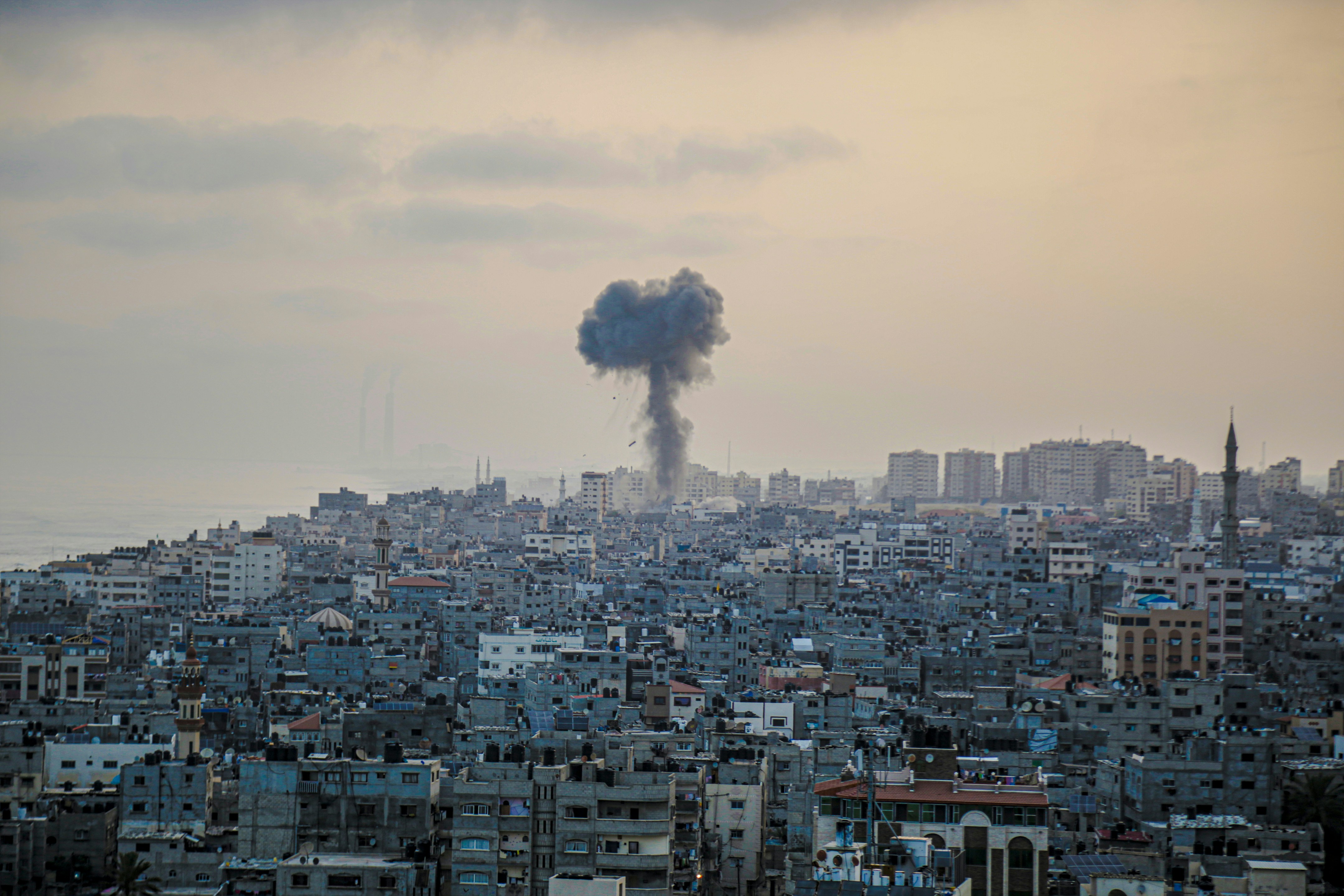
Photo by Mohammed Ibrahim on Unsplash
Disclaimer: Material published by Traversing Tradition is meant to foster scholarly inquiry and rich discussion. The views, opinions, beliefs, or strategies represented in published articles and subsequent comments do not necessarily represent the views of Traversing Tradition or any employee thereof.
- Darul Qasim, “Wilāyah and Its Implications for Islamic Bioethics,” Ahsan M. Arozullah and Shaykh Mohammed Amin Kholwadia, 2018. [↩] [↩] [↩]
- The Qur’an, 2:11–12, 2:143, 3:104, 3:110. Translation by M.A.S. Abdel Haleem. [↩] [↩] [↩]
- Al Jazeera, “AI-assisted Genocide: Israel Reportedly Used Database for Gaza Kill Lists”, April 2024 [↩]
- +972 Magazine, “Revealed: The Israeli army’s AI-powered kill list in Gaza,” April 2024. [↩]
- Al Jazeera, “Updates: Israel Kills Dozens in Gaza – “This is a War of Extermination”, April 2025. [↩]
- Middle East Eye, “Gaza Death Toll Reaches 48,264: Health Ministry”, February, 2025. [↩]
- UN OHCHR, “Experts warn of genocide in Gaza,” October 2023. [↩]
- The Intercept, “Google and Amazon Employees Protest Project Nimbus,” April 2024. [↩]
- The Guardian. “Microsoft Deepens Ties With Israeli Military Amid Gaza War,” January, 2025. [↩]
- Associated Press. “AI usage by Israeli military spiked 200x after October 7, Microsoft & OpenAI tools included.” [↩] [↩]
- American Friends Service Committee (AFSC). “Microsoft’s ties to Israel’s military-industrial complex.” [↩]
- Economic Club of New York. Mustafa Suleyman transcript, 2023. [↩]
- AP News. “Microsoft fires employee protester over Gaza-related AI contracts,” April 2025. [↩]
- The Guardian, “Google Fired Me for Opposing Israel Contract,” Ariel Koren, 2022. [↩]
- AP News, “Microsoft Workers Say They’ve Been Fired After 50th Anniversary Protest Over Israel Contract”, April 2025. [↩]
- “Microsoft Fired Over Gaza Vigil Say Company ‘Crumbled Under Pressure’”, November 2024. [↩]
- Time, “Exclusive: Google Workers Revolt Over $1.2 Billion Contract With Israel”, April 2024. [↩]
- NBC News, “Google fires dozens of workers after sit-ins,” April 2024. [↩]
- The Irish Times, “Court rules against Wix in unfair dismissal case,” August 2024. [↩]
- Al-Ghazālī, “Iḥyā’ ʿUlūm al-Dīn”, Book of Knowledge. [↩]
Amine Mahdawi
Mahdawi is a writer and researcher with a graduate background in Middle Eastern Studies. His academic work has focused on notions of resistance, the nation-state, and Arab nationalism in the modern Arab world as well as the Islamic intellectual tradition. He writes critically on Islam, global politics, and history. When he’s not writing, he is engaged in historical study and is also a student of the traditional Islamic sciences.
Leave a Reply