
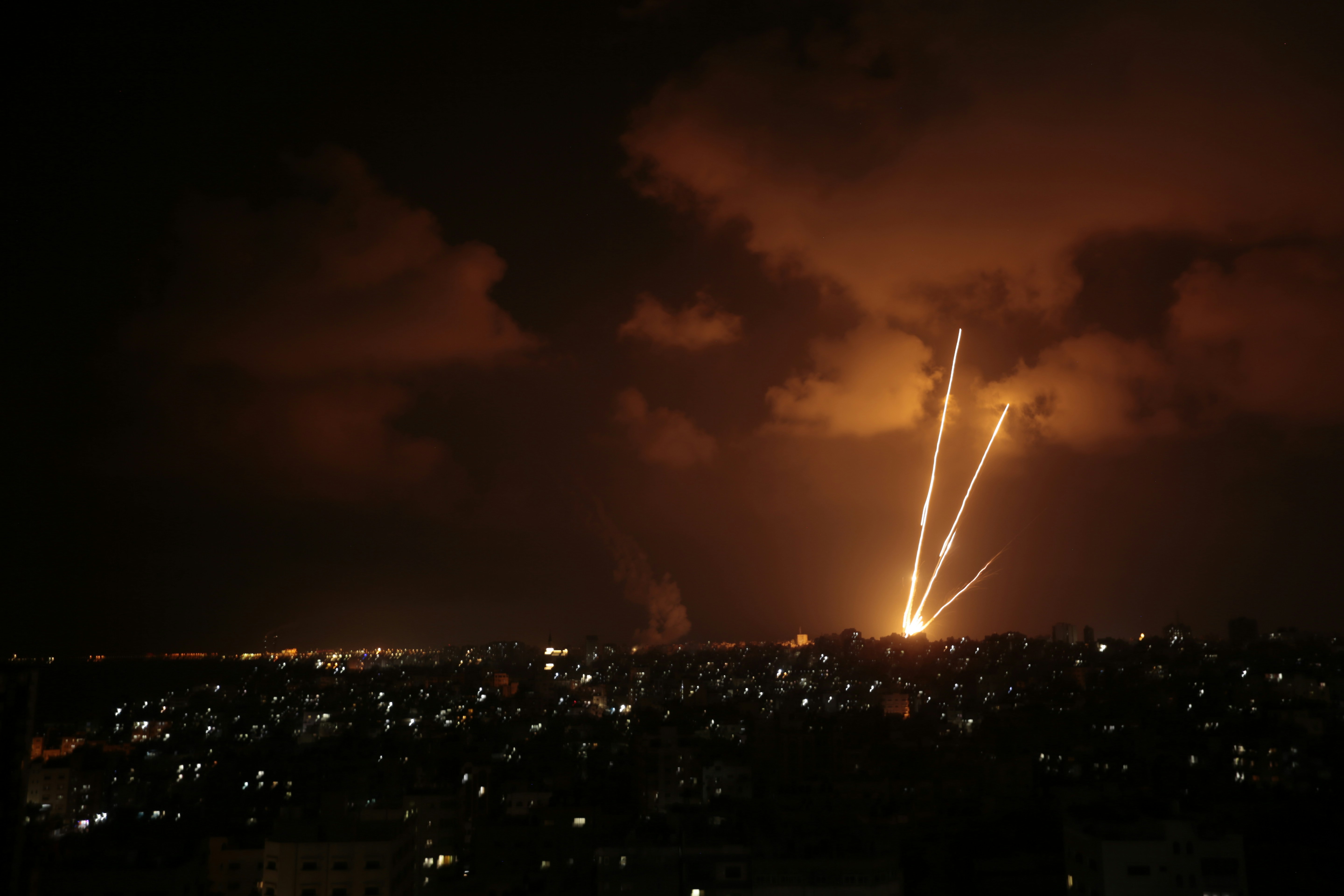
The current tragedy unfolding on our brethren in Gaza is taking on new levels of evil day by day. Evil that is manifested in its most crude form that our generation has ever seen. But what is that impulse which allows man to commit such heinous acts without any moral reconsideration?
Moroccan philosopher Taha Abdurahmane calls this Sharr al-Mutlaq (Absolute Evil). He defines Absolute Evil as something “that cannot be reasoned, conceived, imagined, understood, described, attributeless, nameless and wordless…something which gets worse by every stage beyond human imagination…”. It is a type of evil from which all other smaller evils emanate, an absolute which acts as the precedent for its various particulars—this is what has unleashed itself in the form of Jewish-Zionist onslaught of Gaza.
He goes on to state that this type of Evil is beyond normal human reasoning,1 echoing the words of the 20th century American philosopher Hannah Arendt who considers Utmost Evil as something whose manifestation necessitates the suspension of one’s ability to think or reason.2
Taha summarises it as a state of suspension of reason and then further builds on it from an islamic paradigm of evil.)) Taha goes a step further and proposes that we need a new, upgraded form of “reason” to contextualize and understand this kind of evil. This new reasoning can only be conceived by reorienting ourselves towards Divine Perfection (al-kamal al-ilahi), because Absolute Evil in its essence is an opposing force to Absolute Perfection or Good, an antithesis of the Divine Will. One can’t comprehend any form of goodness, be it values like justice and rightful resistance, without going back to the absolutes which are found in the entity of The Exalted and Just. Any attempt to resist this evil or even criticize it should take the course of this reasoning. Otherwise, it’s just frail activism.
Taha then mentions that the aim of this Absolute Evil is not just to maximise physical human suffering but rather to violate the innate human nature (fitra) itself, which is the vessel of values ingrained in Mankind. He delineates it into three spheres:
- Violating the values that preserve human dignity, an area where the human is stripped of any sanctified value into a biological unit which can be violated in any way it satisfies the Absolute Evil. Voices dehumanising the Gazan Man and justifying the killing of babies are louder than ever.
- Violating the values that preserve the sanctity of the place until the right to exist there is denied and restricted and the world is opened up to plunder and occupation the way the Absolute Evil wants—violating human freedom in every moment of its existence.
- Violating the values that preserve the remnants of time until mankind’s memory is blurred to the extent that values, ethics and goodness are forever tainted from his memory, unable to distinguish good from the evil, oppressor over the oppressed, Divine over Satanic, and thus can be bent in any way it suits the Absolute Evil. The frail justifications of Zionist apologists and politicians on public display bear witness to this fact.
A miraculous fact is that the worst form of this violation is unleashed in the Holy Land (Bayt al-Maqdis), a violation of the last degree. The ultimate violation directed to the human fitrah in its numerical entirety: “Absolute Evil is not satisfied until the innate nature (fitra) is destroyed…Absolute Evil aims to remove us from humanity not just strip from us some attributes of humanity.” This is what Taha calls Radical Extermination and not just genocide, where the slaughter of humanness is the goal with one of its means as the slaughter of humans. An Ibleesian echo of degrading humanity of its true nature and status.
Taha then directs our attention to a uniquely miraculous phenomenon of our age, i.e., “The Perfect Man (al-Insan al-kamil) today is the Gazan Man.” He reiterates the eschatological narration where the Holy Prophet ﷺ is reported to have said: “So hold fast to jihad, and the best of your jihad is Ribat (i.e. guarding the frontier in the face of enemies), and the best and most virtuous of your Ribat is ‘Asqalan (Ashkelon).” (Reported by Tabarani, al-Kabir)
The Prophet ﷺ used the word ribat, which implies someone who is stationed on a guard post or someone who keeps an eye (murabit). The narration declares that near the end of times the best among the Sentinels (Murabitun) will be found in Asqalan, a city near Gaza.
Taha highlights this important fact that in the Divine scheme of things, the Gazan Man is chosen as the manifestation of Divine Perfection in the face of Absolute Evil, a necessary arrangement in and of itself as a showcase of Divine will in order to re-vitalise (tajdid) values for mankind in its entirety.3 The Gazan Man has become the teacher for humanity, a teacher whose harming is equivalent to the harming of the whole of Mankind, though even in his harm he doesn’t fail to represent the Absolute Perfection with which he is bestowed and made responsible of.
The Palestinian Sentinel (Murabit) at this point is serving on two fronts. (i) Re-vitalising the values for humanity and (ii) liberation of man in the world. This responsibility is bestowed upon as a result of the Absolute Perfection to deal with the Absolute Evil, such is that the sanctity of the Palestinian Murabit sanctifies every place he resides in whether in the ghettos of Gaza or in the caves underground. Such is the Perfection of Gazan Man that whatever he does becomes a manifestation of the Divine Will, a congruence between theory and praxis, the realisation of the Muhammadan Way. This exceptional metaphysical nature of the land of Palestine and its people deserves a separate discussion in itself.
“And you threw not, when you threw, but it was God who threw…” (Qur’an 8:17)
“When I love him I am his hearing with which he hears, his seeing with which he sees, his hand with which he strikes and his foot with which he walks.” (Reported by al-Bukhari, Jami al-Sahih)
The presence of Absolute Evil is not a new phenomenon nor is it something for which we don’t have a solution for, but rather it is the reincarnation of Pharaonic policies supported by those stripped of their humanness (fitrah), any attempts at pragmatism with this evil will end in utter failure. As historical precedents, whether Firaun or Thamud, have shown us, they were annihilated into complete oblivion and not accommodated in the Order. The Qur’an is filled with examples of some of the best people mankind has ever witnessed suffering at the hands of Absolute Evil but yet through Divine Will come out as the saviours of human nature and The Divine Word. The resistance of Palestinian people is now transferred to the rest of the Muslim nation (ummah) in a way that necessitates not just the saving of human lives but rather humanness itself which is the basis of the Divine word. Resistance against Absolute Evil and any of its lower forms has now become an individual obligation (Fard Al-Ayn) which, if not undertaken, doesn’t only jeopardize life but the religion of the nation itself. We need to strengthen our posts and upgrade our guards more than ever. Hence the words of the The Prophet of Fierce Battles ﷺ:
“Whoever fights so that the word of God be supreme is indeed in the cause of Allah.” (Reported by Muslim, Jami al-Sahih)
Resistance against Absolute Evil requires an orientation towards Divine perfection and its results necessitates the Glory of the Divine Word-empowerment of the innate nature (fitrah). There is no saving of religion without the saving of the fitrah and its upholders.
“Islam’s far reaching importance lies in the fact that it has not overlooked the existence of human suffering and the fight against suffering which is the crux of human history.” -Alija Izetbegovic
Disclaimer: Material published by Traversing Tradition is meant to foster scholarly inquiry and rich discussion. The views, opinions, beliefs, or strategies represented in published articles and subsequent comments do not necessarily represent the views of Traversing Tradition or any employee thereof.
Photo by Mohammed Ibrahim on Unsplash
- All the Taha AbdurRahmane references are taken from the lecture he gave at the Islam Düşünce Enstitüsü (IDE) Istanbul on July 28, 2024. This particular reference can be listened to @7:00. Link: https://youtu.be/EYRECav_F14?feature=shared&t=420 [↩]
- This is taken from her book Eichmann In Jerusalem (1964) where when describing the psychological state of one of the major Holocaust Perpetrators Otto Adolf Eichmann she mentions:
“The trouble with Eichmann was precisely that so many were like him, and that the many were neither perverted nor sadistic, that they were, and still are, terribly and terrifyingly normal. From the viewpoint of our legal institutions and of our moral standards of judgment, this normality was much more terrifying than all the atrocities put together, for it implied—as had been said at Nuremberg over and over again by the defendants and their counsels—that this new type of criminal, who is in actual fact hostis generis humani, commits his crimes under circumstances that make it well-nigh impossible for him to know or to feel that he is doing wrong.” ((p. 273 [↩]
- Refer to the video @20:59. Link: https://youtu.be/EYRECav_F14?feature=shared&t=1259. [↩]
A. Ali
Curious reader of academic and classical texts, doing Dawah since 4 years by the Grace of Allah.

Leave a Reply