
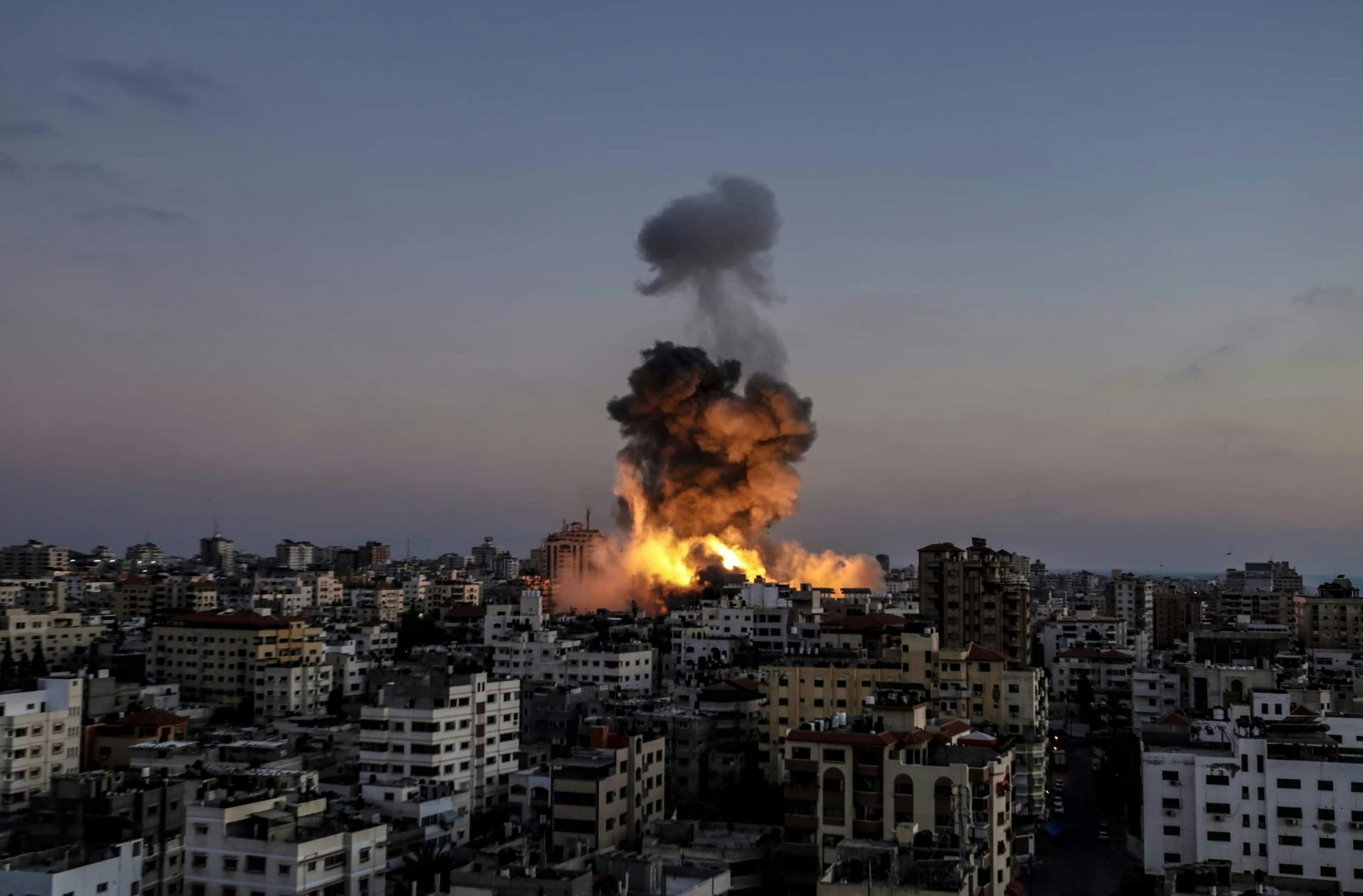
Growing up as a Muslim Palestinian in the West, particularly in a post-9/11 world, you find yourself subject to questioning, both regarding your identity as a Palestinian and your belief system as a Muslim. Growing up as the son of Muslim-Palestinian refugees in Jordan, I was taught about the Palestinian cause through the lens of Islamic tradition. That lens centered the divine imperative to defend Muslim holy sites like Masjid Al-Aqsa and honored the sanctity of Muslim lives, now shed daily under Israeli occupation.
Within that upbringing, we were taught that when it comes to matters of oppression and injustice, you name things for what they are. Why? Because the Islamic tradition requires moral clarity. Naming things for what they are, especially when injustice is involved, is more than a right; it’s a religious duty. Vagueness in such moments is often a sign of cowardice, complicity, or deviation.
Allah says in the Qur’an: “Do not mix truth with falsehood or hide the truth knowingly.” (Qur’an 2:42)
Within the field of Islamic jurisprudence, there’s a principle called tahqiq al-manat: accurately identifying and naming the reality of a matter before issuing a ruling. It’s a rigorous requirement in Islamic legal methodology to ensure one isn’t speaking generally or opining without precise understanding. It demands intellectual clarity, accurate categorization, and unambiguous identification of the manat (subject matter).
In Ihya Ulum al-Din, for example, Imam al-Ghazali dedicates extensive writing to the morality of speech, condemning ambiguity when it serves to mislead or evade the truth. He emphasizes intentional clarity and honesty, even when the truth is unpopular.
That commitment to clarity is intellectual, but beyond that, it is inseparable from the ethics of resistance we were raised with. Our upbringing emphasized the importance of struggle and resistance in all its forms, first and foremost armed resistance, but also ensuring that Israel was forced to defend itself on every front, not just the physical battlefield. A key part of that resistance was naming Zionism for what it is: Jewish supremacism. Unfortunately, over the past quarter century, that clarity has largely disappeared from Western Muslim discourse.
This article won’t try to convince you that Jewish supremacism is real. If you’ve been paying attention these last 22 months, you’ll have come to that conclusion on your own. You’ve seen synagogues auction off stolen land in the West Bank. You’ve seen Jewish-owned businesses fundraise for the Israeli military. You’ve seen Jewish day schools sign petitions backing ethnic cleansing. A recent Haaretz poll found that nearly 8 in 10 Jewish Israelis support the ethnic cleansing of Gaza.1
The evidence is obvious to anyone who’s been paying attention. And yes, there are exceptions, but that’s what they are: exceptions.
The problem has never been with the Jewish faith as a faith, nor with Jews as Jews. The issue is with those who’ve weaponized chosenness into supremacism, those who’ve built an ideological machine out of religious identity and now use it to justify ethnic cleansing, desecration, and occupation. It’s that supremacist current, now dominant across religious, political, and cultural institutions, that we’re naming for what it is.
How We Lost the Courage to Name
Having grown up in the United States, I caught a glimpse of the Muslim-American community before 9/11. Not all of it was good, but one underappreciated positive was that one thing was missing from our speech: fear. It wasn’t unusual to hear a Friday khutbah delivered with boldness. Part of that boldness was the clarity that Zionism was rooted in Jewish supremacism; and that Zionism, whether political or cultural, was preached from the pulpits of synagogues alongside the Tanakh.
Then came 9/11, that boldness disappeared, quickly replaced by the language of survival. And while survival is an instinct, living in permanent survival mode has exacted a cost that is not merely emotional or physical, but existential.
In a post-9/11 world, Palestinians were no longer allowed to properly name their oppressors. We were confined to the realm of half-truths, never permitted to call a spade a spade, either because it risked “alienating” liberal Zionist allies or because it was immediately conflated with the fascism that preceded World War II. A Jewish man, accompanied by Jewish armed soldiers, could barge in and steal your home, have that theft upheld by a Jewish judge in a Jewish court, and still you wouldn’t be allowed to say you’d been dispossessed by Jewish settlers.
You could have your entire family killed in an airstrike by bombs marked with the Star of David, dropped from aircraft bearing the same symbol, piloted by a Jewish man praised as devout in his congregation and backed by nearly every mainstream Jewish organization in the West, and still you wouldn’t be allowed to say that Jewish supremacism killed your family, maimed your child, or turned your loved ones into pieces of flesh you were left to collect in a plastic bag.
In response to this silencing, many Muslims in the West, consciously or subconsciously, turned to frameworks that were more palatable to Western audiences: capitalism, colonialism, and white supremacy. While these lenses offer useful insights, they’re ultimately incomplete for the Muslim.
One reason they fall short is that they stem from secular worldviews that lack divine grounding, which prevents them from identifying the true ideological engine behind the global protection of Zionism.
That engine is Jewish supremacism. If we can’t name it, we’ll never understand the exceptional status Israel holds, nor will we be able to resist it effectively.
Why the Lens Matters
The lens through which we view the world doesn’t just shape how we interpret events, it dictates what we recognize as truth in the first place. Two people can witness the same incident and arrive at opposite conclusions, not because of what they saw, but because of the framework through which they saw it. This isn’t mere philosophising; it’s a Qur’anic reality. Both Pharaoh and the magicians witnessed the miracles of Prophet Musa. Pharaoh responded with arrogance and defiance. The magicians responded with humility and submission. The difference wasn’t the signs, but the lens through which they the understood the miracles.
When we insist on viewing the world solely through secular, materialist, or class-based frameworks, we blind ourselves to the real nature of this conflict. Some claim Zionism is driven by capitalism, pointing to profits from the weapons industry. But if profit were the core engine, why does the war in Ukraine, which has brought greater financial gain to arms manufacturers, fail to provoke the same cultural protection, political reverence, and media censorship as Israel’s genocide in Gaza? Why is criticism of Zionism considered more dangerous than criticism of NATO? The answer: because it’s not economic. It’s ideological. Jewish supremacism gives Zionism a sacred status no other conflict enjoys.
Nowhere is the failure of secular analysis more evident than in how Western Muslims have interpreted the Abraham Accords.
(Side note: While I believe they should be called the Nimrod Accords to reflect their true nature, we’ll use “Abraham Accords” in this article for the sake of clarity, as that is the name by which they are most widely known.)
When filtered through secular or class-based paradigms, the accords are reduced to elite alliances—Israeli, Gulf, and American—serving capital, consolidating power, and reinforcing U.S. imperialism. That analysis isn’t wrong, but it is incomplete. It frames Zionism merely as a tool of empire, rather than recognizing it as an autonomous theological project with its own supremacist identity, eschatological vision, and sacred claims.
This reductionism is dangerous. It strips the conflict of its religious dimensions, divorces it from the ummah, and recasts it as a struggle among global elites. In doing so, it misleads us. Zionism functions not merely as a nationalist project, but as a racialized, theologically anchored movement with pronounced tribal dynamics. It’s uniquely aggressive, uniquely protected, and uniquely hostile to Islam, where it is more than about capital, but about creed.
“O believers! Take neither Jews nor Christians as guardians, they are guardians of each other.” (Qur’an 5:51)
Through the proper lens—the lens of tawheed and the reality of Jewish supremacism—the Abraham Accords are unmasked for what they truly are: not only political normalization, but an assault on Muslim faith. Their purpose is to erode the sanctity of Al-Aqsa, sever Palestine from its Islamic centrality, and recast the Palestinian cause as a godless, nationalist struggle divorced from the Muslim ummah.
This is ideological warfare, and unless we have the courage to name the force driving it, we’ll keep offering shallow, impotent critiques that neither confront nor disrupt the systems attacking us.
The Islamic Lens: Tawheed, Sanctity, Resistance
An Islamic framework doesn’t begin with the categories of state, capital, colonialism, or class. It begins with sanctity, obligation, and divine order. At its core is the belief that certain places, actions, and truths are sacred, not because society deems them so, but because Allah has sanctified them. Thus, Masjid Al-Aqsa is not sacred merely for its history or architecture, it’s sacred because Allah made it so. Its violation goes beyond a political provocation; it’s a theological offense.
Understanding this is essential to understanding Zionism. Zionism is not just a settler-colonial project; it is a theological assault that seeks to erase the sacred, desecrate what Allah has made inviolable, and replace it with a supremacist creed rooted in domination. Its purpose is not only the displacement of a people, but the uprooting of a deen, a divine way of life.
Islam names this clearly. It tells us not just what to oppose, but how to oppose it. It teaches that oppression isn’t just a sociopolitical phenomenon. It teaches us that it’s a rupture in the divine balance, an injustice that must be rectified or it becomes a darkness that spreads, in this world and the next.
The Prophet ﷺ said: “Oppression will be layers of darkness on the Day of Judgment.” (Sahih Al-Bukhari 2447, Sahih Muslim 2579)
This is the lens through which we must see. Not one blurred by secular abstraction, but one clarified by divine revelation; not one that dilutes resistance into vague calls for humanism, but one that anchors it in La ilaha illAllah—the ultimate declaration that sovereignty belongs to none but Allah.
“And who does more wrong than the one who prevents Allah’s Name from being mentioned in His mosques and strives toward their destruction?” (Qur’an 2:114)
The war on Gaza, then, is not just about land or borders. It is a war on Islam itself. And if we lack the courage to name it as such, we are not merely politically misled: we are spiritually lost.
Why Naming It Matters
You can’t fight what you won’t name. If you misname a disease, you mistreat it. If you misname an ideology, you misdiagnose your resistance. Naming brings clarity and turns confusion into action, otherwise, you’re swinging in the dark.
For example, if someone mistakes depression for laziness, they’ll try to fix it with guilt or discipline. But once they name it correctly, they can begin to heal. The same is true for political struggle. If we refuse to name the ideology behind our oppression, we’ll never confront it properly.
Naming Jewish supremacism clarifies the stakes. It clarifies that this isn’t just a material struggle over land or policy, but a battle over theology and legitimacy. Jewish supremacism, more than simply coexisting with capitalism and colonialism; commands and mobilizes their logic when needed. That’s why Zionism enjoys protections no other settler project does. That’s why, as of the writing of this article, there have been nine U.S. congressional hearings on “antisemitism” in the past 18 months, while the slaughter of Palestinians is treated as normal.
Naming the War on Islam
One of the most common criticisms of this approach is the claim that calling it Jewish supremacism is too abstract and thus won’t lead to concrete action. But this naming isn’t an exercise in the abstract; rather, it breaks the grip of liberal respectability politics and gives us the clarity and moral grounding to act with conviction. It tells us exactly what we’re facing and what it demands of us in return.
Palestine is the epicenter of this civilizational confrontation, but it’s not the entire story. This ideology has fueled hostility toward Islam far beyond Gaza. From the U.S. invasions of Iraq and Afghanistan, to drone warfare in Somalia and Yemen, to military support for India’s brutal occupation of Kashmir, to the silence around the ethnic cleansing of Muslims in Bosnia and Sudan, Zionist-aligned institutions and interests have played a direct role. Their influence doesn’t stop at funding bombs over Rafah, it extends into the Islamophobia industry, foreign policy think tanks, surveillance regimes, and lobbying groups that normalize war against Muslims worldwide. To reduce Palestine as a singular example of settler-colonialism ignores the deeper problem: civilizational confrontation.
This is why it’s dangerous to let our movements be shaped by the standards of liberal approval. Islam isn’t a side note in the Palestinian cause, it’s its backbone. The majority of Palestinians are Muslim, and today’s resistance is led by those who make their Islamic identity explicit.2 They quote the Qur’an when speaking of steadfastness and struggle. They invoke Isra’ and Mi‘raj when speaking of Masjid Al-Aqsa’s sanctity. To cast that aside in favor of frameworks rooted in secular, materialist theories—developed by thinkers who may have acknowledged religion as a useful mobilizer but never as divine truth—is to repeat the very mistake that gutted past liberation movements. This results in displacement of truth by narrative convenience, material struggle by symbolic politics, of resistance by aestheticized performance. Malcolm X laid bare this dynamic when he described how the March on Washington was neutralized:
“The original Black militants had planned to march on the White House, the Senate, and the Congress and to bring all political traffic on Capitol Hill to a halt, but the shrewd politicians in Washington, realizing that those original Black militants couldn’t be stopped, joined them.”
“By joining the marchers,” he said, “the white liberals were able to lead the marchers away from the White House, the Senate, the Congress, Capitol Hill, and away from victory. By keeping them marching from the Washington Monument to the Lincoln Monument, marching between the feet of two dead Presidents, they never reached the White House to see the then living President.”
This is exactly what’s happening when we’re pressured to dilute our critique of Zionism and told to reduce it to frameworks like capitalism and colonialism instead of naming it directly for what it is: Jewish supremacism.
We’re being kept marching between monuments, never toward the source of power. We’re told to speak of “imperialism,” “defense industries,” or “colonial structures” instead of coordinated actors with ideological commitments. We’re encouraged to hide behind abstraction, precisely because abstraction keeps power unchallenged. This is how power protects itself, not by silencing critique entirely, but by dictating the terms under which it’s allowed to be spoken.
No, This Is Not Just Another Theory
Yes, every framework involves interpretation, including ours. But it’s a false equivalence to claim that starting with the Qur’an and Sunnah is no different than starting with Marx or Fanon. Islam isn’t just another theory on the shelf. Our foundation isn’t man-made philosophy. Divine guidance is a comprehensive paradigm under which every other philosophy is subject to scrutiny as contingent human constructs measured against a revealed and transcendent standard. Where a framework begins shapes what it values, what it prioritizes, and ultimately, where it leads.
Some accuse this framing of ignoring capitalism and colonialism; it doesn’t. We’re not dismissing those forces, but we’re putting capitalism and colonialism in their proper place as tools. In this context, they’re instruments wielded by Jewish supremacism. As stated above, since October 7, the military-industrial complex has profited more from the war in Ukraine3 than from Israel’s assault on Gaza.4 Yet no state receives the level of political and cultural protection that Israel does. As I pointed out earlier, criticism of NATO is tolerated. Criticism of Zionism is monitored, censored, and increasingly criminalized. An explanation of economics alone doesn’t tell the full story, because the root is ideological, where the defense of Zionism isn’t only about profit or power but about loyalty to a shared supremacist identity.
Jewish supremacism is a political theology, one that asserts Jewish exceptionalism as justification for domination, dispossession, and violence. We’re not talking about Judaism the religion, or Jews as an ethno-religious community. We’re naming the supremacist ideology that has hijacked both and now directs power toward the systematic dehumanization of Muslims.
There are some in our own communities who fear naming this power. They worry it’ll close doors, alienate allies, or put us at risk. That fear is real, but it can’t be what defines us. Yes, there’s risk in speaking the truth, but the greater risk lies in silence: the loss of moral clarity of our tradition, and the continued desecration of our sanctities. If the price of acceptance is our refusal to name the ideology behind our people’s genocide, then we have to reject that acceptance. We’d rather stand in dignified exile than bow for a seat at a table built on our erasure.
A Call to Clarity
We were raised to speak the truth, even if it cost us access. We were taught that dignity isn’t found in being palatable to power, but in submitting to Allah, yet somewhere along the way, we began to fear the cost of clarity more than the consequence of silence. We worried more about being labeled than about being honest. So we hid behind academic jargon, watered-down slogans, and interfaith panels that demanded obedience in exchange for proximity.
If we’re serious about resisting Zionism, we have to be serious about naming what drives it. If we lack the courage to name it as Jewish supremacism, we’ll never find the strength to confront it. With clarity is not only the start of liberation, but a condition for it too.
Gaza’s 1,200 masjids weren’t obliterated, the adhan wasn’t silenced, and prayer wasn’t banned primarily and solely because of capitalism, colonialism, or white supremacy. Palestinians aren’t being branded with the Star of David in Israeli prisons5 primarily and solely because of those ideologies. And Israel isn’t naming its attack dogs after the wives of the Prophet ﷺ6 primarily and solely because of economic theory or racial hierarchies.
This is Jewish supremacism, waging a deliberate, targeted war against Islam and Muslims.
We can no longer insist on analyzing this primarily through detached, secular frameworks. We’re blinding ourselves. These theories might help explain systems, but they’ll never explain the desecration of our masjids, the mockery of our Prophet ﷺ, or the dehumanization of our Ummah.
Refuse to name the enemy, and you’ll never fight it. Keep intellectualizing genocide, and you’ll walk in circles—disoriented, ineffective, and complicit in delay—while the blood continues to spill.
Disclaimer: Material published by Traversing Tradition is meant to foster scholarly inquiry and rich discussion. The views, opinions, beliefs, or strategies represented in published articles and subsequent comments do not necessarily represent the views of Traversing Tradition or any employee thereof.
- https://www.haaretz.com/opinion/2025-06-04/ty-article-opinion/.premium/do-82-of-israelis-really-back-expulsion-of-gazans-the-data-tells-a-different-story/00000197-39da-da41-a9f7-3dde468d0000 [↩]
- https://traversingtradition.com/2023/11/20/thinking-palestine-through-islam-the-mirage-of-secular-dissent-as-epistemic-resistance-against-israel/. [↩]
- https://www.cfr.org/article/how-much-us-aid-going-ukraine. [↩]
- https://apnews.com/article/ukraine-aid-israel-gaza-taiwan-c0645ad3f47f9d919c8988a98593e887. [↩]
- https://www.timesofisrael.com/7-cops-to-be-charged-for-allegedly-branding-palestinian-with-star-of-david/. [↩]
- https://x.com/N12News/status/1736067161129439519. [↩]
Huthaifa H.
Huthaifa H is a Muslim Palestinian living in the United States who shares political commentary focused on the U.S. and the MENA region.


Leave a Reply