
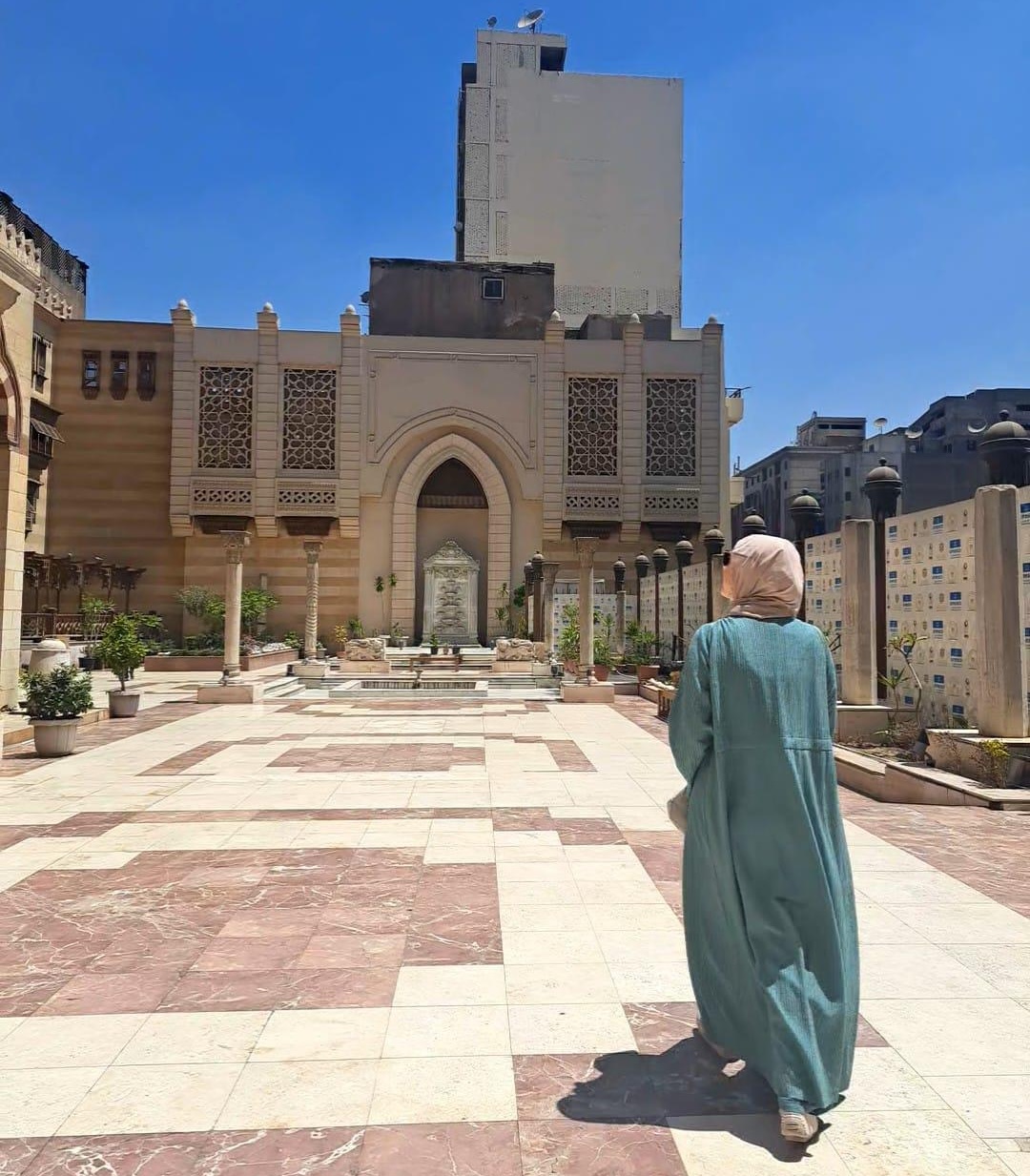
Traversing Tradition has been delighted to interview Ustadha Chloe Idris, one of the few Al-Azhar University students of New Zealander (Kiwi) origin.
Chloe Idris became Muslim in 2008 while completing a Bachelor of Fine Arts at Otago Polytechnic in New Zealand.
In 2016 she moved to Amman, Jordan to begin her Arabic studies, before moving to Egypt in 2017 where she is completing a Bachelor of Usul al-Deen majoring in Tafsir and Quranic Sciences at the prestigious al-Azhar University. During this time, she also completed the Advanced Jurisprudence Program in 2020 through Whitethread Institute.
Chloe has studied various Arabic and Islamic sciences with teachers at institutes around al-Azhar mosque, and her focus is on Hanafi Fiqh, Tafsir, and Qur’anic Sciences, with a particular interest in the structure of the Quran (‘Ilm al-Munāsabāt).
She currently lives in Cairo with her husband and son.
1. What first drew you, as a New Zealander, to pursue Islamic scholarship at Al-Azhar?
When I was in New Zealand, I had a strong desire to travel overseas and start studying Arabic and Islamic studies. There wasn’t much available to me locally, and at the time there were very limited online options, so traveling overseas was the only decent option if you wanted to pursue Arabic and Islamic studies. Al-Azhar wasn’t a specific goal that I had when I left New Zealand, but it was an opportunity that opened up to me after studying Arabic in Jordan, and it felt like the answer to my many duas over the years.
One of the things I appreciate most about Al-Azhar University is the curriculum and the mix of classical and contemporary subjects. I still have all my books from the Al-Azhar high school program, as I find them to be an invaluable resource and helpful for revision.
2. What are your areas of focus?
My degree is a Bachelor of Usul al-Deen, majoring in Tafsir and Qur’anic Sciences. I also focus on Hanafi Fiqh in my private studies.
3. What inspired your focus on Tafsir (Qur’anic exegesis) specifically?
For me, everything comes back to the Qur’an. Before I became Muslim in 2008, I read a translation of the entire Qur’an, and I was struck by how different the Qur’an was to any other book I had read. The unique structure of the Qur’an, how the stories of past nations and Prophets are interwoven with legal rulings and spiritual insights, it felt like a tapestry; when I stood back I could see the beautiful big picture, and when I came close I could see all the intricate details. This feeling only intensified as I learned Arabic and began to appreciate the Qur’an on a whole new level as well.
4. What Tafsir texts do you recommend for beginner students to study?
For beginner students who know Arabic, I recommend Safwat al-Bayan by Shaykh Hasanain Makhlouf (former Grand Mufti of Egypt), and Safwat al-Tafasir by Shaykh Muhammad Ali al-Sabuni (a Syrian Azhari scholar). Both are contemporary works in 1-3 volumes depending on the edition, and the Arabic is easier for beginner students to understand (as opposed to the more advanced Arabic in classical works).
Safwat al-Tafasir by al-Sabuni is arranged nicely in that it includes a brief introduction for each surah where the author discusses the structure of the surah, the reasons for its revelation (asbab al-nuzul), and beneficial linguistic and rhetorical points (balagha), where relevant.
5. Were there particular scholars who left a lasting impression on you during your time in Cairo?
Many scholars have impacted me in different ways, but I’ll mention two: Dr. Mahmoud Abideen al-Azhari, and Shaykh Muhammad al-Sha’rawi (may God have mercy on him).
I was fortunate to attend an intensive course in Qur’anic Sciences with Dr. Mahmoud Abideen. We had daily classes for a few hours for around a month, and I was the only woman who attended. I always appreciated how he welcomed me and prioritised any questions I had. There were a couple of days I had to bring my young son to class with me, and one of these days I had to leave the class early because my son was starting to fuss. I remember packing up and leaving, only to notice that 10 minutes later all the other students were leaving as well – the Shaykh had finished the class early. I don’t know whether he did it for me or not, but I appreciated it all the same.
Shaykh al-Sha’rawi passed away years before I was even Muslim, but his smiling face is seen everywhere in Egypt, even on microbuses and on posters at bakeries. I’ve had many conversations with Uber drivers about him and it’s easy to see the influence he had on the Egyptian people, even all these years later. His tafsir classes were famous, and I hope to be able to teach with the same level of passion and love for the Quran as he did, inshaAllah.
6. Al-Azhar University, to many Muslims outside of Egypt, is often equated solely with traditional Islamic scholarship but the reality is far more complex. Could you demystify the broader structure of Al-Azhar, from its primary school system to its colleges of medicine and sciences, and the online track and Riwaq track?
There are many ways to study at Al-Azhar: Al-Azhar Mosque offers classes that are available to the general public, as well as a 4 year program (Riwaq). Students who complete the 4 year Riwaq program study the traditional sciences under qualified shuyukh and receive a qualification, however, this is not a Bachelors degree.
Al-Azhar University offers degrees (Bachelors, Masters, PhDs) in Arabic and the Islamic Sciences, as well as other typical University programs (Medicine, Humanities, Media, etc). There are different faculties that a student can enter into, such as: Shariah, Usul al-Deen (majoring in either Tafsir, Hadith, or Aqidah), Arabic Language, Islamic Studies, and Da’wah.
In order to enter into the University, foreign students typically need to complete the primary and secondary school program at al-Azhar through Ma’had Bu’uth, an institute that prepares students for university-level study. This institute is specifically for foreigners, and takes 1-6 years to complete in total, depending on how high the student scores in the placement exams. If a student studies well in preparation for these entrance exams, they typically only need to be at the institute for 1-2 years. The primary and secondary school curriculums cover a variety of subjects in Arabic and Islamic studies, as well as general subjects such as history and geography.
Al-Azhar also offers an online degree for a Bachelor of Islamic Studies. The 4 year program has a very comprehensive curriculum, however the tuition fees are much higher than the (minimal) fees of the on-site University, and only the one degree is offered.
7. As a follow up, how can one distinguish a scholar from a graduate of its other programs? In other words, are all Azhar graduates, scholars?
Not all Azhar graduates are scholars of the Islamic Sciences, as Al-Azhar University offers many other programs (like Pharmacy, Humanities, Media, etc).
If a student is a graduate of Islamic Studies, this also doesn’t automatically mean they are scholars.
Like all degrees, it is entirely possible to scrape through the program by simply meeting the bare minimum to pass. In my time at Al-Azhar I’ve met all types of students, and while some students may be there just to pass the time, there are many students whose love for sacred knowledge is evident in their passion and dedication to their studies.
8. What misconceptions do people have about studying in Cairo?
Many students expect to come to Cairo and hit the ground running with their studies, but it can take a while to find teachers and classes, and build those connections. Life in Cairo can often be more difficult and frustrating than Western students expect, especially when it comes to administration.
Also, people can be surprised sometimes at the level of religiosity amongst Egyptians. Here in Cairo, you’re just as likely to see women not wearing hijab as you are seeing women wearing niqab, as well as decorations for Christmas and Rabi’ al-Awwal (the Prophet’s birth month, peace be upon him). Sometimes, Western Muslims expect Muslim-majority countries to have a certain standard and type of religiosity, and it can be jarring to them when they realise things aren’t what they expected.
9. Can you describe what it was like being a wife and mother while studying at Al-Azhar? How did those roles and responsibilities shape your approach to seeking knowledge?
My husband has always been my biggest supporter when it comes to my studies, so being a wife while studying was never difficult, Alhamdulillah. My son was born during my first year at Al-Azhar University, and it honestly took me a few years to find my feet when it came to balancing studies and motherhood. I found myself with a lot less time to study, but through this I found a lot of clarity. There is an abundance of good study opportunities here in Cairo, and many students end up taking on too much at once. Since I had my son, I became very aware of how limited my time was, so I found it easy to say no to many study opportunities in order to focus on the study that was most important to me.
I have also found that when I do my best to parent mindfully and with ihsan, there tends to be ease in my studies, Alhamdulilah. There have been many times I’ve been up all night with a sick child the night before an exam, only for that exam to be my best one. Tawakkul is key when it comes to parenting and studying!
10. How did you and your husband support each other as fellow students at Al-Azhar? Were there moments where your paths of study overlapped or diverged?
Our study paths overlapped at the beginning, and then diverged; our first year we were studying Arabic together in Jordan (the institute was small so men and women were together), and then when we came to Egypt, we studied together with a teacher to prepare for the Azhar entrance exams. Once we were accepted into the Azhar school program (Ma’had Bu’uth) we studied separately, as there are different campuses for men and women, both at the Ma’had and the University. Our study focus also differed when we began at the University: his focus is Islamic Law and Legal Theory, specifically in Shafi’i fiqh, and mine is Tafsir, Qur’anic sciences, and Hanafi fiqh.
Even though our courses and classes are different, the habits and lifestyle of being a student is the same, and this is one of the perks of being married to a student of knowledge as a student yourself. They understand what is required in order to be successful on this path. We do our best to look for ways to facilitate study for each other; my husband might have early morning classes, I might have weekend classes. We have fun visiting bookstores together. We balance study time and parenting, particularly around exam times. It’s a shared goal, so we are both invested in each other’s success.
11. What challenges did you face as a female foreign student at Al-Azhar?
The challenges I faced were never due to gender, Alhamdulilah, rather they were challenges that all foreign students experienced, and often the Egyptian students would face these same difficulties as well. It’s important to be resilient as a student of knowledge, especially when entering the Al-Azhar system and dealing with administrative matters.
The process of applying to Al-Azhar can be convoluted and confusing: I applied in May 2017, but wasn’t accepted to sit the entrance exams until September 2018. During that time, I continued my studies privately, but I never knew when the exam would be. “Next month inshaAllah” was something we heard a lot!
General administration was difficult as well. One year I spent two full days squashed in a queue to pay my yearly fees, without success. There were approximately 200 women trying to pay as well, and only one employee processing payments. Things like this can be frustrating, as you often end up missing classes in order to complete the necessary admin work.
It’s not uncommon for classes to be taught in the Egyptian dialect, so this can be difficult for foreign students (especially at the beginning), when their entire Arabic journey has been focused on learning Classical Arabic (Fusha). The Azhar books are all written in Fusha, but they’re often not printed and made available to students until at least halfway through the semester, so this is an added challenge.
12. What are your plans after Al-Azhar?
I have finished my degree, Alhamdulilah, but I know that this is only the beginning of my study journey. These years of study have given me the necessary tools and allowed me to build a strong foundation, so that I can continue my studies to higher levels and continue benefiting from the scholars here in Egypt.
We hope to stay in Egypt for a few more years inshaAllah, and I plan to spend this time revising and solidifying my previous studies, and attending more classes with Azhari scholars. I also hope to teach more, so that I am better able to benefit my community when we eventually return back to New Zealand, inshaAllah.
I ask Allah swt to give us success in our studies, and to make it easy for all students (and aspiring students) to gain access to sacred knowledge.
Disclaimer: Material published by Traversing Tradition is meant to foster scholarly inquiry and rich discussion. The views, opinions, beliefs, or strategies represented in published articles and subsequent comments do not necessarily represent the views of Traversing Tradition or any employee thereof.

Leave a Reply