
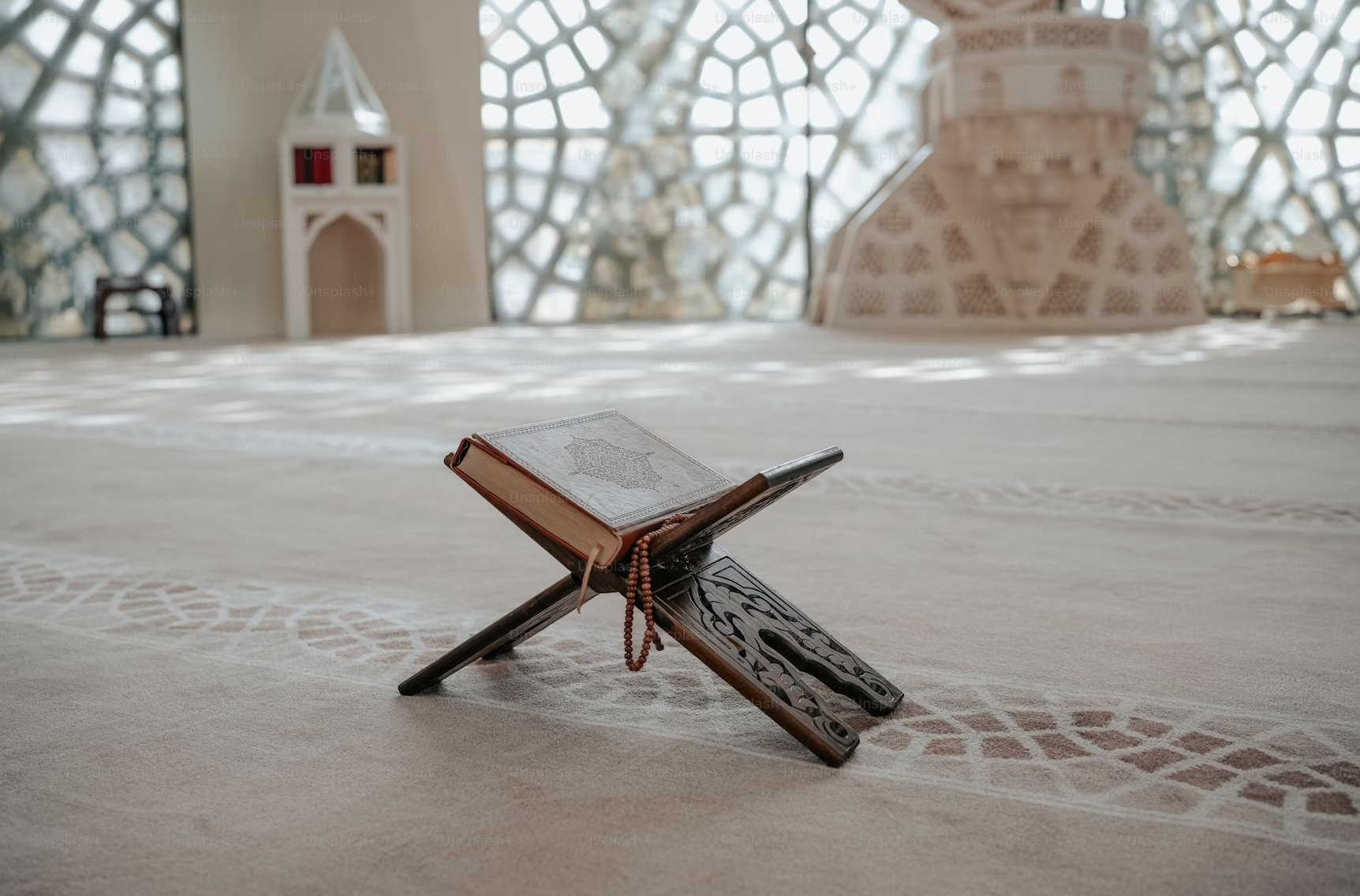
The following is a transcript of a webinar delivered in December, 2024 with Mawlana Faraz Abdul Moid. He explored the prophetic imperative of seeking knowledge, the challenges Muslims face in pursuing organized learning today, and how Darul Qasim’s Muslim Academic Revival Series (MARS) addresses those needs. Registration for Fall 2025 is now open, with the deadline on Friday, August 15. You can learn more and register at: https://darulqasim.org/mars/.
Mawlana Faraz Abdul Moid serves as a faculty member and Assistant Dean of Students at Darul Qasim College in Chicago. He completed his undergraduate studies at St. Louis University and the University of Illinois at Chicago before pursuing higher Islamic sciences at Darul Qasim, where he specialized in tafsir under Shaykh Amin Kholwadia, Maulana Kamil Uddin, and Shaykh Issam Eido. He lectures on a range of subjects and is actively involved in guiding students on their journeys of Islamic learning.
1. Many people are familiar with the hadith that seeking knowledge is obligatory upon every Muslim. We often hear this from scholars, imams, and da‘wah workers. Can you help us understand this obligation? To what extent does it apply for the average Muslim, and what does it look like in practice today?
To understand our conception of knowledge and education, we have to go back to the beginning of Islam.
Before the Prophet ﷺ came, that period was called the era of ignorance, Ayyam al-Jahiliyyah. Jahiliyyah simply means the absence of knowledge. Humanity, despite having knowledge of the cosmos, lacked the most essential knowledge: that which connects this world to the hereafter.
The coming of the Prophet ﷺ marked the end of Jahiliyyah. What distinguished the prophets, including Rasulullah ﷺ, from other human beings was their knowledge—divine knowledge through revelation. This knowledge cannot be attained through sensory perception or rationalization alone; it is informed knowledge, given directly from Allah.
The Prophet ﷺ is described as a Nabi, a title rooted in naba, meaning important news or knowledge. He became the source of illumination, education, and enlightenment for humanity.
The Prophet ﷺ said:
“Seeking knowledge is an obligation upon every Muslim.”
(Sunan Ibn Mājah 224)
Knowledge is not something with an endpoint. It’s not a particular point that you come to and then you say that I am now knowledgeable. It is a lifelong process. There is a saying from the Salaf: min al-mahd ila al-lahd, from the cradle to the grave. I once mentioned this, perhaps during a presentation or some conversation with our teacher and the founder and president of Darul Qasim, Shaykh Amin Kholwadia. And interestingly, he said, no, knowledge is not from the cradle to the grave because there’s more knowledge that you gain in the grave. In the barzakh, when the soul experiences angels and realities of the unseen, knowledge grows. On the Day of Judgment, people will gain further knowledge by witnessing with their own eyes what they had only heard about.
But consequential knowledge—the knowledge that informs action, worldview, and practice—is to be gained in this world, from cradle to grave.
Even the Prophet ﷺ, though given perfection and complete guidance, was commanded by Allah in the Qur’an:
“Say: My Lord, increase me in knowledge.”
(Qur’an 20:114)
This is the only thing in the Qur’an the Prophet ﷺ was explicitly commanded to seek increase in—not wealth, not sustenance, but knowledge. If the most knowledgeable of creation was commanded to ask for more, how much more do we need to?
So seeking knowledge is not a secular endeavor. All knowledge is from Allah—whether of the cosmos or the sacred sciences. Everything points back to Allah. Engaging in education is therefore a prophetic act. And when it comes to sacred knowledge specifically, the knowledge of this world and the next, that is an obligation we must continuously pursue. There are multiple modes of learning and different ways of deepening our understanding—what is known as external knowledge and internal knowledge. Regardless of the form, the pursuit is essential, and it is most effective when undertaken in an organized, methodical, and systematic manner.
2. What advice would you give to people who may feel intimidated by the vastness of the Islamic tradition? Some might be hesitant to take that plunge, even if they feel the desire. Others who are already studying might feel burnout. How should they begin or push forward?
The Islamic tradition is enormously vast. Instead of feeling intimidated by that, I see it as something to enjoy for an entire lifetime. Think of it like a football game: the game lasts 60 minutes—four quarters, fifteen minutes each. The anxiety for the player comes when thinking about what happens after the game ends. What comes next, after the moment of enjoyment?
Seeking knowledge is different. The Prophet ﷺ said there are two types of people who are never satisfied: the person who seeks wealth and the one who seeks knowledge. Neither is ever satiated. But for the seeker of knowledge, this is a blessing. Knowledge is an endless ocean one can dive into, a lifelong opportunity. We even have stories of our predecessors who continued studying and teaching from their very deathbeds.
So the key is to change our perspective. Don’t compare yourself to others or feel that you need to know everything at once.
The real issue comes from how we approach learning today. For many Muslims in America, when they have a question about Islam, the first thing they do is search online. Some may ask their local imam, which is a sounder approach, but often we don’t have scholars readily accessible.
This online, piecemeal way of learning is haphazard and scattered. We call it intishar—being spread out without order. That disorganization creates confusion and intimidation, because you don’t know where to begin, how to continue, or how the pieces fit together.
Think about how children learn math. There’s a curriculum: numbers first, then basic arithmetic, then multiplication and division, followed by geometry, algebra, pre-calculus, and so on. Step by step, in a structured way. Without that organization, learning math would be overwhelming. The same applies to Islam.
When learning is scattered (something from here, something from there, sometimes in the morning, sometimes on weekends) it leads to frustration and intimidation. But when you step into an arena where education is systematic, with a clear pedagogy and curriculum, the process becomes calmer. At level one, you are only expected to do level one work. You don’t need to perform at level five. As you progress, you move step by step.
That is why organized learning is so necessary. It not only brings the highest benefit but also removes the intimidation many people feel. Seeking knowledge is a lifelong endeavor, and with structure, it becomes a journey of growth rather than anxiety.
3. Before we get into the MARS program, can you give us a quick introduction to Darul Qasim College and the work it has been doing?
Darul Qasim College is based in Chicago, Illinois, U.S. It is the project and initiative of Shaykh Mohammed Amin Kholwadia. All of us at Darul Qasim—faculty, staff, and board members—have learned from him.
Shaykh Amin Kholwadia is a senior scholar, both in age, knowledge, and spirituality. He is originally from England and studied in various parts of the world before coming to the United States in the early 1980s, at a time when scholarship was practically absent here. Even the Muslim population in America was relatively small then, only growing significantly in the 80s and 90s.
Shaykh Amin began as a scholar engaging in the prophetic trait of ta‘leem. He spent years—decades—learning, and then shifted his focus to teaching while continuing to study under his teachers. That continued until the year 2000, when Shaykh Amin formally established Darul Qasim as an institute to provide structured, organized knowledge through classes, curriculum, and programs tailored to the needs he saw in the community.
One of the first programs open to the public was a tafsir session. That tafsir session continues to this day—24 years later—every Sunday.
As Darul Qasim developed and grew, it established what later became known as the Shaykh al-Hind Program, a program shaped by Shaykh Amin and his own teacher, Shaykh Dr. Khalid Mahmood, a great academic and spiritual scholar in England who passed away about four years ago. The Shaykh al-Hind Program, named after the scholar Mahmud Hassan (who was honored with the aforementioned title) was designed as a one-year program to provide the necessary knowledge required of the modern-day Muslim. It covers Arabic, Aqīdah, Qur’an and its sciences, Hadith and its sciences, fiqh, and enough of the fard ‘ayn that every individual must know.
Fard ‘ayn knowledge is the amount of knowledge obligatory for every Muslim to know. Beyond that is fard kifayah knowledge, knowledge required of specialists, scholars, and teachers in order to guide the broader community. To use an analogy: everyone knows how to use over-the-counter medicine like Tylenol or ibuprofen, but it is physicians who carry the specialized knowledge necessary to serve society as experts. That specialized level corresponds to fard kifayah.
The Shaykh al-Hind Program began producing students. Eventually, Darul Qasim expanded further and in 2015 launched a full-time curriculum to train scholars. Shaykh Amin himself already had many students who were scholars in their own right. Together, they established the ‘Alimiyyah Program, our intermediate and advanced program in the Islamic sciences.
This program offers both full-time and part-time study for those who wish to advance their knowledge at a specialist level. Alhamdulillah, it has been running now for about a decade, producing graduates. I myself spent years studying under these teachers and Shaykh Amin directly.
Most recently—last summer—Shaykh Amin began yet another initiative: the MARS Program, short for Muslim Academic Revival Series. This program is, you could say, a step down in academic level compared to the ‘Alimiyyah, but not in academic rigor. It is still rigorous, but without the barriers or prerequisites that can make advanced programs inaccessible. It was designed as an online program, open to anyone with a base level of intellectual maturity (at least age 18 and above). There are no entry requirements, no prerequisites.
It is part of Shaykh Amin’s broader vision. After having established the institute itself, the Shaykh al-Hind Program, the weekly tafsir sessions for nearly a quarter century, the ‘Alimiyyah Program for producing specialists, and even post-‘Alimiyyah specializations in fiqh and tafsir—with plans to expand to hadith and aqeedah as well—he saw the need to raise the bar for the entire Muslim community.
We already have a subset of people engaged in fard kifayah knowledge. But the literacy of the broader community as a whole also needs to be elevated. The MARS initiative was started for that very purpose.
4. What is meant by “academic revival”? How did the idea for this program come about, and why the choice of this title?
Earlier I mentioned how the Prophet ﷺ took the entire world out of the age of ignorance—Jahiliyyah—and into an age of enlightenment, knowledge, and education.
As the Ummah of Muhammad ﷺ continues, it goes through cycles. There are peaks, but there are also dips and troughs. These downturns happen when the Ummah moves away from Islam. Moving away from Islam has a consequence: neglecting the prophetic knowledge available to us.
The Prophet ﷺ told the Sahaba (Companions) that at the turn of every century, there will be a reviver (mujaddid), someone who will revive Islam for the Muslim community. Islam doesn’t disappear, but due to people’s ignorance and lack of practice, it can become covered, like cobwebs forming over something valuable. Then a person, or sometimes a group of people, comes along to revive the knowledge of Islam, which in turn revives its practice and application.
One way of expressing revival is with the word ihyaa, bringing life back. So the title “Muslim Academic Revival Series” rests on three words: ihyaa, Muslim, and academic. Ihyaa means giving life back to the Ummah. Academic refers to ‘ulum, the sciences of knowledge. This isn’t new knowledge we’re inventing; the peak of knowledge was with the Prophet ﷺ and the Sahaba. After them, it became a matter of preserving that knowledge, applying it, and answering new challenges of each time and place through it.
The Prophet ﷺ said in a hadith:
“This knowledge will be carried by the trustworthy of every successive generation, refuting the corruption of extremists, the distortions of falsifiers, and the interpretations of the ignorant.”
(Musnad al-Shāmiyyīn 588)
Revival happens when scholars safeguard and transmit knowledge in this way: removing the corruption of extremists who misapply Qur’an and Hadith, correcting those who innovate by attributing things falsely to Allah and His Messenger ﷺ, and refuting the interpretations of those who speak without knowledge.
For the revival of the Muslim Ummah to take place, the knowledge of Islam itself must be revived. That can’t remain the work of only a select few scholars; the entire community’s level of literacy must be raised.
With today’s resources (the internet, video, live teaching) Shaykh Amin saw it was time to use these tools to spread knowledge widely and elevate the literacy of Muslims everywhere.
5. There are many online initiatives today. How does the MARS program differentiate itself from other online courses or methods of studying the sacred sciences?
There are other initiatives people can benefit from, but I think the distinction of this program really lies in Darul Qasim itself. It is the level of expert knowledge that can be given in these academic fields.
The study of Islam has four core areas: theology, Qur’an, Hadith, and fiqh (Islamic law). Alhamdulillah, the way Darul Qasim is organized, we have expert-level scholars working within departments—‘Aqidah, Qur’an, Qira’ah, Tafsir, Hadith, Fiqh, Seerah, and even a History department currently being developed, all under the guidance of Shaykh Amin. The distinction of the MARS program comes from the distinction of Darul Qasim.
As for the program, firstly, it’s entirely online. Classes are literally streamed into your living room or study space. Of course, it’s best to set aside a proper spot and maintain adab (good conduct) with knowledge, but if circumstances prevent that, you can still log in wherever you are. This removes the hindrance of travel. Darul Qasim has two campuses, Glendale Heights and Hoffman Estates, both beautiful in their own ways. Many students still travel from out of town, even out of state, but for those who can’t, MARS makes access possible.
Also, there are no prerequisites. In our Shaykh al-Hind entry-level program, for example, students must at least be able to read the Qur’an fluently. But for MARS, even that is not required. Anyone can enroll. There is also no homework, no pre-reading before class, no assignments afterward. Any barriers or intimidation are removed.
Classes are recorded, so if you miss a live session, you have the entire week to catch up. In fact, I told some of my friends and acquaintances in the community who joined my section, “If you can’t log in at 8 p.m. each week, just listen the next morning on your way to work.” Chicago is known for long commutes. You can listen on the way to work, on the way back, even review lessons during your commute. It’s very convenient.
No one should feel hindered or intimidated. If something goes over your head, simply ask the teacher. People of all levels attend—sometimes complete beginners—and it’s completely fine to ask for clarification even on basic terms. That’s the kind of environment we aim to create in MARS.
What also stands out are the four different time zones. Each class is offered in four sections, with four different instructors, to serve students across the U.S. from California to New York, as well as in Europe, the Middle East, and Asia. We’ve had international students join—one Kashmiri student in our summer program logged in daily from New Delhi five days a week. For MARS, since it’s only once a week, it’s even more manageable. The recordings are always available. The platform we use, Canvas, is user-friendly and intuitive; you only need basic tech skills to access everything.
So the distinctiveness of MARS is this: it offers organized, systematic, rigorous academic learning of Islam. Not haphazard, not piecemeal, but structured, curriculum-based, and guided by pedagogy. It takes you step by step, from one level to the next. That’s what sets this program apart.
6. Fall 2024 was the first semester of the MARS program. What was the response from students, and what impact did it have?
The impact was felt right away, even during registration. The section I was teaching filled with 50 students, we actually had to cap it. Other sections, like the ‘Aqidah, class, also reached 50. On average, 20 to 35 students logged in consistently each week. Clearly, there was interest and strong engagement, not only locally but from the global community.
Darul Qasim is known internationally. For example, this past summer Shaykh Amin was invited to present at a university in Istanbul. People there already knew about Darul Qasim, so it’s not surprising that the MARS program drew international attention.
Students responded positively to MARS. Many were surprised by the organized, systematic way of teaching Islam. They weren’t used to that. Their prior exposure may have been Sunday school, Jumu‘ah khutbahs, MSA events, or online lectures—beneficial in their own way, but often scattered and haphazard. So when they encountered a structured approach, they were taken aback by how much organization and rigor it actually takes to impart Islamic knowledge properly. Some even felt overwhelmed by the amount of knowledge packed into just 15 weekly sessions. Remember: there are no exams, no quizzes, no homework, no requirements. You simply log in, learn at your own pace, take what you can, and ask questions if you need clarification. Even so, the depth and thoroughness of the material impressed the students.
Interestingly, some of the participants were themselves scholars, graduates of other seminaries. They joined as a refresher and also to observe how Darul Qasim organizes its curriculum and teaching.
The class I taught was on Qur’anic themes: the sophistication of wahy (revelation) and the complexity of some of our most basic beliefs. For example, we all learn from a young age that we believe in Allah, His Messenger ﷺ, and the angels. But beyond Sunday school knowledge of angels, most people don’t realize how complex the angelic realm truly is. The Qur’an contains a wealth of detail about the angels, their roles, and how they interact with both this world and the hereafter.
Presenting the Qur’anic view of that realm in a structured way left many students in awe. They appreciated not only the information but the method by which it was organized and taught.
7. We touched earlier on how MARS is meant to raise the baseline of knowledge for the average Muslim. What are the long-term goals of the program?
The long-term goal, first and foremost, is to raise the level of Islamic literacy. The vision with MARS is broad: it addresses the needs of the wider Muslim community. The idea is that if the general literacy of the Ummah is raised, then the next level—the level of specialized scholarship—will automatically rise higher as well.
This model is simple: every Muslim should fall into one of two categories. Either you are a teacher—an expert scholar engaged in ta‘lim—or you are a student. The first group will always be small, because not everyone has the ability to specialize. But the second group—students—should include everyone else. And when both groups are identified clearly, the community can unite around the pursuit of knowledge.
So the long-term goals of MARS are:
- To share valuable knowledge widely.
- To nurture academic excellence, deeply rooted in our turath (tradition).
- To raise the literacy of Muslims everywhere, so the community as a whole can move forward in its education.
By “tradition,” we mean the educational and da‘wah system established by the Prophet ﷺ, carried forward by his Companions, and preserved by subsequent generations. They always adjusted to the needs of their times and places, but without sacrificing the foundational principles established by the Qur’an, the Prophet, and the Sahaba.
Raising literacy serves both dunya (this life) and akhirah (the next life). Knowledge of Islam informs our afterlife, but also benefits us in this world. That worldly benefit becomes clear when we implement the Shari‘ah, but to implement it, we must first know it.
This connects to other initiatives under Darul Qasim, such as Al-Amin Ethics. That program highlights the beauties and benefits of Islam, showing how the Shari‘ah provides guidance and benefit not only to Muslims but to non-Muslims as well.
So the MARS program is part of this larger vision: bringing the benefit of Islam, through knowledge, to the entire world.
8. How do we choose which Madhab (school of jurisprudence and methodology) to study?
That’s an excellent question, and it highlights a big strength of the MARS program. At Darul Qasim, we currently have two full fiqh departments—Hanafi and Shafi‘i. InshaAllah, as we continue to grow in scholars, resources, and space, we plan to add Maliki and Hanbali departments as well.
Through MARS, however, all four madhahib are already being offered this semester (Hanafi, Maliki, Shafi‘i, and Hanbali) taught by highly qualified scholars.
Which madhab should you choose? The general rule is: study the one you already follow, so you can strengthen your understanding and practice. Fiqh is a very practical science—it governs daily life. So the madhab you live by is the one to study.
If you don’t know which madhab you follow, ask your local imam which one your community practices, and start there.
That said, some people are inquisitive and want to learn about other madhabs. MARS provides the perfect opportunity. You can register in another madhab’s class and explore its inner workings at an introductory level. That can be an excellent enrichment.
9. Where should we begin? What should we learn first?
That’s exactly what the MARS program is designed for.
If you don’t know where to begin, join MARS. It doesn’t require any prior knowledge. Remember, the four core subjects of Islamic learning are:
- Aqeedah (creed and belief)
- Qur’an
- Hadith
- Fiqh (Islamic law)
Our MARS classes are based on these four. In Fall 2024, we offered Aqeedah and Qur’an. This upcoming Spring semester, we’ll be offering Hadith and Fiqh. In Fall 2025, Aqeedah and Qur’an will be re-offered.
You can take them at your own pace. Begin with whatever is available—Hadith, Fiqh, Aqeedah, Qur’an—and continue from there.
MARS is for everyone. It’s introductory but still rigorous, informative, and structured. And it comes without the pressure of tests, quizzes, or grades. Those belong in our full-time and part-time curricula on campus. MARS is meant to give you that foundational entry point, in a calm, organized way.
For anyone interested, please visit daralqasim.org/mars to register for the program. If you’ve already registered, thank you—it will truly benefit your journey in learning the religion and the sacred sciences.
Disclaimer: Material published by Traversing Tradition is meant to foster scholarly inquiry and rich discussion. The views, opinions, beliefs, or strategies represented in published articles and subsequent comments do not necessarily represent the views of Traversing Tradition or any employee thereof.
Mawlana Faraz Abdul Moid
Mawlana Faraz Abdul Moid did his undergraduate degree at Saint Louis University (MO) and the University of Illinois at Chicago. He studied higher Islamic sciences at Darul Qasim College. After completing hadīth studies (dawrat al-hadīth), he matriculated into the Takhaṣṣuṣ fī al-Tafsīr program, specializing in tafsīr under Shaykh Amin Kholwadia, Mawlana Kamil Uddin, and Shaykh Issam Eido. Currently he is faculty at DQC as a lecturer and the Assistant Dean of Students.
Leave a Reply