
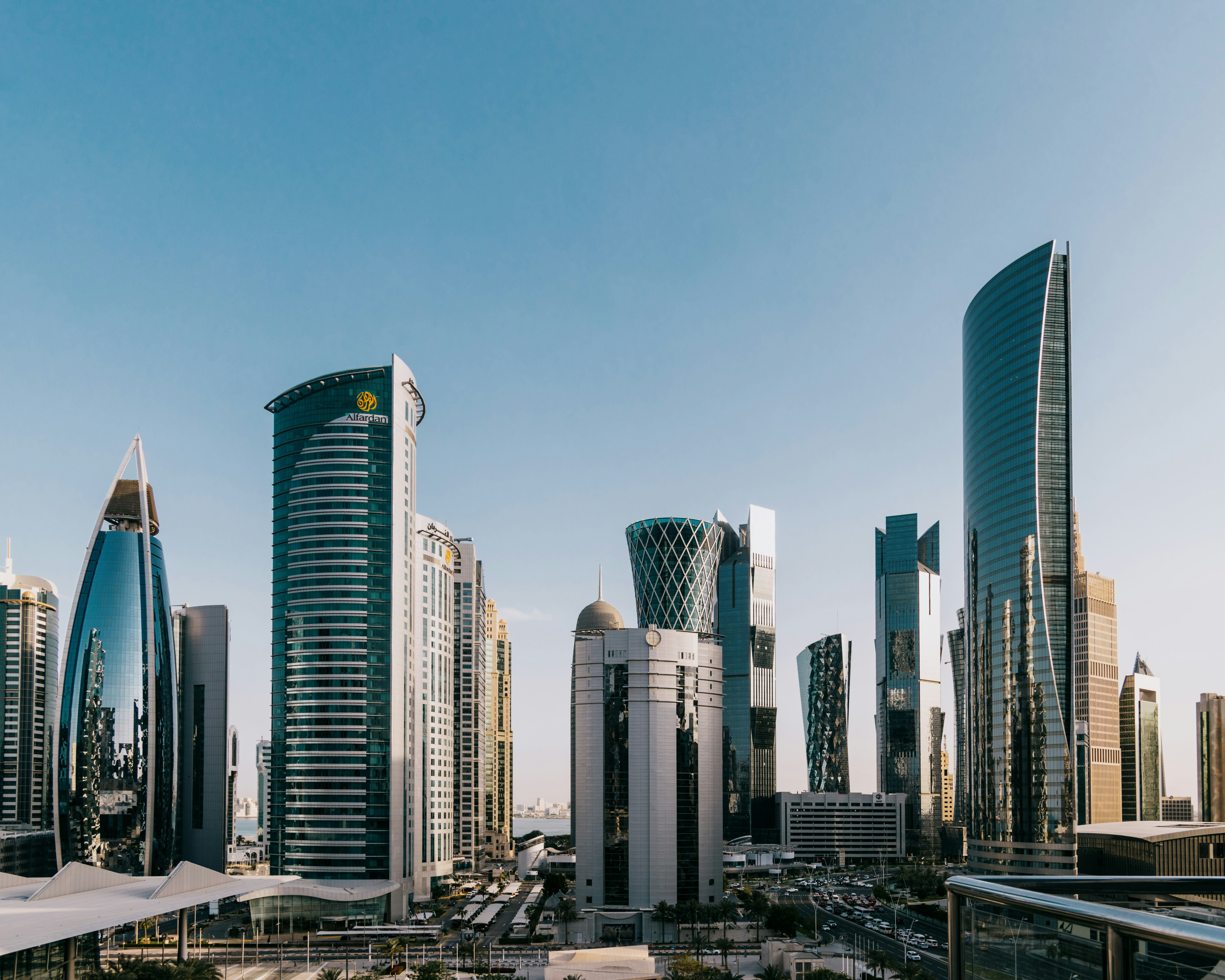
The leaders of 57 states from among the Arab League and Organization of Islamic Cooperation (OIC) gathered in Doha this month to make remarks on a course of action in response to the Israeli airstrike on the Qatari capital on September 9. In this latest aggression during which the Zionist entity targeted residential buildings allegedly housing Hamas delegation members and their families, Qatar joined the ranks of Palestine, Lebanon, Syria, Yemen, and Iran as the victim of an unlawful Israeli attack on its sovereign land in a clear violation of the standards of international law and human rights. While sanctions, war, and sectarian conflict have contributed heavily to the de-development of the aforementioned nations in recent decades, Qatar stands apart as one of the smallest yet most influential states in the region, being the richest country in the world by GDP per capita as well as the world’s second largest exporter of liquified natural gas (LNG) as of 2024.
Qatar has long resisted absorption into any particular ideological or transnational bloc, maintaining strong diplomatic relations with a host of neighboring countries and world powers even in times of crisis and opting for an opportunistic approach to both domestic and foreign policy development. By cultivating soft power through the global popularity of the Aljazeera media network and continuous mediation efforts on the part of the Qatari government across the region, the wealthy Gulf state has refined its status in the international sphere as a neutral but capable emerging force, supplemented not only by an intricate network of alliances and partnerships but its demonstrated economic formidability as well. Economic diversification efforts particularly on the part of the Qatar Investment Authority along with recent expansions into German and other European gas markets in the wake of the Russia-Ukraine war reflect Qatar’s commitment to developing soft power and the economic viability to fund hard power capabilities, a policy objective well-evidenced by the 434% increase to its military budget over the previous decade.
It is important to consider that Qatar’s neutrality as a means of not only building state legitimacy but also ensuring the protection of its sovereignty through overlapping diplomatic agreements has an extensive historical precedence reaching back to the Ottoman era. When the al-Thani dynasty first broke away from the rule of the Khalifas of Bahrain, an early commitment to anti-piracy efforts in the Persian Gulf with Britain coincided with the allowance of an Ottoman military base on Qatari land. These combined agreements legitimized al-Thani’s authority in the fledgling nation while also providing military protections from the Saud, Khalifa, and Nahyan forces seeking territorial expansion across the Arabian Peninsula at the time. This arrangement later served as a basis for the establishment of a British protectorate, effectively guaranteeing the al-Thani family long-term rule.
We can see a similar pattern emerging in Qatar’s contemporary foreign policy in which diplomatic efforts are used to stabilize national security and reduce external threats. The nation is now home to two of the largest American military bases in the Middle East, Al-Udeid and Sayliyah, while also hosting the only existing Turkish military command in the Arab world at the Tariq bin Ziyad air base. Despite continually escalating tensions between the United States and the Islamic Republic of Iran, Qatar has renewed reconciliation efforts between these powers while also expanding defense and trade agreements with them. While it has resisted normalizing diplomatic relations with Israel without the implementation of a cohesive two-state solution, Qatar was the first Gulf state to open an Israeli trade office in Doha in 1996 following the signing of the Oslo Accords, only to close it four years later in the wake of the Second Intifada and currently participate in ceasefire negotiations between Israel and the besieged Gaza Strip to end the ongoing onslaught in Gaza.
It comes as no surprise then that Sheikh Tamim bin Hamad al-Thani promptly called for the convention of an emergency Arab-Islamic summit in Doha to condemn the Israeli air raid and discern an actionable trajectory for the attending nations. Many leaders reiterated statements of condemnation and calls to action that ranged from the formation of an Arab-Islamic committee at the UN to complete severance of relations from the Zionist entity. The emir of Qatar’s opening remarks at the summit issued strong words of caution against the threat posed by Israeli expansionist violence, but notably absent was an explicit commitment to a material response to the Israeli strike. While accusing the Zionist state of attempting to hijack the ceasefire negotiations with the illegal attack, al-Thani concluded his speech stating, “For our part, we are determined to do everything necessary and permissible to us by international law, to preserve our sovereignty and confront this Israeli aggression.” The final communique issued from the organizers of the summit included measures for the foundation of a joint defense pact between a number of the participating nations, representing a preventative mechanism to mitigate future Israeli attacks. However, this strategy seems to fall short in light of the existing international agreements and UN conventions already in place that have demonstrably failed to restrain the state terrorism committed by the Zionist entity throughout the time of its existence.
The rhetoric expressed by al-Thani alongside fellow regional leaders present at the summit– including Egyptian president Abdel Fattah el-Sisi, who has continued to enforce the current Israeli-Egyptian blockade on Gaza while strongly condemning both the Israeli onslaught on Gaza as well as the attack on Qatar– continues to uphold Qatar and the greater Arab world’s legacy of “neutrality” and cautious abidance by international law. In his speech, Al-Thani emphasized the Qatari role in mediating ceasefire negotiations, presenting once again a nonaligned position ante what recent reports have estimated to be over 600,000 Palestinians murdered in Gaza in what the UN Independent International Commission of Inquiry on the Occupied Palestinian Territory has officially designated a genocide as of September 16.
In this context, continued restraint and caution reflect not a commitment to international standards of law and human rights, but rather a commitment to a foreign policy based in opportunism and deference to the hard power strategies exercised by larger nations, namely the United States. The secretary-general of the Gulf Cooperation Council (GCC) addressed the US directly in his speech at the Doha summit, urging not Qatar or any other nation present but the US government to intervene against further Israeli aggression on Arab land, a call that falls on deaf ears as US Congress approved a $510 million arms sale to the Zionist entity earlier today and Trump continues to ignore Israel’s genocide in Gaza and ethnic cleansing of the occupied West Bank.
The exponential growth of Qatar’s economic and military capacity over the past decade, its careful construction of powerful alliances and partnerships with world powers, and its remarkable demonstration of strategic diplomacy in heading off tensions with its neighbors both during and in the aftermath of the 2017 Gulf Crisis all have not hindered Israeli violence on Qatari sovereign land, nor have they resulted in the US or its allies taking definitive measures against Israel in response to the attack. This is not because Qatar and its like are materially incapable of responding against the Zionist state by any means, but rather because in the century-long balancing act carried out by these regimes, the dignity of our people is an affordable expense to maintain a sense of impartiality and legitimacy on the global stage.
What the Arab and Islamic world has allowed in Gaza has now manifested in country after country, paying no mind to our conceptualizations of our own nationality, ethnicity, class, or religion, and it appears that no amount of caution or condemnation has sufficed to slow the Zionist entity’s effort to establish itself as the sole power in the region at the expense of our lives and sovereignty. Those who gathered to represent the masses of the Arab-Islamic world reminded us yet again what the blood of the people they claim to lead is worth: words of outrage, perhaps, but nothing more.
Disclaimer: Material published by Traversing Tradition is meant to foster scholarly inquiry and rich discussion. The views, opinions, beliefs, or strategies represented in published articles and subsequent comments do not necessarily represent the views of Traversing Tradition or any employee thereof.
Baya Laimeche
Baya Laimeche is a University of Arizona graduate and CASA-I alum focusing on international relations, Middle Eastern and North African studies, and Arabic language. Her research interests primarily involve decolonial theory and Arabic literature as well as sociolinguistics in the MENA.

Leave a Reply