
Utku Barış Balaban’s Industrial Islamism dismantles the common assumption that Islamism in modern Turkey arose primarily from cultural nostalgia or religious resentment against Westernization. Instead, he locates its roots in the rise of a distinct social class, the faubourgeoisie, that emerged from Turkey’s accelerated post-Cold-War industrialization.1
The faubourgeoisie class is composed of small and medium-sized manufacturers, subcontractors, shopkeepers, and construction contractors, the thousands of non-monopoly entrepreneurs who form the connective tissue between global capital and local labor. They are not workers, though they live and speak like them and they are not bourgeois, though they employ others. They stand between both worlds, fragile, ambitious, and perpetually squeezed by corporate monopolies above and the proletariat below.
Balaban’s first major claim in Industrial Islamism is deceptively simple yet subversive: Islamization follows industrialization. The more a Muslim-majority country industrializes, the more factories rise, the more markets globalize, the more wage relations penetrate daily life, the more visible becomes the invocation of Islam in politics. This is not a “cultural reaction,” as Orientalist narratives often insist, but a structural one. It is a transformation internal to capitalism itself, occurring as traditional relations of production give way to new, precarious networks of small-scale accumulation.
In Turkey, Islamism couldn’t be seen as something that emerged as a backlash to modernity but as its intimate expression, language through which the anxieties, inequalities, and aspirations of new industrial classes could be articulated and sanctified. Balaban argues that Turkey’s case, reflects a wider phenomenon across the Muslim-majority world. In the post-Cold-War decades, as global markets penetrated the peripheries of the Islamic world, new entrepreneurial strata emerged , not the comprador bourgeoisie tied to Western monopolies, nor the impoverished proletariat, but it was an in-between class seeking its own legitimacy. In Iran, this took the form of the bazari-ulema alliance under Khomeini; in Egypt, the urban merchants aligned with the Muslim Brotherhood;2 in Indonesia, the small industrialists who found in political Islam a means to negotiate with both state elites and global capital. Turkey’s faubourgeoisie belongs to this same genealogy, a class of local industrialists who Islamized the language of commerce to stabilize their uncertain ascent in a globalized economy.
Balaban’s second argument extends this pattern into a specifically Turkish dynamic: the strategic alliance between the faubourgeoisie and the Islamists. Beginning in the 1950s, figures such as Necmettin Erbakan recognized that these small manufacturers, vulnerable yet numerous, could be the backbone of a populist political movement. The result was the creation of institutions like MÜSİAD (Independent Industrialists’ and Businessmen’s Association), which served as the economic arm of political Islam. MÜSİAD gave the faubourgeoisie a corporate identity and ideological mission: to oppose the secular bourgeois monopoly represented by TÜSİAD, and to promote an alternative model of development grounded in “Islamic morality,” entrepreneurial discipline, and loyalty to the community. This alliance proved historically decisive. When the Justice and Development Party (AKP) rose to power in 2002, it was not a revolution of the poor, it was the political coronation of the faubourgeoisie. The “Anatolian Tigers”, manufacturers from cities like Kayseri, Konya, and Gaziantep became symbols of this new Islamic capitalism. Through them, Islamism entered the logic of governance and global finance as a new articulation of hegemony. The same class that once resisted proletarianization now disciplined the proletariat under the moral guise of religion. The mosque replaced the union; zakat replaced collective bargaining. As Balaban puts it, domination was no longer merely economic, it became relational to God and ethics.
In this way, Islamism lost its essence as a militant and revolutionary ideology and became something like managerial control of what Foucault would call a regime of domination. Workers were pacified through moral narratives of obedience, charity, and divine order, while the faubourgeoisie translated its class ambitions into religious duty. The Islamists’ populism masked an underlying asymmetry: their claim to represent “the people” relied on the systematic subordination of labor to the moral authority of capital. Hence, Balaban’s argument carries a deep irony: what appeared as the “Islamic revival” was, in fact, the capitalist reorganization of faith itself. Turkey in its fullness cannot be described as an anomaly within the Muslim world, but only as its most articulate case. Unlike the faithful but violent jihadist movements of the Middle East or the dynastic Islamisms of the Gulf, The AKP’s longevity is solid evidence of the stability of the political economy, and the success of a class alliance that translated industrial expansion into religious legitimacy. This nexus between industrialization and Islamization also explains why Turkey’s secular elites failed to suppress the Islamist movement: they misunderstood it as cultural regression rather than capitalist adaptation. The faubourgeoisie did not, and could not overthrow the Republic; it replaced its social base. Secularism became an aesthetic posture of the old petty bourgeoisie, while Islamism became the grammar of the new industrial order.
The third argument concerns the relationship between the Islamists and the working class, and how this relationship is structured through domination. While the Islamists rose to power through democratic means, their control over the working population was never limited to electoral legitimacy. It was, rather, a project of moral and disciplinary power that sought to align religious obedience with industrial order. Islamism in Turkey has functioned as a regime of domination in Foucault’s sense, not merely as a political ideology but as a mechanism of control that reproduces class hierarchy through religious vocabulary. Within this framework, the worker is not simply an economic actor but a moral subject, whose labor is given spiritual significance. Submission to the employer becomes reinterpreted as obedience to divine will; economic dependence is transfigured into piety. Through this process, the industrial workplace becomes a sacred extension of the mosque. The daily rhythm of labor mirrors the moral rhythm of prayer. In this way, Islamism moralizes the very order of production, integrating factory discipline into the ethical language of faith. The faubourgeoisie, who form the economic backbone of industrial Islamism, have benefited from this synthesis. Their authority over workers is not maintained through coercion but through moral consent. Religion is unfortunately commodified as a means of ensuring productivity, generating what may be called governable faith. Through the internalization of obedience, the Islamist order eliminates the possibility of class antagonism. Calls for justice are reinterpreted as rebellion (fitna), and dissent is pathologized as spiritual corruption. The working class, having been integrated into a moral economy, ceases to appear as a political subject. In Turkey, this transformation was decisive for the Islamists’ consolidation of power. Since the early 2000s, their ability to mobilize the working masses has been inseparable from the moral framework that sanctifies industrial relations. By presenting economic hierarchy as divine order, the Islamists neutralized opposition not through violence but through conscience.
This is what distinguishes industrial Islamism from both secular capitalism and traditional piety. It is capitalism with a theological conscience, a very eccentric one, and one may even stretch to say, an oxymoronic one, and one where domination reproduces itself through devotion. The final argument situates the rise of industrial Islamism within a theory of class formation and capital accumulation. Understanding the Islamists’ ascent in Turkey requires examining the social class that made their political success possible, the faubourgeoisie. Small-scale producers, artisans, manufacturers, and subcontractors, have repeatedly acted as agents of industrial expansion across history.3 Unlike technocrats who operate within state or corporate hierarchies, this class conducts business on the margins of cities and nations, in global faubourgs. They are the subcontractors and small manufacturers who form the connective tissue of global capitalism. Their existence enables the post–Cold War industrialization of regions outside the North Atlantic and provides multinational capital with flexible, low-cost production networks. In wealthier regions, franchise owners share the same function: peripheral actors in the vertical corporate chain who also act as buffers against labor unionization.
This class position is crucial for understanding Turkey’s political economy, where the petty bourgeoisie, once dominant, has been displaced by the rising faubourgeoisie whose economic role aligns more directly with the logic of global accumulation. The petty bourgeoisie, leading the early Republican and secularist projects, viewed their mission as a civilizing and modernizing one, an “Orientalist fantasy,” as Erdem Damar calls it, that sought to separate itself from both Islamism and socialism.4 Yet, throughout Turkish history, the secularists repeatedly allied with Islamists against socialist movements, ensuring that the real struggle remained confined within the limits of capitalist hegemony. By the 1980s, the alliance hardened into a dual-class order, secularist petty bourgeoisie versus Islamist faubourgeoisie, which monopolized political life and excluded the socialist Left and non-Islamist liberals alike. As global capitalism expanded and the faubourgeoisie became indispensable to production, secularism itself was demoted to a secondary ideological principle. The Turkish case of industrial Islamism stands apart from the broader political transformations that shook the Arab world in the early 2010s. Across the Middle East and North Africa, the revolutions that began with the self-immolation of Mohamed Bouazizi in Sidi Bouzid (Tunisia, December 2010) revealed not only the exhaustion of authoritarian regimes but also the structural weakness of Islamist movements in forming a stable alliance with any productive class comparable to Turkey’s faubourgeoisie.5 6 In all cases, Islamism was reduced to mass mobilization without material consolidation.7 What a Marxist might say is that the Arab Spring exposed what Balaban’s theory clarifies by contrast: Islamism without industrialization remains populism without hegemony. The Turkish Islamists’ success lay not merely in their religiosity or rhetoric but in their anchoring within the global economy through the faubourgeoisie. The real contrast between Turkey and the Arab world isn’t really ideology but of industrial structure and class formation. Turkey’s Industrial Islamism is the political expression of a productive class integrated into global capitalism; the Arab revolutions, by contrast, reveal Islamism unmoored from production, suspended between populism and repression.8
After asserting his arguments, Balaban argues against two false narratives. He situates the circulation classes, those that occupy the middle stratum between the proletariat and the bourgeoisie, as rentiers whose economic position is defined by their participation in the process of circulation rather than direct production. Within this stratum he identifies three interrelated groups whose labor is fundamentally epistemic whose social function is knowledge production.
This theoretical triad, rentier status, circulation function, and epistemic capacity, is the conceptual bridge that links the book’s economic anthropology to its political argument: explaining why and how Turkish Islamists rose to enduring power in the 1990s and beyond. Given this, Balaban then rejects the two dominant explanatory narratives.
The first is the grand culturalist narrative that reduces Turkish history to a perennial tension between modernist, secular elites and antimodern, pious masses. This narrative, he argues, collapses upon scrutiny: popular Islamist ascendancy is relatively new, and local mechanisms of political mobilization remain historically unexamined. The notion that “pious masses” were always politically Islamist is a retrospective myth constructed by elites to rationalize their failure to maintain hegemony, i.e. an idealist propaganda.
The second narrative, economic reductionism, frames Islamism as a byproduct of neoliberal redistribution, clientelism, social assistance, and market reform. Yet this too is inadequate. Islamists had mobilized sections of the urban working class before capturing the central government in 2002. Their later political persistence, despite sharp economic decline (a 32% fall in per capita income between 2013–2020, among the steepest globally), shows that their legitimacy does not rest on economic performance alone. Instead, constantly showcasing that Islamists have successfully positioned themselves as the political expression of the epistemic class, those managing and symbolically producing meaning, information, and legitimacy within global capitalism. Their power lies not merely in distributing resources or preaching morality, but in reconfiguring knowledge itself, transforming Islamic discourse into an instrument of bureaucratic reason, political administration, and ideological control.
This is why, even amid economic contraction and authoritarian regression, Islamism in Turkey endures, though it cannot be said as pure return of dawn, but as an epistemic regime at least, a reorganization of faith through the logic of circulation and governance. The sum of the thesis is concluded by identifying the intellectual limitation of both dominant narratives about Turkish Islamism: cultural essentialism and economic reductionism. Each, in its own way, abstracts the phenomenon from the broader material and epistemic context. The first imagines politics as a perpetual moral contest between secular elites and pious masses, mistaking values for classes. The second reduces Islamist mobilization to clientelist redistribution, assuming the poor merely trade loyalty for welfare. Both frameworks misrecognize the actual actor behind these shifts, the faubourgeoisie, the new social class born within the circulation of surplus value. Since the 1980s, this faubourgeoisie, composed of small producers, local entrepreneurs, and knowledge managers, has shaped the very structure of global capitalism. Its relation to both the proletariat and the petty bourgeoisie has determined the ideological forms of politics. In Turkey, this has taken the shape of a religious-bureaucratic populism that reorganized Islam into an administrative and epistemic tool.
Thus, Islamism, fascism, developmentalism, and secular technocracy are not antithetical ideologies, but variants of one phenomenon, the political unconscious of the circulation classes. In each, religion or rationality becomes the idiom through which the middle class reasserts its hegemony over knowledge, governance, and moral order in an industrialized world.
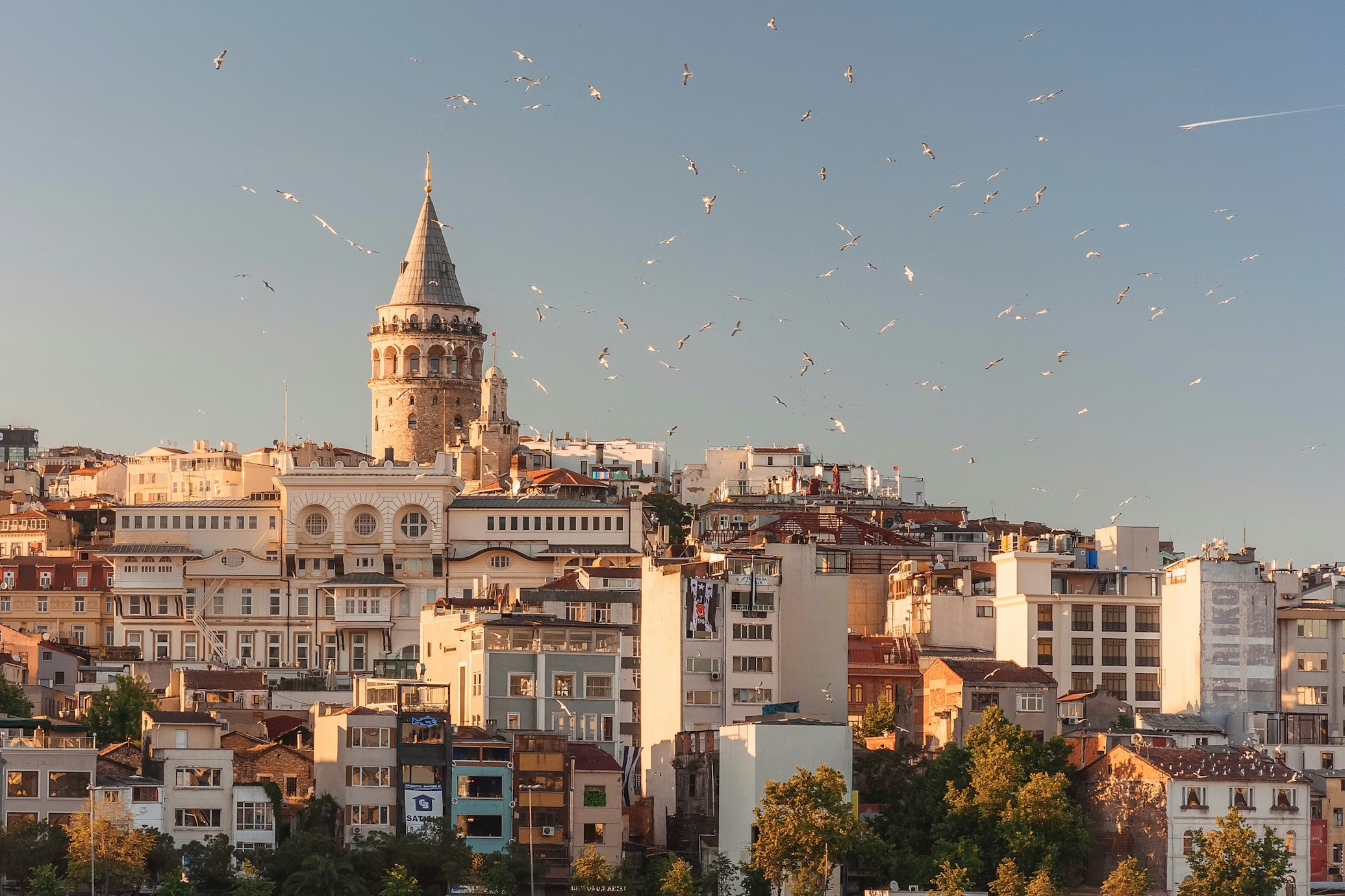
Photo by Anna Berdnik on Unsplash
Disclaimer: Material published by Traversing Tradition is meant to foster scholarly inquiry and rich discussion. The views, opinions, beliefs, or strategies represented in published articles and subsequent comments do not necessarily represent the views of Traversing Tradition or any employee thereof.
Works Cited:
- Balaban, A. (2023). Industrial Islamism: The Making of Turkish Capitalism. Columbia University Press. [↩]
- Alexander, A. & Bassiouny, M. (2014). Bread, Freedom, and Social Justice: Workers and the Egyptian Revolution. [↩]
- Pirenne, H. (1937). Economic and Social History of Medieval Europe. [↩]
- Damar, E. (2020). “Orientalist Fantasy and the Turkish Republic.” Middle East Critique. [↩]
- Beinin, J. & Vairel, F. (Eds.) (2013). Social Movements, Mobilization, and Contestation in the Middle East and North Africa. [↩]
- Tripp, C. (2013). The Power and the People: Paths of Resistance in the Middle East. [↩]
- Gerges, F. (2015). Contentious Politics in the Middle East: Popular Resistance and Marginalized Activism. [↩]
- Hanieh, A. (2013). Lineages of Revolt: Issues of Contemporary Capitalism in the Middle East. [↩]
Abdullah Alwi
Abdullah Alwi is a PhD candidate whose main interests consist of the Religious sciences, Philosophy, meta-metaphysics and Literature. He may be found on Instagram @jiljilwy and has written for multiple publications.

Leave a Reply