
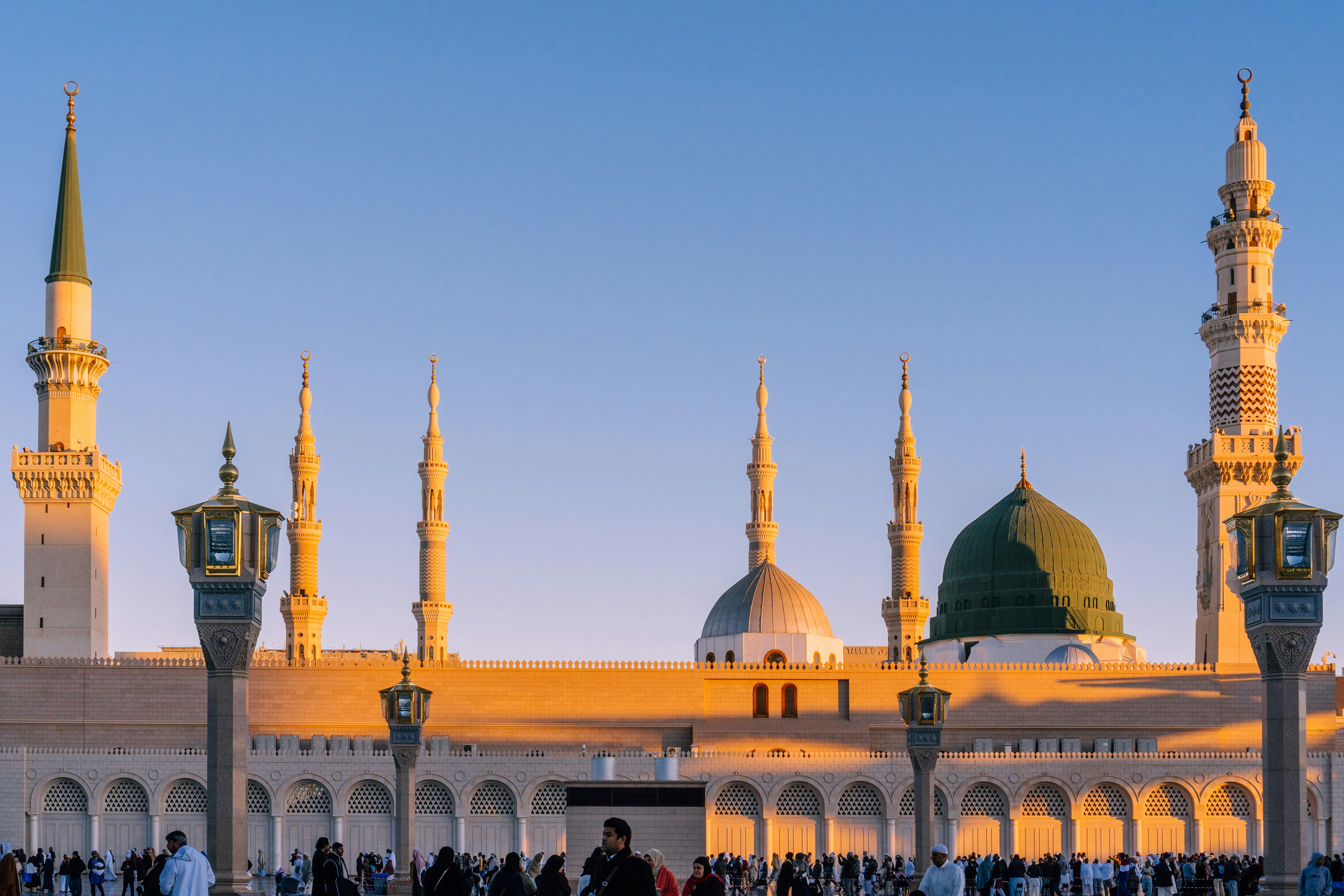
A meditation on how capitalism reshapes even sacred experience and how we participate in that reshaping.
Sat in Masjid Nabawi during the last ten nights of Ramadan, like many, I felt deeply in my soul that I never wanted to leave. Why would anyone want to leave the place where the Beloved (ﷺ) resides? Later that same night, I went to one of the malls behind the masjid in search of a quick and cheap iftar before heading back for qiyam-ul-layl (voluntary night prayer). Bear in mind, this was the last ten nights of Ramadan; the shops in the mall were ram-packed and would remain so until the early hours of the morning. Perfumes, abayas, tasbeehs and all manner of trinkets were being bought and sold.
This isn’t a criticism of the people running their businesses or the people doing the shopping. I was lucky enough to be there by myself, so I had no familial obligations or children to keep energised and entertained during the long nights. Ergo, I had no reason, unlike others, to spend time in malls. What did break my heart was the presence of a McDonald’s, a Starbucks and a KFC, all of which are on the BDS list, right behind the Haram. All of them had long queues coming out of the door.
A couple of days later, I was having suhoor with my friend, a Madina local. It was a platter of Yemeni rice with half a chicken and bisbas sauce. We spoke about living in Madina and I recounted my observations to him. I wondered out loud, how difficult it must be for the shopkeepers right by the Haram to have to keep their shops open all night in the most blessed nights and miss out on the opportunity of worshipping right by the Beloved (ﷺ). At that point I realised I could never live in Madina. Because I couldn’t bear the thought of having to miss out on the company of the Beloved (ﷺ) whether for work or for shopping.
The broader political economy, call it the zeitgeist, call it Pax Americana, forces upon us a persistent paradox: that even at the heart of the sacred, we remain entangled in the machinery of capitalism. We cannot step outside of its logic, even at the borders of the Haram. The very thing we seek to escape encroaches deep into our retreat.
Of course, Islam allows for shopping and work, encouraging those activities even. Others may even enjoy the fact that they are carrying on with the mundanities of life in Madina al-Munawwarah. My discomfort speaks to the intrusion of global capitalism in sacred spaces, especially when that global capitalism takes the form of companies that are actively harming our ummah and our ready purchase of their goods.
Though I’ve spent some time bemoaning the proximity of the malls and shops to the Haram, I don’t think that is the problem. Neither, really, are the goods being purchased. Perfume, tasbeehs, food, abayas, prayer mats and all other manner of Islamic paraphernalia are, ostensibly, “good”. The problem is our relationship with these products. Consciously or unconsciously we are attempting to become spiritual through consumption. Two things, spirituality and worldly consumption, which are at odds in our tradition.
We frame these purchases as the thing which will bring us closer to Allah, abandoning the locus of spirituality and transformation (the Haram) for the amulets of capitalism. Our presence is therefore absent from the sacred. But the deeper corruption runs further than just distraction. Capitalism does not only compete with ibadah, it infiltrates its forms. The automated zakat payment processed before midnight, the prayer app that logs our adhkar, the Quranic recitation playing through earphones while we scroll; these preserve the architecture of worship while quietly evacuating its interior, a creeping secularisation of our deen. We fulfil the obligation; we do not make the journey. Preference is given to the temporal forms of worship and not the object of that worship, Allah, such that our connection to The Divine ends up mediated, filtered through the very structures of consumption we imagined we had left behind at the door of the Haram.
Perhaps the sharpest macro illustration of this is the desire among Muslims in the Global North to make “hijra” to places like Dubai in pursuit of an “Islamic” lifestyle. But what is Islamic about migrating to a hyper-capitalist city-state whose own marketing is built on conspicuous consumption, and whose prosperity rests on the near-total disenfranchisement of its migrant workforce? The Islamic aesthetic is present; the Islamic ethical substance is largely absent. This is the same logic at work: form preserved, interior evacuated. Shaikh Abdul Hakim Murad, in a lecture on hajj, recalls Imam al-Ghazali’s etiquettes for the pilgrimage, among them, that one ought to walk. The insight is that the journey itself is preparation; the soul needs time to comprehend the magnitude of what it is approaching. “Nowadays,” the Shaikh observes, “one can be in Harrods one day and in the Haram the next.” We arrive at the sacred without having travelled toward it. The geography changes; we do not.
Consumption, even ‘conscious consumption’ is not the answer we seek. Commerce has to decentre ourselves and needs intentionally to help build the community. A commerce that is not about the private accumulation of wealth but feeds back in order to structurally improve society. My friend, with whom I ate a Yemeni suhoor, demonstrated how this might be done.
How then, do we reframe our relationship with buying and selling, in a way that aligns with our spirituality? Coming back to the BDS of it all for a moment, while I am a big believer in it as a moral and pragmatic tactic it doesn’t go far enough. It still interposes our resistance through consumption; not challenging capitalism, merely rewarding and punishing brands based on our political commitments.
BDS cannot fully do what it needs, neither can the borders of the Haram remain free of the imposition of capitalism, because there remains a deeper problem. This problem is not that Starbucks is present in Madina, it is that Starbucks is legible there, that the categories it relies upon (the consumer, the brand, the transaction) already make sense to people who have been educated into a global commercial ontology that has no room for amanah, no concept of rizq, and no institutional memory of the suq as commons. The problem isn’t just which companies we patronise, it’s that we’ve inherited a framework for thinking about commerce that is itself foreign to our tradition.
The stores in Madina mirror stores elsewhere. There are, on one level, franchises that remove the wealth from the community and use it to actively harm the ummah (McDonald’s, KFC, and Starbucks). They operate a model of extractive capitalism, that is, removing wealth from the community for private profits. At the same time they coerce locals into labour at often barely liveable wages. These types of stores maintain no relationships with the community beyond viewing them as targets for consumption.
Imagine that. On the borders of the Haram, people are being co-opted to work for companies that are harming our people globally with impunity, being forced to miss the nights of Ramadan and they still aren’t able to meet their financial needs.
The second type, we could call circulating commerce. Trade that keeps money local but is still for personal enrichment. Think of the independent shops in Madina malls run by independent traders. Many of them may very well give back to the community through sadaqah and zakat. Sadly, this remains unstructured and dependent on personal kindness. While the community is served in this manner, it isn’t built.
This leads me to the third type of commerce. After suhoor with my friend, later that same morning, I bought some gifts from him. With some of the money he made from the profits of the sale, he went to buy pallets of water and dates, which he handed out to pilgrims arriving by foot in Madina at iftar time. We may call this generative commerce. Commerce that directly benefits the community.
Sadly he is only one person, which has its obvious limitations. His impact will be limited. If he’s sick, who buys the pallets? If he doesn’t have the money, how does he procure goods for distribution? Ultimately, how many people will he help? But this is the basis of a community-led waqf-based commerce. A resource that can be accessed by anyone who needs it without gatekeeping. It’s inalienable and cannot be separated from those who need it. Moreover, it doesn’t belong to a single individual or a private corporation. Wealth is not accumulated by them, they are structurally locked out. Community benefit and obligation are at the centre of commerce, not consumer choice. Finally, it’s permanent. Meaning, it doesn’t rely on a single person.
By setting up these kinds of awqaf, the possibilities of what we could achieve are enormous. Imagine the impact on pilgrims in the haramain. People can stay in hotels and shop at stores set up as awqaf. These in turn not only provide a livelihood for locals, they also create a community-owned asset. This asset can go towards locals and their needs and also towards subsidising the Umrah of pilgrims who struggled to save up for it.
My friend didn’t give because he had money left over. He gave because he understood, perhaps intuitively, that his profit was never entirely his to begin with. This is the ontological break with capitalism’s foundational premise. Capitalism tells us that what we generate is ours fully, privately, absolutely. Islamic tradition tells us something different: that wealth is held in trust, that the community’s claim on it precedes our own, that we are custodians rather than owners. This is what amanah means in practice. Waqf is the institution that makes this permanent. It doesn’t rely on the surplus generosity of good people. It builds the communal claim into the architecture of commerce itself, so that giving isn’t something that happens after profit, it is baked into the very act of exchange. The pilgrims receiving water and dates at iftar weren’t recipients of my friend’s charity. They were receiving what the tradition always said was partly theirs.
Disclaimer: Material published by Traversing Tradition is meant to foster scholarly inquiry and rich discussion. The views, opinions, beliefs, or strategies represented in published articles and subsequent comments do not necessarily represent the views of Traversing Tradition or any employee thereof.
Photo by Sulthan Auliya on Unsplash

Nadeem Dawud
Nadeem studied History at Oxford and King’s College London. His studies focused on the creation of nationalisms and culture in diasporic communities. His thesis explored the formation of the diasporic “Pakistani” identity and the role of women in shaping it. He also focused on postmodernism, postcolonial studies, and decolonial thought. Since leaving his postgraduate studies early, without completing his PhD, he has focused on telling Muslim stories and building resilient Muslim communities. He is the author of the forthcoming biography of Kalbinur Sidik, a survivor of the Chinese concentration camps. He also co-hosts the Boys in the Cave podcast with Tanzim Alam. All of this he has done with the aid of Allah, the graciousness of his wife, and the light of his two daughters.

Leave a Reply