
In an era characterised by heightened state repression, digital militarism, and the weaponisation of sovereignty, the global language of resistance is increasingly shaped by comparison. Palestine is frequently likened to apartheid South Africa, while Algeria is often evoked alongside Vietnam’s anti-colonial struggles. These parallels are drawn in hopes of generating international solidarity, framing state violence in morally resonant terms, and situating oppressed communities within a broader historical arc of anti-colonial resistance.
While these analogies are often made with good intentions and have yielded a positive response to highlight patterns of racialised violence, settler colonialism, and militarised occupation, they also carry unintended consequences. When used uncritically, comparative frameworks risk erasing the specific material conditions of each context, reducing political agency to mere rhetoric, and inadvertently reinforcing colonial logics under the guise of solidarity. The desire to make complex struggles more legible can ironically obscure more than it reveals. This tendency risks flattening distinct historical and political realities into a simplistic moral uniformity that, though emotionally compelling, can become epistemically violent.
To truly stand in solidarity, we must learn to engage with each struggle on its own terms, rather than impose familiar interpretive frameworks which might lead to the dismissal of indigenous authority and the imposition of dominant epistemologies. This essay critically examines how comparative analysis, despite its emancipatory intent, can paradoxically undermine the very liberation movements it seeks to support by superimposing external narratives that obscure local specificities.
The Coloniality of Comparison
Professor Walter D. Mignolo and Professor Catherine E. Walsh, in their seminal work On Decoloniality: Concepts, Analytics, Praxis argue that the act of comparison itself is deeply embedded within the colonial matrix of power. They assert that Western epistemologies—long-standing instruments of colonial domination—continue to shape how knowledge is produced, categorised, and legitimised globally. Comparative frameworks, far from being neutral, often marginalise indigenous and local ways of knowing and being, thereby reinforcing the very colonial structures they claim to challenge. Mignolo expands on this critique through the concept of “border thinking,” a mode of thought born from the lived experiences of those who exist at the peripheries of the world order. He posits that true decolonial thought requires an embrace of localised knowledge systems.
Comparison, therefore, carries with it historical baggage—some emancipatory, others imperial. As Edward Said reminds us, empire does not merely conquer land; it shapes the very conditions of perception. The categories we employ—nation, identity, resistance, human—are products of European modernity. When we compare, we often rely on this vocabulary, reinforcing the very hierarchies we seek to dismantle. We may not compare to demean, but often, we compare to simplify. And simplification, however well-intended, remains a privilege of the outside observer.
The language which positions Muslim traditions and knowledge as inherently “other,” deficient, or backward is not merely a matter of semantics but of ontology. The categories through which we understand resistance are often predicated on universalist claims rooted in Eurocentric thought.
The simplification of liberation struggles is a form of epistemic violence that enacts power by imposing reductive binaries and normative standards alien to the lived contexts it examines. For those within Islamic frameworks, such external simplifications distort and erase internal nuances, subordinating rich theological and ethical discourses to the terms and conditions of secular, Western epistemologies.
The poet of the East, Allama Iqbal, precisely captures the frailty of Western civilisation in these couplets of his poem ‘Tulu-e-Islam’,
Nazar Ko Kheerah Karti Hai Chamak Tehzeeb-E-Hazir Ki
Ye Sanaee Magar Jhoote Nagon Ki Rezakari Hai
Woh Hikmat Naz Tha Jis Par Khiradmandan-E-Maghrib Ko
Hawas Ke Panja’ay Khoonin Mein Taegh-E-Karzari Hai
The glitter of modern civilisation dazzles the sight;
But this clever craftsmanship is a mosaic of false jewels.
That science, in which the scholars of the West took pride,
Is the sword of warfare held in the bloody grip of greed.
The Mechanics of Parallelism
These parallels do not arise in a vacuum. They are constructed strategically and deliberately through advocacy campaigns, infographics, social media hashtags, NGO reports, and academic conferences. For instance, in international advocacy for Palestine, it has become common to describe the Israeli occupation as apartheid, drawing a direct line from South African history to Israel’s settler-colonial regime.
This analogy has yielded strategic gains. It aligns the Palestinian cause with a globally recognised moral triumph and leverages the legacy of the anti-apartheid struggle to mobilise support. The apartheid frame has been further amplified by reports from organisations such as Human Rights Watch and Amnesty International, both of which have concluded that Israel’s regime constitutes apartheid under international law.
However, this framing often functions as a conceptual shortcut, displacing crucial aspects of the Palestinian struggle that do not map neatly onto the South African precedent. In South Africa, the Black majority fought for equal rights within a single, unified state. By contrast, Palestinians are not fighting for inclusion into a settler state. They are not asking to be treated equally under Zionism. They are demanding its dismantlement.
Therefore, the apartheid analogy, while strategically useful in certain advocacy contexts, ultimately obscures the foundational nature of Zionist settler colonialism and its totalizing aim; not merely to dominate Palestinians, but to replace them. The very existence of the Israeli ‘state’ is predicated on the material and historical erasure of the Palestinians. Unlike apartheid South Africa, where the system depended on the exploitation of Black labour while keeping the population physically present, Israel’s structure of domination seeks the opposite—the complete removal of the indigenous population. This logic of elimination is what renders Israel not just an authoritarian regime, but fundamentally an illegitimate one—a false state built upon the ruins of other people’s sovereignty, memory, and sacred geography.
‘Israel’ is a US-backed settler colonial project whose legal, military, and narrative apparatuses are designed to justify its violent origins retroactively. From the Nakba of 1948 to the ongoing Genocide in Gaza, the project has always been about substitution. It is a regime constructed on a mythology of belonging atop the bones and memories of a displaced people.
What makes Israel uniquely illegitimate is its totalizing structure—one that does not allow for reconciliation, symbolic recognition, or even partial integration of the indigenous population. The Zionist entity is not interested in ‘managing’ Palestinian existence; it seeks to eliminate it altogether. This is distinct from other settler colonies, which, while rooted in genocide, eventually transitioned into multiethnic liberal democracies (however flawed), or made gestures—however cynical—towards truth and reconciliation. Israel offers neither. Its laws are not just discriminatory; they are ethnonationalist to the core, elevating Jewishness as the sole legitimate subjectivity of the state, and rendering all others perpetually contingent, alien, or criminal.
To critique Israel merely as a violator of human rights is insufficient; it must be understood as a fabrication sustained by the systematic removal and silencing of the indigenous. Palestinian liberation, therefore, is not about reforming this structure – it is about undoing the lie at its core.
Zionist Appropriation of the Holocaust and the Monopoly on Suffering
The Zionist regime, far from being merely a participant in global narratives of comparison, has itself weaponised analogy, most notably through the invocation of the Holocaust as the singular moral benchmark for human suffering. In Western discourse, the Holocaust occupies a sanctified space. It has been elevated into a civilisational litmus test, an unquestionable moral absolute. But this sanctification has not produced a universal ethics of care; rather, it has been monopolised by the Zionist state to shield its settler-colonial project from scrutiny.
Any analogy that links Israel’s actions against Palestinians to historical atrocities is immediately branded antisemitic, while the regime itself invokes the trauma of the Holocaust to justify the dispossession and extermination of Palestinians. The result is a perverse ‘moral’ economy in which Jewish suffering is rendered eternal and exceptional, while the suffering of Palestinians is dismissed as either provoked, fabricated, or inconsequential.
Rather than remembrance, it is the weaponisation of memory. The Holocaust is invoked to extend beyond a warning against genocide into a political license to perpetuate it, so long as it is cloaked in the rhetoric of “security” and “self-defense.” The West, too, participates in this economy by invoking the Holocaust repeatedly in museums, schools, and through literature to rebrand itself as morally redeemed from its historical sins. It allows Europe and America to feel good about “never again” while materially supporting a regime that enacts an ongoing Nakba in Gaza.
The Zionist entity thus thrives not in spite of Western guilt, but because of it. It feeds on it, converting it into diplomatic impunity and ideological cover. To name this is not to deny the Holocaust but to resist its cynical abuse by a state that desecrates its memory every time it bombs a hospital in Gaza or bulldozes an olive tree in the West Bank.
Palestine as a Metaphor
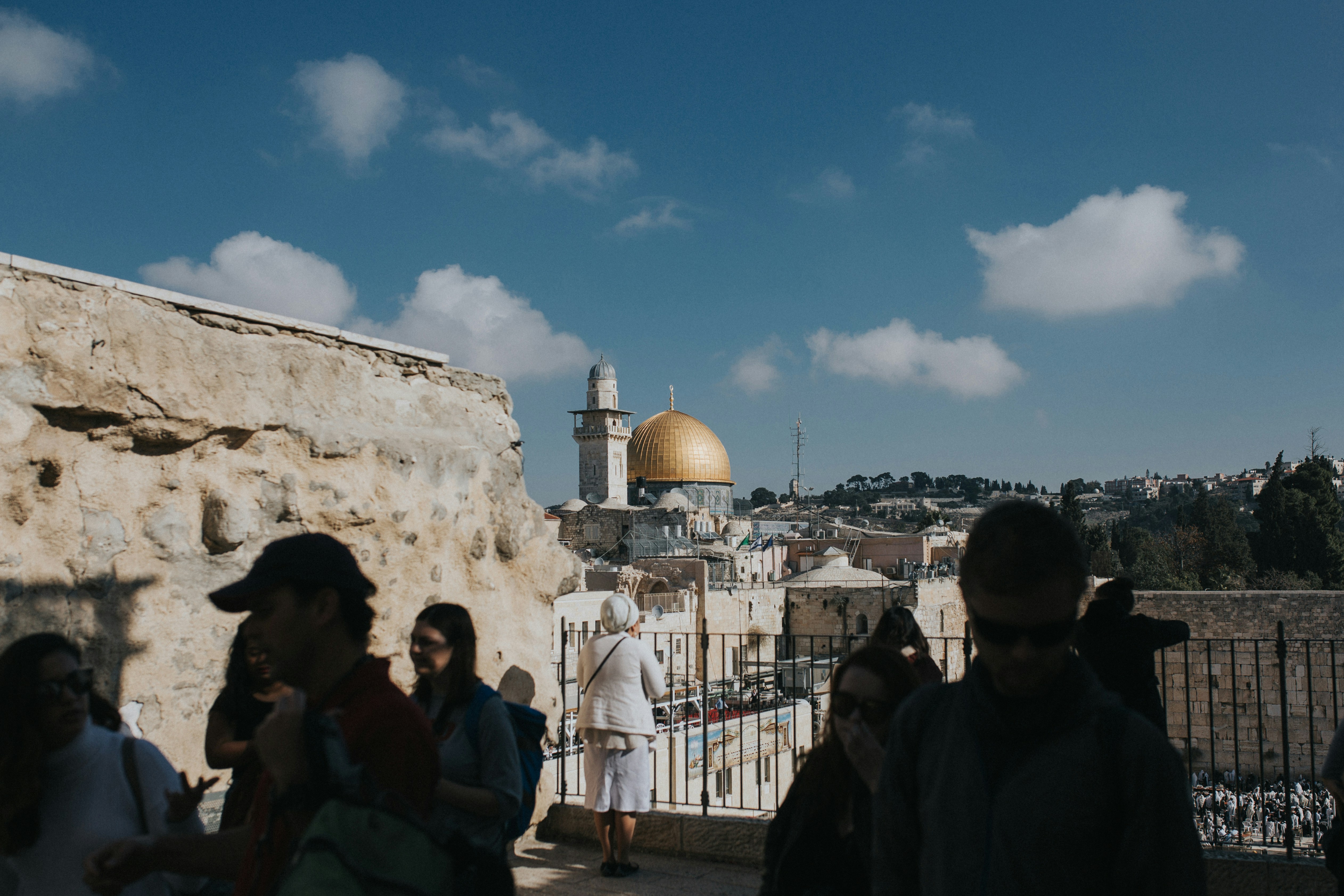
Among Muslims, the centrality of Palestine in our political and emotional imaginations is not accidental. It is not simply another case of human rights violation or yet another node in the global south’s archive of pain. It is a trust. It is Al-Quds. It is Al-Aqsa—the first qiblah, the place of the Prophet’s ascension. Prophet Mohammad ﷺ spoke of its sanctity, and generations of scholars, poets, and leaders have wept for its liberation. It is the land of the Isra and Mi’raj. The occupation of Palestine is not just material; it is metaphysical. It aims not only to remove people from their land but to rupture their relationship with the divine, to desecrate the sacred, to erase the memory that binds past, present, and future. To cast Palestine as “just another” occupied land is to miss what is at stake.
The assault on Palestine must be understood as part of a broader imperial architecture that has long targeted not just territories but our collective identity. The Zionist project, backed by imperial powers, is not acting in isolation—it is operating within a historical continuum of settler colonialism that not only aims to sever indigenous people from their land but also to fracture the body of the ummah by striking at one of its most vital spiritual arteries.
This is why the reaction of Muslims globally is not merely one of sympathy but one of visceral identification. We are not watching from the outside. We are watching a part of ourselves under siege.
The imperial-Zionist nexus understands this symbolism well. Its violence is deeply symbolic. It targets schools, cemeteries, mosques, libraries, not just to demolish infrastructure, but to erase memory, to rupture the continuity of culture, to sever the ties that hold the ummah together across time and space. It is a metaphysical violence cloaked in the machinery of modern warfare.
Additionally, insisting on the sanctity of Palestine does not mean denying the sanctity of other liberation struggles—whether in Sudan, Congo, or elsewhere, they carry their textures of sacredness, of memory, of cosmology. To treat any of them as identical to Palestine—or worse, as footnotes to it—is a disservice to all. It is to refuse the erasure of what makes each movement unique.
Palestine cannot be understood through frameworks that ignore its spiritual geography.
When it is invoked purely as a symbol, whether by Muslim solidarity movements or international rights discourses, it often becomes a spectacle, divorced from its theological, historical, and political depth.
Palestine insists on being remembered not only in policy briefs and resolutions, but in du’a, in poetry, in khutbahs, in the tears shed in the quiet hours of the night.
The Changing Faces of Colonialism
Colonialism, like capital, is adaptive. Its logic remains consistent: domination, extraction, erasure, but its methods evolve. For instance, a settler-colonial state in which a demographic majority is excluded from political life functions differently from an occupation regime that controls a fragmented, stateless population. A colonised region incorporated into a postcolonial nation-state is shaped by different forces than a colonised territory administered by an external imperial power. Each is a distinct configuration of dispossession, shaped by specific political, legal, and spiritual histories.
In Necropolitics, Cameroonian philosopher Achille Mbembe shows how contemporary regimes of control operate through the management of death, deciding who may live and who must die. This is no longer colonialism in the classical sense, but its afterlife—new technologies of surveillance, data-driven repression, and hyper-legalised violence. Settler states now operate through international courts and media campaigns as much as they do through weapons. Colonialism today writes press releases.
To ignore these differences is to misunderstand the contemporary power dynamic. Worse, it risks reproducing the very Western arrogance we claim to oppose—assuming we can read one struggle through the lens of another, usually filtered through Euro-modern categories. The map of global liberation is not a clean chart of parallels and analogies. It is a dense, uneven, spiritually charged landscape. Some struggles unfold in sacred space; others in ancestral land buried under pipelines and border walls. Some resist through poetry and mourning, others through guerrilla warfare or courtroom battles. None of them is reducible to the other.
This is what anthropologist Saba Mahmood called for in Politics of Piety: a rethinking of agency beyond liberal scripts. In her ethnographic work among Muslim women in Egypt, she argued that what looks like passivity from one framework might be deeply agentic in another. Her insight applies equally to resistance: not all struggles will look like a march, a protest, or a vote. Some will be spiritual, local, quiet, or intergenerational, and they deserve to be recognised on their own terms.
Conclusion: Beyond the Comfort of Comparison
This essay does not intend to dismiss scholarly comparative frameworks, but calls for an honest assessment. The impulse to compare liberation struggles stems from a place of empathy and political strategy. At its best, analogy can foster solidarity, create global awareness, and lend moral weight to movements otherwise obscured by media and geopolitical biases. Yet, as this essay has argued, comparison carries epistemological risks: the flattening of histories and the erasure of distinct voices may inadvertently obscure what they seek to illuminate.
Comparative frameworks must be wielded not as instruments of simplification, but as invitations to deeper engagement. Analogy should not erase, but rather illuminate through contrast, not collapse. The political potency of comparison lies not in enforcing synonymity, but in acknowledging differences. Every liberation struggle emerges from its own cosmology, shaped by specific forms of loss, resistance, and renewal. To truly honour each battle is to let it speak in its own tongue.
As Muslims, our responsibility in global solidarity is not just to join the chorus, but to refine our ears. We do not measure the legitimacy of a struggle by how closely it maps onto the secular language of human rights. Austro-Hungarian scholar Muhammad Asad, in his book Islam at the Crossroads, sheds light on the shallowness of Muslims reproducing Western frameworks. He writes,
“…to imitate Western civilisation in its spirit, its mode of life and its social organisation is impossible without dealing a fatal blow to the very existence of Islam as an ideological proposition.”
We measure it through maqasid (divine purposes), the Qur’anic paradigm of ‘adl (justice), and through the preservation of human dignity as taught by the Prophet Muhammad ﷺ.
To stand with Palestine, Sudan, Congo, Uyghur, or any site of resistance is not to flatten their struggles into each other, but to approach each as sacred and irreducible. To honour a people’s struggle is to learn their grammar before speaking their name. It is to stand not at the centre, but at the edges—attentive, accountable, and unafraid to admit that this story is not mine to define, but it is mine to honour.
Disclaimer: Material published by Traversing Tradition is meant to foster scholarly inquiry and rich discussion. The views, opinions, beliefs, or strategies represented in published articles and subsequent comments do not necessarily represent the views of Traversing Tradition or any employee thereof.
Anusha Rehan
An undergraduate student with particular interest in Islamic political theory, Muslim ways of knowing, and South Asian politics.
Omama A. Talha
A student of English literature with a deep interest in religious studies, Islamic literature, politics, history and poetry.

Leave a Reply