
A Book Review of Voices of Resistance: Diaries of Genocide by Batool Abu Akleen, Sondos Sabra, Nahil Mohana, Ala’a Obaid
“The trial is immense, O God. We do not object to your decree, but we are exhausted.”

Voices of Resistance: Diaries of Genocide, a work published by Comma Press in July, centres the lives of four courageous Palestinian women who have been, and continue to be, impacted by the ongoing genocide. 20-year-old Batool Abu Akleen, 26-year-old Sondos Sabra, 43-year-old Nahil Mohana, and 32-year-old Ala’a Obaid have come together to collaborate on what is arguably one of the most important pieces of literature published since the genocide started. The co-authors of this work are students, poets, writers, mothers and daughters, survivors, and everything in between. Diary entries are unique in that they provide a personal (and in some ways, more intimate) account of the genocide.
Voices of Resistance is not a work that endeavours to garner pity from the reader; it proves to the world that life, humanity and resilience persist against the harrowing backdrop of ethnic cleansing. One thing that stands out in all the diary entries is the solidarity amongst the displaced and comfort in numbers; we witness families helping families and strangers helping strangers.
From accounts of generations wiped out in one go, to the physiological and psychological effects of famine, to constant displacement, to pregnancy and childbirth, to haggling at markets and studying for exams, the breadth of stories recounted in this work serve as a reminder to the reader that people of Gaza are not just faceless statistics; they are distinctive, diverse individuals who, despite going through the worst atrocities imaginable, continue to live and endure. The candid, evocative narrations of the four women in Voices of Resistance showcase the best and worst of humanity.
“I refuse for our names, as Palestinians, to be synonymous with only misery and despair.”

The very first diary entry in the book, that of Batool Abu Akleen, begins on January 10, 2024—my birthday. I couldn’t help the sense of guilt I felt when I read the date in the top right hand corner of the page. Why do I get to progress into my late twenties when babies in Gaza can’t even live long enough to reach their first birthdays? It was difficult not to question and compare aspects of my life to that of women such as Batool and Ala’a. Of the four diaries, Batool’s is one that continues to resonate with me long after finishing. This is largely due to her detailed, vivid descriptions of everyday life as a woman under occupation. She describes what it means to be displaced, anxiety at an all time high, living in a tent with her family in Deir al-Balah, struggling with basic hygiene and mensuration, the noise of drones and jets making it difficult to think or sleep.
An excerpt that stands out from her diary is:
“My body is so exhausted I can’t move. I stay like this, listening to the sounds around me: the songs from the party our neighbour Modi has thrown for his wedding, the applause of his campmates, the pounding of airstrikes, the buzzing of drones.”
This scene aptly captures the conditions that Palestinians in Gaza are made to contend with, where joy and terror overlap against the perpetual backdrop of bloodshed. One can clearly picture the chilling contrast between the jubilant, melodic atmosphere on the ground and the cold, mechanical surveillance of the killing machines in the air above, ready to strike at any moment.
Ala’a, who authored the fourth diary, draws a similar picture:
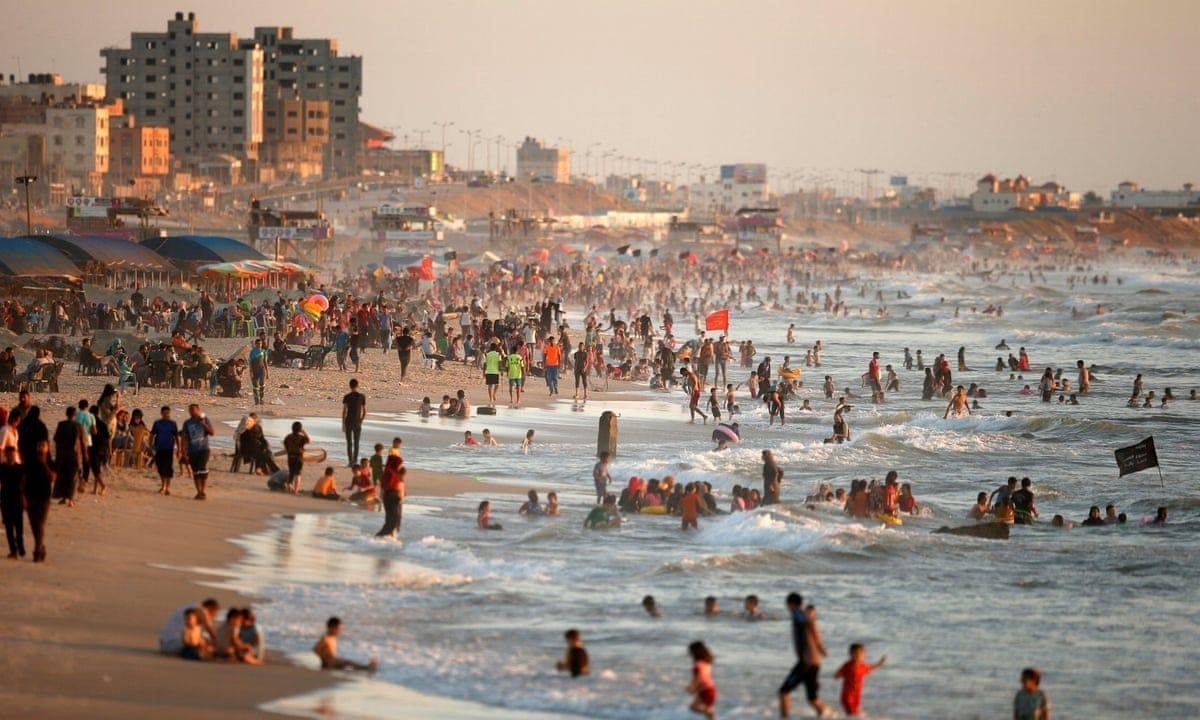
“What pains me most is how seamlessly the sound of the waves blends with the roar of an Israeli F-16 flying overhead. […] My children’s laughter rings out, celebrating the big bag of seashells they’ve gathered. It’s the most beautiful sound.”
Another reason why Batool’s diary entries stood out to me is the brutal honesty with which she compares her situation to that of her neighbours. In what I’m sure must have taken both courage and guilt to admit, she pens:
“You rejoice while others grieve. You rejoice when you realise that the home that was bombed wasn’t yours, but the one right behind it. You feel a little sad, but you’re still happy about your survival. Survival is individual, always individual. Joy is individual, and so is grief.”

Sondos Sabra is the author of the second set of diary entries that span October 7, 2023 to March this year. She focuses on the logistics of displacement; packing in a hurry, gathering the family, sourcing transport, finding a place to seek refuge. The immediate shock and fear induced by the cruel leaflets descending ominously from the sky is palpable through the pages. Nahil Mohana, author of the third diary, relates a similar account, though her perspective on the constant calls for evacuation has shifted:
“When the occupation’s leaflets first fluttered from the skies, they terrified us. Later, they worried us. Now, they cheer everybody up. We can burn them on our fires to heat our dignity-flavoured morning coffee.”
Sondos describes the destruction around her. She begins with the idyllic imagery of her family picking olives by hand, forgoing the machinery and chemicals that would undoubtedly speed up the harvesting process. The tender treatment of the trees and the fruit they bear contrasts starkly with the ecocide that is inherent to the Israeli occupation and expansion of settlements. The diminishing landscape of Palestine is felt acutely by those living in the land, more so now with the mass destruction of natural landscapes, homes, schools, hospitals, residential buildings—places once full of love, knowledge, healing and happiness gone in an instant. Nahil also touches upon this as she recounts how the Israeli Army demolished every single tree in her late grandfather’s orchard. Her grandfather was known for being extremely environmentally conscious and taught his grandchildren how to care for the land. Destruction, as we know, is not just limited to buildings—civilians are also deliberately targeted, as Sondos’s diary entry ‘We Kill Terrorism’ penned on December 7, 2023 demonstrates.
“Who knows, perhaps terrorism hides in the warmth of a home, in the bells of churches or the minarets of mosques, between the pages of books, in the streets and alleyways of the camps, or even amidst the tents of the displaced. The Israeli occupation has every right to erase anything from the face of the Earth, if they so desire. And no one has the right to criticise Israel.”
The yaqeen with which Palestinians enact their faith during times of unfathomable hardship is incomprehensible for the vast majority. One fajr, Sondos’s father recites the following verse from Surah Baqarah, which reduces her to tears: “And We will surely test you with something of fear and hunger and a loss of wealth and lives and fruits, but give good tidings to the patient.”

A common theme in many of the diary entries is the impact of the genocide on children, whether they are siblings, offspring, nieces and nephews, neighbours or strangers. Nahil narrates the challenges around having to explain the unfolding events to her daughter Habiba, who, as a young girl, swiftly picked up on new words and phrases from the radio. This correlates with the account of Sondos, who tried her best to shield her four-year-old sister Fatima from the chilling sight of dismembered bodies. Ala’a likewise recalls hearing the news about fifteen people killed by an airstrike, one of whom was a six-year-old girl, Sarah, who has the same name as Ala’a’s own sister. The physical and psychological toll of losing parents, siblings, houses and limbs on children can never be fully grasped. It is well-documented that Gaza has the highest rate of child amputees in the world.1
Nahil, who came close to being martyred on several occasions, expounds upon her disbelief at having escaped death over and over again. Food scarcity and famine is one thing, but targeted civilian attacks have been the defining feature of the genocide.
“Gaza will become a vast graveyard, at the mercy of an insatiable enemy.”
The final diary of Ala’a provides a unique personal perspective—that of pregnancy and childbirth during a genocide. She was five months pregnant when the genocide unfolded. The stress of pregnancy, paired with the abduction and detention of her elderly father and brother had adverse effects on her health. This was heightened when the family decided to split up; her parents going to al-Sinaa, her sisters to Khan Younis, and herself, her brother Jamil and sister-in-law Sarah seeking shelter in a kindergarten in Rafah. Though initially nervous about the prospect of living with strangers, Ala’a found herself readily embraced into the fold like family. Accounts like this bring to mind the footage of Palestinian men working tirelessly to rescue people from rubble, highlighting the humanity and selflessness of Palestinians, particularly Palestinian men who have been excluded from popular narratives that focus on women and children, which inadvertently validates Israel’s claims that any Palestinian male is a terrorist and thus a legitimate target.
With the decimation of hospitals all over the Gaza strip, maternity services have taken a great hit, with very few offering obstetric care. Ala’a’s unfiltered account of the immense physical toll of continuous displacement, the discomfort of sleeping on the ground while pregnant and later having to plead for space at the Emirati Hospital in Rafah upon entering labour, was heartbreaking to read. She finds herself questioning whether sharing their stories with the world is worth it if nothing is going to change.
“No matter how cruel the war, our love will always give us something worth holding onto.”
As the genocide in Gaza surpasses its second year, the failure of global superpowers, politicians, and the elites of our Ummah to act remains a stain on collective humanity. Though hostages have been released, the ceasefire has already been violated several times–a wholly unsurprising tactic that has resulted in even more death and destruction. The targeted extermination of Palestinian journalists, who have been forced to document their own genocide, has been a calculated undertaking by Israel in an attempt to control the narrative. Civilians have had to step up to replace the hundreds of journalists that have been targeted and killed, largely leaning on social media to showcase the ongoing decimation of their homeland. Voices of Resistance is more than just a literary undertaking, it is a living testimony that illuminates the power of writing as a means of survival and preservation. Where news headlines portray Palestinians as shapeless statistics, the diary entries of these four women prove that there are real lives behind the headlines, lives that grieve and rejoice, despair and hope. Against the backdrop of global indifference, the four writers of this work prove that resistance is not only necessary, but inevitable.
If you would like to purchase a copy, you can do so from Comma Press here. All proceeds from the book go to the writers in Gaza.
Disclaimer: Material published by Traversing Tradition is meant to foster scholarly inquiry and rich discussion. The views, opinions, beliefs, or strategies represented in published articles and subsequent comments do not necessarily represent the views of Traversing Tradition or any employee thereof.
Works Cited:
Sahar A.
Sahar is an avid reader and writes varied book reviews. An advocate of diversification in literature, she focuses on amplifying the voices of authors who are reclaiming the Muslim narrative in literature. You can find her reviews on Instagram and Goodreads.
Leave a Reply