
“Buddhist Extremist Cell Vows To Unleash Tranquility On West,” reads a recently recirculating The Onion headline from 2013. An extraordinary piece of satire, given how just a few months ago in July 2025, renewed violence in Myanmar displaced at least 150,000 Rohingya, Myanmar’s long-persecuted Muslim ethnolinguistic minority.1 At least 427 Rohingya are believed to have drowned in two separate shipwrecks in early May.2 The dead had been fleeing Myanmar’s western Rakhine State, but also the swelling desolation of Bangladesh’s overcrowded Cox’s Bazar, host to the world’s largest refugee camp.
That so many have been displaced and perished is no anomaly. It is the predictable outcome of a people trapped in permanent exile: stateless and disposable in a region that debates their fate but disavows responsibility for their existence. The Rohingya are outside the law. They are a different category than refugees or economic migrants, as they are denied recognition as citizens of any state, existing in what Italian philosopher Giorgio Agamben might call bare life. Their status is the consequence of state design and Buddhist nationalism, implemented with the linguistic finesse and administrative ruthlessness by the successive governments of Myanmar.
Brief History
Statelessness is intimately linked to the rise of the nation-state and its bureaucratic obsession with categorization. Beginning in the 19th century and accelerated by postcolonial state formation in the 20th, states began defining belonging in legal terms through registries and fixed territorial claims. As the cases of the Rohingya, the Bedoon of Kuwait, or Dominicans of Haitian descent demonstrate, statelessness is frequently deployed to consolidate power by controlling the boundaries of the national “we.”
Rohingya statelessness lies in the deliberate sculpting of the Burmese national identity during and after independence from Britain. Myanmar maintains that pre-colonial Muslim populations like the Kaman, a legally recognized predominantly Muslim ethnic group, in Rakhine State are distinct from the Rohingya, who are descendants of migrants during British rule and thus falsely maintain a story of indigeneity. (Note that the Kaman, who are largely citizens, face discrimination and are subject to violence, and as of September 2023 issuance of passports to them was suspended.3) The state narrative, however, ignores historical records showing layered Muslim presence in Arakan/Rakhine for centuries, Arabic and Persian-linked networks along the Bay of Bengal by the late medieval period, and, from the 15th century, the Mrauk-U court’s Persianate titulature and coinage.4
Who the Rohingya are, then, is an ethnolinguistic community speaking a Bengali-related vernacular (unsurprising, given the geographical contiguity between northern Rakhine and Bengal) with deep roots in the Arakan littoral, later augmented by British-era migration. These facts are not mutually exclusive. Whether they or others have always used the term “Rohingya” is the wrong test. Even scholarship that shows the label consolidating in the mid-20th century refers to communities present much earlier (for example French historian Jacques Leider, who disputes the antiquity of the term but not the long Muslim presence). By the early 19th century British India had annexed Arakan and the long-standing Muslim presence along the littoral was increasingly documented by and through colonial presence. Administrators and travelers (like the oft-cited Buchanan-Hamilton’s 1799 note on “Rooinga”/”Rooinga”) to later geographical indexes, recorded histories of these Muslim communities. Over the later 19th and early 20th centuries, the rice boom and new maritime routes drew substantial migration from Chittagong, gathering recent arrivals atop older settlements. Censuses first grouped most as “Bengali Muslims,” then distinguished “Arakan Mahomedans” from “Chittagonians.” Self-designations of “Rwangya/Roewengya” existed uneasily with bureaucratic labels; by the late 1940s, Muslim leaders in North Arakan began standardizing this, pairing it with evidence of historical rootedness to counter the emerging postcolonial national-race framework.
In the first years after independence in 1948, Muslim politicians from North Arakan sought recognition as an official nationality and pressed for autonomy in the Muslim-majority region that would briefly become the Mayu Frontier District. During the late 1940s and 1950s, mujahids like Jafar Kawal called for an autonomous Muslim state, leading rebellions and uprisings,5 while political figures such as Sultan Mahmud (health minister elected from Buthidaung) lobbied for recognition and protections and were open to compromise.6 Other leaders alternated between bargaining for equal rights and local self-rule and incorporation into what was then East Pakistan. In 1947, a delegation appealed to Jinnah and argued cultural and religious affinity. Jinnah received their representations but declined to champion annexation as his government treated the area (and as lying firmly inside Burma’s sovereignty.5
By the early–mid 1960s the insurgency had been largely suppressed and the military government dismantled the Mayu Frontier District, rolling back the tentative concessions that had accompanied the first political consolidation of the Rohingya identity. In the years before Ne Win’s 1962 coup, the Rohingya still participated in national politics as enfranchised citizens though not yet formally codified as one of Burma’s “national races.”6 U Nu’s government even courted their votes by promising an autonomous Muslim zone within Rakhine alongside statehood for the Buddhist majority. The coup ended those openings, imposing direct military rule. When the junta revived constitutional talks in 1973, it made Rakhine a state but stripped away any recognition for the Mayu Frontier’s Muslim population, completing the absorption of their territory without autonomy or representation.
Large military sweeps in 1978 under “Operation Nagamin” (Dragon King) drove over 200,000 Rohingya into Bangladesh.78 Officially framed as a citizenship verification and anti-illegal immigration campaign, the operation was, in fact, a coordinated military purge targeting Rohingya villages. Troops and local militias conducted brutal raids, demanding identity papers many residents had never been issued, accompanied by killings, rapes, and mass arrests. Repatriations followed under international pressure, but many returned to destroyed homes hemmed in by surveillance, travel restrictions, and the denial of political participation.9
In 1982 the military government passed a new Citizenship Law. The Rohingya were pointedly excluded from the list of 135 ‘national races’ eligible for full citizenship, rendering most of them stateless or confined to tenuous forms of documentation subject to administrative discretion.10 The presence of some newer migrants was used to delegitimize all Rohingya, past and present, leveraging ethno-nationalist ideology and geopolitical paranoia: if they did not belong in the imagined past, they had no claim to the present. Dr. Elizabeth Rhoads argues Myanmar’s “citizenship regime is arguably one of the most racialized in the world,” keeping the Rohingya in endless “citizenship scrutiny” while their children inherit the same deferred, second-tier status, shut out from equal documentation, schooling, and mobility.10 Until now, the state refuses to use the word “Rohingya,” intending to degrade with “Bengali,” a term freighted with the implication of foreignness and illegal migration. The Buddhist nationalist narrative further casts them as a demographic threat capable of altering the ethnic and religious character of the nation. This eliminates the Rohingya from the civic order yet preserves them as a problem to be policed.
Buddhist Nationalism
The outcome of a complex history, coordinated ideological campaign, and convergence of Buddhist nationalism and statecraft leads me to point out an irony of perception here: a faith largely viewed in the Anglo-American world as as pacifist and detached from worldly ambition is indeed the political banner under which the ethnic cleansing of the Rohingya has been carried out. Norwegian Professor of Theravada Buddhism Iselin Frydenlund writes the following (emphasis mine):11
“On 17 October 2017 Sithagu Sayadaw gave a sermon to Burmese soldiers at a military camp in the Karen state. At the time, the military was fully engaged with their massive ‘clearance operations’ in Rakhine, and the soldiers who participated in the Buddhist ritual at which Sithagu Sayadaw gave his sermon, were soon to be sent off to partake in the operations in Rakhine. In the sermon – which would be a functional equivalent to a military sermon in other armies across the world – the monk made extensive use of a Sri Lankan 5th century AD Buddhist chronicle called the Mahavamsa. This text, which contains passages where killing of non-Buddhists is glorified if committed to save Buddhism from perceived danger, has been used in Sri Lanka for centuries to legitimate Buddhist claims to the island and as well as a source for Buddhist political ideology.
In Myanmar, the text is part of the monastic school curriculum, as an authentic source for early Buddhist history. In his sermon, however, Sithagu Sayadaw, brought the very controversial passages on the legitimate use of violence into the present, thus bestowing Buddhist moral authority over the military operations in Rakhine. In his speech, the monk claimed that ‘The battle was because of the effects of the power of the Dhamma (Buddhist teachings)…and as a result of the unity of the monks in fighting the battle together, the battle was over. That was how they had a landslide victory in beating the invaders’. Translocated into a new setting, the Mahavamsa now serves to legitimate violence in Rakhine, and to frame the Rohingyas as ‘invaders’.”
Sithagu Sayadaw, among the most well-known religious figures in Myanmar, and his sermon are damning not for the reason of some essential propensity toward violence (note that the point is not that religion should affect no governance and military logic) but that its moral authority can be and is mobilized to sanctify ethno-nationalist violence.12
Roughly 90% of the country’s population is Buddhist. Since the colonial period, monastic orders have played a central role in political mobilization, from resisting British rule to reinforcing post-independence unity. Far from being apolitical or passive, many among the sangha (monastic community) in Myanmar have been entangled with and enjoyed state power.13 What emerged in the 21st century, however, was a more overt, populist, and at times explicitly violent strain, most famously embodied by the 969 Movement, led by Ashin Wirathu, a monk dubbed by international media as the “Burmese bin Laden” for illustrative purposes (the problem of using Muslim terror as a comparative baseline notwithstanding).14 His sermons, often laced with anti-Muslim conspiracy theories, situate Islam as an existential threat and the Rohingya as an invading demographic tide:
“[Muslims] are breeding so fast and they are stealing our women, raping them…They would like to occupy our country, but I won’t let them. We must keep Myanmar Buddhist.”13
969’s iconography mimics military insignia. Its ideology is grounded in ethnic preservation, advocating a boycott of Muslim-owned businesses and even tacitly encouraging inter-communal violence. One journalist reports that even 969 is intended as “786’s cosmological opposite” (some Muslims consider 786 to be the numerological representation of the basmalah).15
To evidence this point, the case of the Rohingya does not stand alone. In Sri Lanka, the far-right Bodu Bala Sena’s street campaigns and the 2014 Aluthgama and 2018 Kandy riots (Sinhalese Buddhist mobs targeting Muslims, mosques, and their properties)16 drew on a Sinhala-Buddhist protectionist argument, wherein majoritarian dominance was defense of the sāsana.17 The sāsana is imagined as historically imperiled (cyclical decline inviting vigilant stewardship) so projects of demographic regulation, market boycotts, or “cleansing operations” can be narrated as repairs to the moral order, not deviations from it.18 Likewise, in southern Thailand, state-aligned militias and lay “volunteers” were framed as defenders of a Buddhist-civilizational frontier against Malay Muslims; just last year, the Statute of Limitations expired for the 2004 Tak Bai massacre, in which security forces’ mass arrests, murder, and inhumane transport of detainees (during which many suffocated to death) led to at least 78 causalities.19 And outside of these Theravāda polities, we can look to Japan, too, where it is easy to forget that Zen lineages furnished moral and metaphysical rationales for imperial militarism.20 I bring these cases, again, to not prove Buddhism is “about” or “not about” violence; but, in the words of Dr. John Clifford Holt, “Buddhist religious culture is not above violence but in some instances is inextricably entwined with it.”
Why the surprise over Buddhist violence persists is owed to modern image-making. “Buddhist modernism,” for example, as distilled by reformers and Western interlocutors, foregrounds meditation and rational ethics.21 Missionaries and media reify the contrast (for example, Islam is read through political and security frames, Buddhism primarily through wellness) so when Buddhist nationalism turns explicitly majoritarian, it appears anomalous rather than patterned arising from a geo-political vernacular of war:
“These events are instances that reflect a religious syntax in political play. By religious syntax I mean to highlight how elements (symbols and rites) of religious culture can transcend their specifically religious connotations and assume significations that have definitive political denotations…But what interests me here specifically in this context is how factors of ritual time, ritual space, and specific symbols can function as catalysts for the potential outbreak of intercommunal violence when they are deployed, targeted, or exploited for not only religious purposes. I use the term “syntax” because elements of religious culture sometimes occasion a syntactical structure, a rhetorical catalytic channel, or an emotional, transitive stimulus for the outbreak of intercommunal violence. Ritual and symbol, in these instances, do not so much signify a transcendent reality pointing to a trans- social or metaphysical reality as much as they can constitute or signify veritable existential social and political articulations.”
-Dr. John Clifford Holt
None of this makes “ideology” a free-floating cause. The relevant question is counterfactual: absent the Buddhist frames and brokers, would this violence have occurred, at this scale, against these targets, with this moral confidence? Comparative work across Hindutva, Buddhist nationalism, Jewish settler-colonialism, Islamic sectarian militias, Christian militias, etc. can show similar logics but different intensities depending on state structure and media ecosystems and transnational patronage (one can go on). The task, then, is to weigh name when and how religious ideas and institutions cultivate violence precisely, so there can be accountability.
Current Status
Nobel Peace Prize laureate and figurehead of the country during the height of the 2016–2017 military operations in Rakhine State, Aung San Suu Kyi, refuses to utter the word ‘Rohingya.’22 She defended the military’s actions in the Hague as counterinsurgency operations as a “clearance campaign” against terrorists despite overwhelming evidence of systematic rape, burning of villages, and mass executions.23 What began as localized pogroms escalated into a mass displacement of over 700,000 Rohingya into Bangladesh, later satellite imagery confirming the obliteration of entire villages. The United Nations (U.N.) and human rights groups went on to label it a textbook case of ethnic cleansing, and in many accounts, genocide.
And then, despite the evidence, the reports, videos of burning villages the witness testimonies, the crisis has quickly folded into global amnesia. Although the Gambia, on behalf of the Organisation for Islamic Cooperation (OIC), brought a case to the International Court of Justice (ICJ) in 2019, with Myanmar’s 2021 military coup the matter was further buried under the weight of a country unraveling in civil war. The junta, having ousted Suu Kyi’s government, renewed crackdowns in Rakhine, now on other ethnic groups in addition to the Rohingya, and are locked in open combat. The Arakan Army, which seeks autonomy in the region, was reported to have killed thousands of Rohingya and displaced at least 300,000 in 2024.24
As of mid-2025, the Rohingya remain in a state of prolonged displacement. For the roughly 350,000 Rohingya who remain in Myanmar, conditions worsen. The camps inside Rakhine are de facto open-air prisons, severing them from healthcare, employment, and education. Entire generations have grown up behind barbed wire.
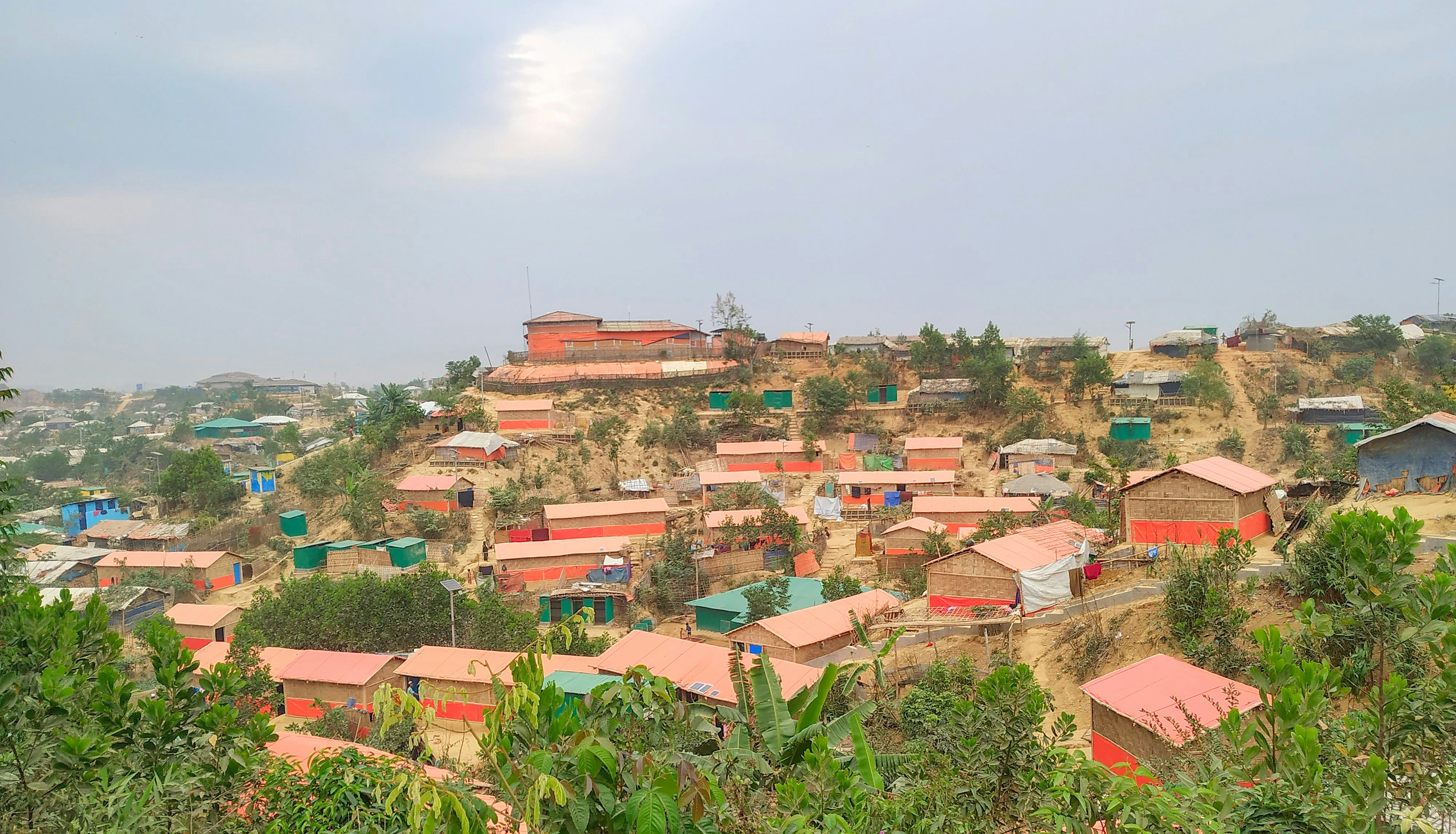
Those who fled to Bangladesh mostly reside in Cox’s Bazar in decrepit conditions. An overcrowded maze of tarpaulin and bamboo, it’s over eight years into what was meant to be a temporary emergency shelter. The population is entirely dependent on humanitarian aid, which has been gutted by geopolitical re-prioritization and global inflation. With President Trump’s decimation of USAID, for example, multiple hospitals in Cox’s Bazaar have shut down.25 The World Food Programme also slashed food rations to the caloric minimum in early 2025 due to lack of funding, and it now stands at about $6 per person per month.26
There are few statistics that adequately convey the enormity of this catastrophe. The mortality rate for children under five is over 30%. Refugee children are experiencing the worst degree of malnutrition since 2017. Children and teens are trafficked into prostitution at an unfathomable scale:27
“My family have disappeared. I have no money. I was raped in Myanmar. I used to play in the forest with my brother and sister. Now I don’t remember how to play.”
Beyond these borders, tens of thousands have drifted farther afield to Malaysia, Indonesia, Thailand, India, Pakistan, and beyond via irregular routes. Some have lived in Saudi for decades.28 Others are locked in detention centers.
Few are given any durable solution: neither resettlement, local integration, nor repatriation. They are simply told to wait, with no timeframe, in countries that neither want to absorb them nor invest in their return. Their plight goes largely unknown.
Photo by Sadek Husein on Unsplash
Disclaimer: Material published by Traversing Tradition is meant to foster scholarly inquiry and rich discussion. The views, opinions, beliefs, or strategies represented in published articles and subsequent comments do not necessarily represent the views of Traversing Tradition or any employee thereof.
Works Cited:
- United Nations News. “150,000 Rohingya Flee to Bangladesh amid Renewed Myanmar Violence.” UN News, 11 July 2025, https://news.un.org/en/story/2025/07/1165369. [↩]
- “Over 400 Rohingya Feared Drowned in Two Shipwrecks off Myanmar Coast: UN.” Al Jazeera, 24 May 2025, https://www.aljazeera.com/news/2025/5/24/over-400-rohingya-feared-drowned-in-two-shipwrecks-off-myanmar-coast-un. [↩]
- [Kaman Muslims Are Not Allowed to Apply for Passports].”BNI Online, 6 Sept. 2023, https://www.bnionline.net/mm/news-101389. Original title: အစ္စလာမ်ဘာသာ ကိုးကွယ်သည့် ကမန်တိုင်းရင်းသားများ နိုင်ငံကူးလက်မှတ် ပြုလုပ်ခွင့်မရဖြစ်နေ. [↩]
- Leider, Jacques. “Rohingya: The History of a Muslim Identity in Myanmar.” Oxford Research Encyclopedia of Asian History. May 24, 2018. Oxford University Press. Date of access 5 Nov. 2025, https://oxfordre.com/asianhistory/view/10.1093/acrefore/9780190277727.001.0001/acrefore-9780190277727-e-115. [↩]
- Fair, C. Christine. “The Making of the Rohingya Genocide and Myanmar’s Impunity.” Current History, vol. 118, no. 807, 2019, pp. 149–53. JSTOR, https://www.jstor.org/stable/48614437. Accessed 8 Nov. 2025. [↩] [↩]
- Leider, Jacques P. Rohingya: The Foundational Years. Policy Brief Series, no. 123, Torkel Opsahl Academic EPublisher, 2020. https://shs.hal.science/halshs-03050687/document. [↩] [↩]
- Fair, C. Christine. “The Making of the Rohingya Genocide and Myanmar’s Impunity.” Current History, vol. 118, no. 807, 2019, pp. 149–53. JSTOR, https://www.jstor.org/stable/48614437. Accessed 8 Nov. 2025. [↩]
- Zawacki, Benjamin. “Defining Myanmar’s “Rohingya Problem”” Human Rights Brief 20, no. 3 (2013):18-25 [↩]
- Abrar, C.R. 1994. Repatriation of Rohingya Refugees. Forced Migration Online. Retrieved from: https://www.burmalibrary.org/sites/burmalibrary.org/files/obl/docs/Abrar-repatriation.htm [↩]
- Rhoads, Emily L. “Citizenship Denied, Deferred and Assumed: A Legal History of Racialized Citizenship in Myanmar.” Citizenship Studies, vol. 27, no. 1, 2022, pp. 38–58. Taylor & Francis Online, https://doi.org/10.1080/13621025.2022.2137468. [↩] [↩]
- Iselin Frydenlund. Buddhist Justifications of Violence during the 2017 Rohingya Refugee Crisis. 2020. https://shs.hal.science/halshs-03151055/document. [↩]
- https://www.newmandala.org/sitagu-sayadaw-justifiable-evils-buddhism/ [↩]
- Beech, Hannah. “Myanmar’s Buddhists Are Protesting. But Not for the Rohingya.” Foreign Policy, 16 Feb. 2021, https://foreignpolicy.com/2021/02/16/myanmar-rohingya-coup-buddhists-protest/. [↩] [↩]
- Hannah Beech, The Face of Buddhist Terror, Time, July 1, 2013, https://time.com/archive/6643742/the-face-of-buddhist-terror/. [↩]
- Bookbinder, Alex. “969: The Strange Numerological Basis for Burma’s Religious Violence.” The Atlantic, 11 Apr. 2013, www.theatlantic.com/international/archive/2013/04/969-the-strange-numerological-basis-for-burmas-religious-violence/274816/. [↩]
- Rashid, Zaheena. “In Sri Lanka, Hate Speech and Impunity Fuel Anti-Muslim Violence.” Al Jazeera, 13 Mar. 2018, https://www.aljazeera.com/news/2018/3/13/in-sri-lanka-hate-speech-and-impunity-fuel-anti-muslim-violence. [↩]
- Holt, John Clifford (ed.), ‘A Religious Syntax to Recent Communal Violence in Sri Lanka’, in John Clifford Holt (ed.), Buddhist Extremists and Muslim Minorities: Religious Conflict in Contemporary Sri Lanka (New York, 2016; online edn, Oxford Academic, 20 Oct. 2016), https://doi.org/10.1093/acprof:oso/9780190624378.003.0009, accessed 14 Nov. 2025. [↩]
- Matthew J. Walton, Buddhism, Politics and Political Thought in Myanmar, 2016 [↩]
- International Commission of Jurists. “Thailand: One Year On, Still No Statute of Limitations Reform in Tak Bai Massacre Case.” ICJ, 24 Oct. 2005, https://www.icj.org/thailand-one-year-on-still-no-statute-of-limitations-reform-in-tak-bai-massacre-case/. [↩]
- Christopher Ives, Imperial-Way Zen: Ichikawa Hakugen’s Critique and Lingering Questions for Buddhist Ethics. [↩]
- David McMahan, The Making of Buddhist Modernism, 2008. [↩]
- “Aung San Suu Kyi: Myanmar’s Leader Defends Country at ICJ.” BBC News, 11 Dec. 2019, https://www.bbc.com/news/av/world-asia-50709830. [↩]
- Beech, Hannah. “Aung San Suu Kyi Defends Myanmar Against Rohingya Genocide Accusations.” The New York Times, 11 Dec. 2019, https://www.nytimes.com/2019/12/11/world/asia/aung-san-suu-kyi-rohingya-myanmar-genocide-hague.html. [↩]
- Medet, Halil Ibrahim. “Rohingya Muslims Face New Threat from Arakan Army after Being Persecuted by Myanmar Military.” Anadolu Agency, 3 Dec. 2024, updated 4 Dec. 2024, https://www.aa.com.tr/en/asia-pacific/rohingya-muslims-face-new-threat-from-arakan-army-after-being-persecuted-by-myanmar-military/3412335. [↩]
- Amnesty International. “Bangladesh: International Community Must Act to Avoid Devastating Aid Cuts for Rohingya Refugees.” Amnesty International, 13 Mar. 2025, https://www.amnesty.org/en/latest/news/2025/03/bangladesh-international-community-must-act-to-avoid-devastating-aid-cuts-for-rohingya-refugees/. [↩]
- Ahmed, Kaamil, and Shaikh Azizur Rahman. “World Food Programme Halves Food Rations for Rohingya in Bangladesh.” The Guardian, 6 Mar. 2025, https://www.theguardian.com/global-development/2025/mar/06/world-food-programme-food-rations-rohingya-bangladesh. [↩]
- “The Rohingya Children Trafficked for Sex.” BBC News, 21 Mar. 2018, https://www.bbc.com/news/world-asia-43469043. [↩]
- Werleman, C.J. “Why Is Saudi Arabia Deporting Rohingya Refugees?” TRT World, 25 Jan. 2019, https://www.trtworld.com/opinion/why-is-saudi-arabia-deporting-rohingya-refugees-23403. [↩]
Hashmi is best known for her project, Muslims Condemn. She is an Attorney based in the U.S. with a background in Molecular, Cellular, & Developmental Biology and Linguistics. Her interests include the Islamic sciences, specifically legal philosophy and Maliki fiqh, cognitive linguistics, and bioethics.
Leave a Reply