
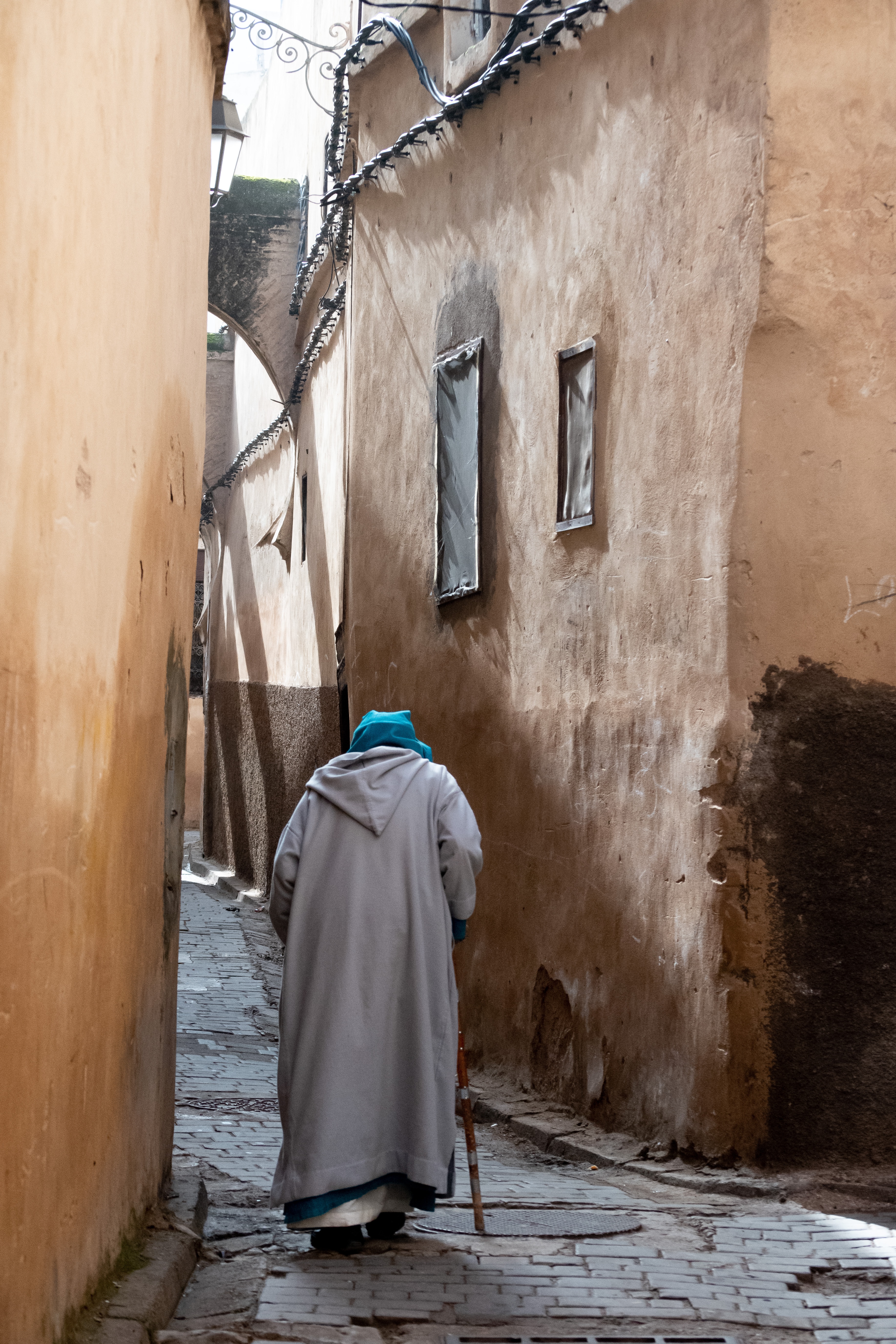
Cloak billowing greyed and dirty
Eyes cast down modest and lowly
Walking through this glittering city
Stick in hand, caravan in tow
Lips parched and footsteps slow
In this land, so strange
In this place of no restraint
In this towering, beckoning mirage of escape
You journey through.
In his book The History of the World, after detailing the epic explosion of Islam in the Arabian Peninsula, Andrew Marr concludes that the Prophet Muhammad’s ﷺ goal of spreading Islam across the world has failed. From his narrow and unimaginative perspective, Marr is unable to see what is glaringly obvious to Muslims: Allah, The Lord of time itself, plans and maneuvers His objectives over the entirety of human history.
The account of Taa’if alone epitomizes how the unwavering focus and mercy of the Prophet Muhammad ﷺ set into motion a tidal wave of change, even if the fruits were not witnessed in the lifetime of that Most Perfect of Creation ﷺ, who took refuge under a tree, blood sticking his blessed feet to his shoes. For when Islam eventually entered the hearts of the people of Taa’if as the Prophet ﷺ had prayed for, it was a descendant of theirs, Muhammad Ibn Qasim, who extended Umayyad rule into India and introduced Islam to the humid and luscious landscape of South Asia. Many centuries later, when a pummelled post-war Britain passed the British Nationality Act (1948) and citizenship became accessible to the newly independent Commonwealth, terraced homes of Muslim-South Asian mill workers lined the streets of British industrial towns. Thus, beyond what seemed conceivable a millennium ago, the seemingly strange message of the Prophet Muhammad ﷺ and his unlikely community became the conviction of Muslims from Mecca to Manchester and the world over.
May peace and blessings forever be on Sayyiduna Muhammad ﷺ.
The rich history of the Muslim diaspora varies from culture to culture, but in every Western country where our children are raised, we are collectively othered. While our ethnic and racial differences may have been the first victims of bigotry, post-9/11 the West overtly turned its aggression onto our faith. The subsequent War on Terror ensured this unmooring, its brutality forcing Muslims to flee their homelands, making up the majority of the roughly thirty-seven million people displaced worldwide.1 Like the Commonwealth immigrants before him, a Muslim refugee skirts on the edge of society, a social pariah and a nationalist’s scapegoat.
In democratic political systems, despite the noisy claims of representation, this ostracization continues. As the popular adage goes, the Right seeks to destroy Muslims; the Left seeks to destroy Islam. And so, in the polarized arenas of Western politics, we are exiled for refusing to subscribe to wholesale party-politics, instead interrogating the notion of blanket voting and highlighting the limits and hypocrisies of mobocratic power. In states with no democratic mechanisms, entire Muslim communities are imprisoned or driven out, and, like the cruelty that faces the Uyghurs in China, our faith is considered a cultural threat to be stamped out.
Even in predominantly-Muslim countries, Western hegemony works to uproot long-lasting Islamic values, not satisfied with mere geographical and political plundering, but instead brazen in their insistence that Muslims denounce the very beliefs that make us people of faith. Our committed and ardent support for the Palestinian resistance and rejection of the LGBTQ agenda are two salient examples that assert the Ummah’s independence of opinion, no matter the size and spin of the well-funded opposition.
They implore you to stay
Sweeping a hand at their castles of clay
“Where are you going? What do you seek?
This is a city of great reprieve!”
They sell you potions of wistfulness
Ointments of calm
Cylinders of joy and deceitful charm
And all the while
A storm rages above
Growing and darkening like a falling robe
Smothering the alleys
Choking the streets
Thick with lies, and rage, and insatiable greed
And in their eyes you see
Beyond the facade of smiling gaiety
A gaping loneliness
A chasm of grief
A dark, long quarry to depravity
In Crime and Punishment, Svidrigailov, the protagonist’s foil, argues that “ghosts only appear to sick people,” because ghosts are “scraps and shreds of other worlds” which “a healthy person, naturally, has no need to see (being) earthbound.” But when a person falls ill “the normal terrestrial ordering of his body is impaired, the possibility of another world begins to show himself.”(( Dostoevsky, Fyodor. Crime and Punishment. Oxford University Press, 2019.))
What if, borrowing Svidrigailov’s argument, we swapped sickness with strangeness, and considered our alienation as a gateway to higher spiritual planes?
In the Islamic tradition, Allah reveals the world of the unseen — angels, jinn, and heaven and hell — to those who have estranged themselves from the depravity of their societies. Because of their divine strangeness, Messengers are sent revelation, Anbiya and Awliya can communicate with the jinn, and all act as a bridge between the two worlds. While access of such degree is reserved for a distinguished few, the feeling of otherworldliness remains attainable for us all.
In Allah’s infinite wisdom, Shariah has maintained its mandate on physical, exterior worship, setting the very bodily and outward identity of a Muslim apart from others. Thereafter, our values, the timelessness of our moral code and the spiritual lingua franca we use to communicate unhook us from the tendrils of this life, set us outside the rigmarole and serve as a portal to heaven. A pause in the supermarket to scan a list of ingredients, adjusting the hijab in the reflection of a window, checking the time for prayer before a journey, each of these moments make us strangers to this life of limitations. Each is a checkpoint as we journey back to Allah.
And these actions do not transform only us. Like Svidrigailov’s ghosts, the metaphysical realm glides over, cleans the condensation off our singular perspective and adorns the world around us. The small room in a corporate high rise is stacked with angels of light during salah; a jigsaw of a modest outfit becomes an act of submission; the halal butchers and interest-free bank accounts each metamorphose from their base ambitions to goals far loftier. Thus, our righteous actions are a balm for the natural world and emit a glow in the spiritual dimensions, the opposite of a “relieving” disbeliever whose death, the Prophet Muhammad ﷺ said, “relieves the people, the land, the trees, (and) the animals from him.”((Sahih al-Bukhari, Kitab Al Riqaq, Hadith 6512)) The act of standing above the parapet, therefore, is not merely our honor but our duty. And, the need for upstanding believers has never been more urgent:
Christianity ultimately succumbed to the unrelenting pursuit of modernity in the 1960s with the establishment of Vatican II, following a history of muddying and outright falsifying the religion sent to Jesus, upon him be peace,2 Judaism, already corrupted by its followers’ refusal to accept the prophethood of Muhammad (saw), has evolved into an identity that exists outside of religious practice with “Jewishness” regarded as a patchwork of ancestry, culture and race far more than it is a steadfast, faithful obligation3.
Thus, Islam remains the only major monotheistic religion that has not yet yielded.
In the storm of hyper-secularity, quasi-spiritual self-centredness and illogical gender reconstructions, Muslims still stand. Over a century of colonialism and twenty years of the War on Terror have not prevented the Ummah from resisting efforts to placate us. It seems the concerted effort to sideline and ostracize Muslims, to shun our values and discredit our beliefs, has tempered a resilient people.
With full faith in Allah’s promise to preserve His book, we know Islam will survive. What is yet to be determined is the role we each play in its conservation. In our personal spheres, our schools, workplaces and communities, when we feel pushed out into the social wilderness, strangers to the last party of civilization, how strongly we hold our ground, unapologetically champion Islam, and with eyes set firmly on the hereafter, remain true to our purpose will determine our part in preserving this beautiful faith.
Recall the early years of the Seerah, when traveling pilgrims met Qurayshites manning the roads to Mecca warning them of a sorcerer and madman amongst them. Then think of our Beloved Prophet ﷺ — ridiculed and abused — unrelenting in his divine mission, no matter the sacrifice. In embracing the strangeness long attributed to being Muslim, we follow the legacy of our beloved Prophet Muhammad ﷺ and his esteemed Sahaba, both in participating in an Ummah-wide resistance and striving for personal salvation.
And so, onwards we walk
Cloaked strangers to this land
Clutching our guiding sticks, close at hand
Our footsteps following a straight, clear path
Smiling at the glad tidings of those who’ve passed.
It was narrated from Abu Hurairah that the Messenger of Allah ﷺ said: “Islam began as something strange and will go back to being strange, so glad tidings to the strangers.’”4
Disclaimer: Material published by Traversing Tradition is meant to foster scholarly inquiry and rich discussion. The views, opinions, beliefs, or strategies represented in published articles and subsequent comments do not necessarily represent the views of Traversing Tradition or any employee thereof.
Photo by Carlos Torres on Unsplash
Works Cited:
- Mohammed, Jahangir. “An Ummah of Refugees: Our Treatment of Muslim Refugees fails the Test of Brotherhood.” Ayaan Institute, 16 Jan. 2021, https://ayaaninstitute.com/expertise/analysis/an-ummah-of-refugees-our-treatment-of-muslim-refugees-fails-the-test-of-brotherhood/ [↩]
- Brown, Andrew. “How the Second Vatican Council Responded to the Modern World | Andrew Brown.” The Guardian, Guardian News and Media, 11 Oct. 2012, http://www.theguardian.com/commentisfree/andrewbrown/2012/oct/11/second-vatical-council-50-years-catholicism. AND Douthat, Ross. “How Catholics Became Prisoners of Vatican II.” The New York Times, The New York Times, 12 Oct. 2022, http://www.nytimes.com/2022/10/12/opinion/catholic-church-second-vatican-council.html. [↩]
- “2. Jewish Identity and Belief.” Pew Research Center’s Religion & Public Life Project, Pew Research Center, 11 May 2021, http://www.pewresearch.org/religion/2021/05/11/jewish-identity-and-belief/. [↩]
- Ibn Majah, Kitab Al Fitan, Hadith 61 [↩]
Amirah Chati
Amirah Chati is an alimiyyah graduate with a Bachelor’s degree in the UK. An ardent follower of politics and current affairs, she hopes to center the role and values of a Muslim in her writing, combining her teaching in the local madrasah with policymaking and research.


Leave a Reply to Sheikh Faizan NabiCancel reply