
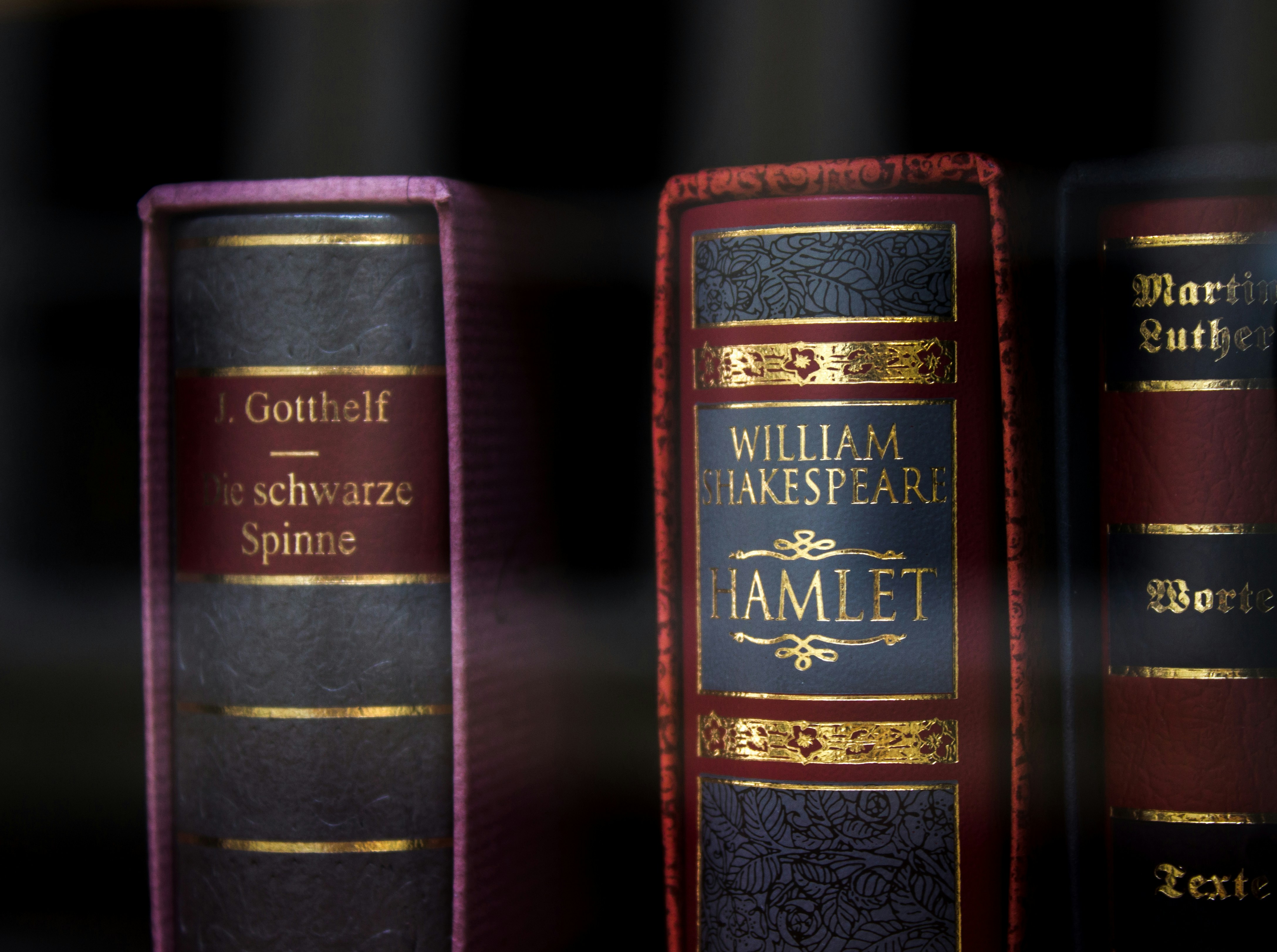
Hamlet. The name can be synonymous to “hero” or “villain.” Feminists may paint him as misogynistic because of his dialogue towards Gertrude and Ophelia, while communists might characterize Hamlet as a thwarted revolutionary in his struggle against Claudius and Polonius. So which view is the correct one? Is there a correct one? The glasses recommended by Islamic literary theory gives us the picture that William Shakespeare intended us to see him with: sweet prince. A Muslim paradigm helps one empathize with the character as he should be understood—a heroic youth’s tragedy against old villainous tyranny.
Islamic literary theory, as defined by Dr. Fawzia Gilani-Williams, is “an empowerment theory that seeks to provide morally-centric emancipatory perspectives grounded in the teachings of the Quran and authentic Sunnah.”1 The Qur’an is a Muslim’s primary source of dīn (way of life), and how they understand the world around them. As a result, I may mention a ḥukm (ruling) while not giving the ḥikm (reasoning). This does not mean that the ruling has no reasoning. Rather, Muslims understand that a reasoning does not have to be provided by Allah (ﷻ) to believe that a ruling is beneficial. Examples include:
- Ḥukm: Alcohol is forbidden according to numerous sources (Quran 2:219, 4:43, and 5:90).
- Ḥikm: In 2:219, as mentioned above, the Quran says: “… They ask you ˹O Prophet˺ about intoxicants and gambling. Say, ‘There is great evil in both, as well as some benefit for people—but the evil outweighs the benefit…’”
- Conclusion: The Qur’an indirectly acknowledges that there could be health benefits for the heart, however, the mental impairment (referenced in 4:43) is also a consequence of the intoxicant.
- Ḥukm: After being widowed, a lady must wait four months and ten days before remarrying another man.
- Ḥikm: The verse only mentions the ruling; no ḥikm is mentioned.
- Conclusion: The ḥikm is open to qualified interpretation. Scholars like Shaykh Ahmed Saad Al-Azhari theorize that it can be for multiple reasons, such as verifying that there is no pregnancy, allowing a lady ample time to grieve, and also grant her the opportunity to heal.2
These rulings and reasonings are all too relevant for those familiar with Hamlet. In fact, non-Muslim historians like Margaret Litvin have drawn comparisons between Hamlet’s beliefs and those of traditional Islam:
…Hamlet loathes drinking (he calls it “swinish”), rails against unchastity, and believes that a “dram of evil” is enough to contaminate a whole person or even nation, however “noble” the remainder. His distrust of social conventions and appearance (“I know not ‘seems’”), of unregulated natural and social processes (“think rank and gross in nature”), and particularly things of the flesh (e.g., “O shame, where is thy blush?”) suggests a puritanism that wishes nature could be restricted by divine law. He invokes heavenly rewards and the power of prayer, choosing not to kill the kneeling Claudius lest he send him to heaven. He contemplates suicide and finds it theologically incorrect, yet he embraces martrydom.3
Why is the mention of unchastity relevant? Like alcohol, the ḥukm of premarital intercourse is that it is also forbidden.4 We never see Hamlet drink wine, even during the last battle with Laertes.5 An Islamic literary theorist may then assume this is a testament to a righteous character. Ophelia further confirms that notion by using words like “honorable” to describe his previous advances.6 These advances were in the form of letters, a milder way of showing affection. Some modern interpretations assert that the two could have been lovers, however, for Hamlet to remain a hero—and a foil to Claudius, the tempter of Gertrude. I argue that it is essential to believe that Hamlet was celibate, and pursued Ophelia nobly. In her words, he did so “[w]ith almost all the holy vows of heaven…”7 For Hamlet to then call out his mother’s infidelity in the “bedroom scene” would be hypocritical, and would lose the audience’s allegiance—especially those of the fairer sex. As Elizabethan scholar, John Dover Wilson, asserts in his What Happens in Hamlet: “Shakespeare asks every spectator to sympathise with his hero”8. Can it be “The Tragedy of Hamlet” if we do not mourn for what we believe to be his noble heart?
Let us discuss Hamlet’s angst as well as his affections. His internal conflict is multi-faceted. The first ghastly thorn is that his uncle has married his mother within a month. A disconnect with modern audiences is that “marriage laws are the subject of free discussion.”9 However, not so in Islam: as mentioned above, a widow must wait four months and ten days before remarrying. The marriage between Gertrude and Claudius in a Muslim country would not only be reprehensible, but illegal. For Claudius to tempt a grieving queen into a politically beneficial marriage for himself would add to the vileness of his character. Litvin also points out that Claudius has “excessive interest in Ophelia, whether as an attractive woman or as a source of subversive talk [“Pretty Ophelia. . . . Follow her close, give her good watch, I pray you”].”10 Hamlet was the next rightful ruler. However, Claudius has preyed upon a bereaved child, widow, and kingdom.
But Gertrude is not innocent, either. Hamlet was written during the Elizabethan reign. Shakespeare, as well as his audience, had been comfortable with a single woman as queen. The setting is irrelevant: “Hamlet is an English prince, the court of Elsinore is modelled upon the English court, and the Danish constitution that of England under the Virgin Queen.”11 Gertrude could have ruled without a king while Hamlet was at school. Something is rotten in the state of Denmark, then, for her to have, in her own words, an “o’erhasty marriage”.12
Considering all these details, we can look at Hamlet’s mourning in a sympathetic light:
A little month, or ere those shoes were old
With which she followed my poor father’s body
Like Niobe, all tears, why she, even she–
Oh, God! a beast that wants discourse of reason
Would have mourned longer–married with my uncle,
My father’s brother, but no more like my father13
For most, the thought of their uncle marrying their mother a month after the father’s death would churn their stomach, and would make them suspicious as well. Wilson also mentions an interesting piece of dialogue from the Ghost: that the marriage is “incestuous”14 It would only be “incest” if brother-in-law and sister-in-law were having an affair. According to the Qur’an’s 24th chapter, in its second verse, the punishment for adultery is one-hundred lashes to the unmarried person, and stoning (i.e. death) to the one who is. But the Ghost pleads for Hamlet to leave Gertrude alone, and for his son to kill Claudius. Similarly, death is also the ruling given for manslaughter.15 To have Claudius killed is more than a moral obligation—it is a religious one, one that Hamlet would be justified in seeking (however, Islamic theorists would disagree about Hamlet being justified in undertaking).
The capital punishments above may appear harsh. However, the stipulations for those punishments are also strident. For adultery, there must be four witnesses to testify16 unless the two confess. Neither of the perpetrators will, especially Claudius, who also committed regicide. Additionally, the one who claims something must also bring the proof for it.17 Hamlet acknowledges that the ghost may have been a figment of his imagination (Hamlet, 3.2, 83-85), and thus comes up with the idea of the play in order to test his uncle’s reaction.
But even for a Muslim, especially a Muslim woman, his speech towards Ophelia in the “nunnery scene” is more than concerning. Based on the dialogue that Hamlet and Polonius partake in, the young knave is all-too-aware of the plot to use Ophelia as bait.18 Thus, “Hamlet’s words to her are meant for the ears of them both.”19 This act could potentially be seen as permissible, as the Prophet ﷺ said: “War is deceit.” (Bukhari 3029). In a sense, Hamlet has declared war against the king, and being robbed of his throne, must resort to ample methods to overcome him. As previously mentioned, a God-fearing Islamic theorist would not agree with the exact execution of Hamlet’s deceit to Ophelia. This would merely explain his behavior—not excuse it entirely.
Excuses are also a part of Islamic law. Just like common law, there are instances of insanity. Within Islam, one who acts while being majnun (insane) is not held accountable for their actions. Hamlet admits openly that he suffers from melancholy.20 Notably, his “to be or not to be” speech is one that has him debating on suicide from the disgust he feels about his mother’s incest and his father’s murder. We never see Hamlet except in all black,21 and in the “closet scene,” Ophelia reports:
My lord, as I was sewing in my chamber,
Lord Hamlet, with his doublet all unbraced,
No hat upon his head, his stockings fouled,
Ungartered, and down-gyvèd to his ankle,
Pale as his shirt, his knees knocking each other,
And with a look so piteous in purport
As if he had been loosèd out of hell
To speak of horrors, he comes before me.22
Most people have not seen a dead body. But most people can agree that it would be a traumatic experience, one that would be difficult to recover from. To wash a body is an act of worship in Islam, as well as a show of camaraderie for a fellow Muslim.
The sight of a dead body is jarring enough—but a ghost that can speak? To an extent, Hamlet’s “antic disposition” may be put on, but scholars such as Wilson note that his mental instability only grows as the play proceeds. Gertrude calls her son “poor wretch”23 after noticing his mental state—the same words she uses to describe Ophelia after she drowns.24
Ophelia also regards Hamlet as a madman during “The Mousetrap”25, and even stated “Oh, what a noble mind is here o’erthrown!”26 after he rejected her. Polonius acknowledges that Hamlet is mad.27 Thus, many of Hamlet’s following actions, like the murder of Polonius—would be, Islamically speaking, acts of temporary insanity. “When Hamlet tells us that he is subject to ‘a sore distraction’ and killed Polonius in madness we are expected to believe him.”28 That grace would also be extended to Ophelia, as her suicide—while a forbidden act—was also undertaken while she was in a state of junun (insanity). As beautifully stated in Hamlet’s Arab Journey: “The English poet does not limit his story to a specific people or to a particular instance of the human condition, but treats human beings, whatever their nation.”29 Indeed, a “Moorish” reading of the Elizabethan Hamlet—not Othello—makes us more sympathetic to the main character. Perhaps, an Islamic theorist can understand Hamlet as he was always meant to be—and not to be.
Photo by Max Muselmann on Unsplash
Disclaimer: Material published by Traversing Tradition is meant to foster scholarly inquiry and rich discussion. The views, opinions, beliefs, or strategies represented in published articles and subsequent comments do not necessarily represent the views of Traversing Tradition or any employee thereof.
References:
- Dr. Gilani-Williams, Fawzia. “An Introduction to Islamic Literary Theory: A Conceptual Framework for High School Students.” Bloom Charter School Libraries, Al Ain, United Arab Emirates. 2023. [↩]
- Anon. “I valued my Iddah period.” https://www.mariecurie.org.uk/talkabout/articles/iddah-was-my-time-to-heal-mourn-and-reflect-after-my-husbands-death/273522 mariecurie.org.uk [↩]
- Litvin, Margaret. Hamlet’s Arab Journey: Shakespeare’s Prince and Nasser’s Ghost. Princeton University Press, 2011. [↩]
- Quran 17:32 [↩]
- Hamlet, 5.2, 227 [↩]
- (Hamlet, 1.3, 111 [↩]
- Hamlet, 1.3, 114 [↩]
- Wilson, 44 [↩]
- Wilson, 39 [↩]
- Litvin, 173 [↩]
- Wilson, 28 [↩]
- Hamlet, 2.2,57 [↩]
- Hamlet, 1.2, 147-152 [↩]
- Hamlet, 1.5, 42 [↩]
- Quran 2:178 [↩]
- Quran 24:4 [↩]
- al-Sunan al-Kubrá lil-Bayhaqī 21201 [↩]
- Wilson, 104-107 [↩]
- Wilson, 114 [↩]
- Hamlet, 2.2, 605 [↩]
- Wilson, 96 [↩]
- Hamlet, 2.1, 77-84 [↩]
- Hamlet, 2.2, 168 [↩]
- Hamlet, 4.7, 157 [↩]
- Wilson, 182 [↩]
- 3.1, 151 [↩]
- 2.2, 204 [↩]
- Wilson, 217 [↩]
- Litvin, 74 [↩]
Hannah Alkadi
Hannah Alkadi rights the wrongs in our world by writing about them—in essays, poetry, and short stories. She is a freelance writer, upcoming children’s book author, and MFA Candidate in Writing for Children and Young Adults.
Leave a Reply