
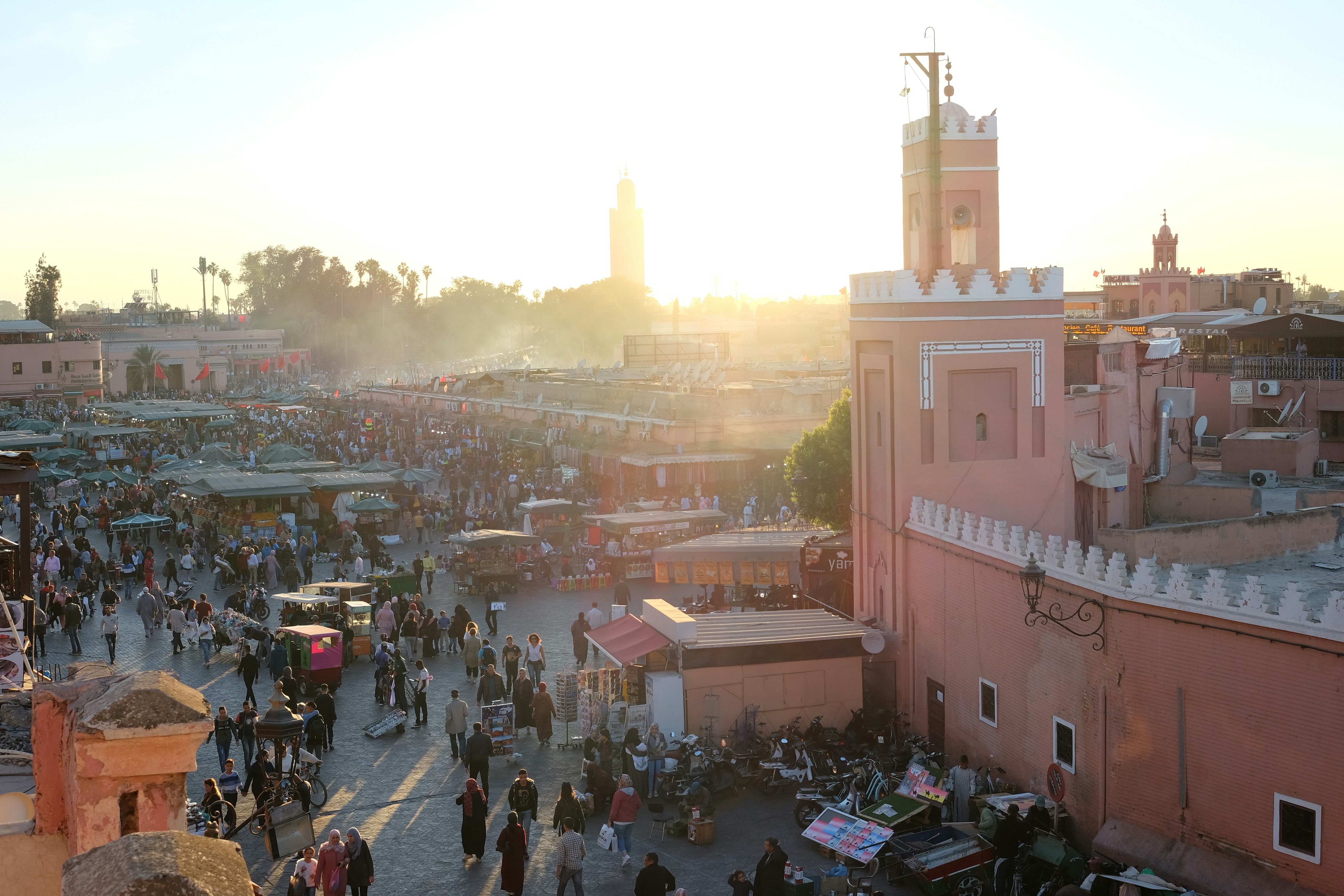
In a world of sprawling malls and Amazon Prime, it can be hard to fathom, much less appreciate, the significance of a morally infused economic space. The Ramadan/Eid bazaar offers us a practical example.
These seasonal bazaars are a hubbub of energy, bringing communities together prior to the sacred semi-hibernation period of Ramadan. They are a space to meet friends and run into long-lost acquaintances (and stray family members). To some, the Ramadan bazaar may appear to be an explosion of unregulated energy prior to a month of endurance and scarcity, yet many such bazaars maintain a reference to sacredness in terms of how they are designed (e.g. by donating proceeds to charity), the products they market (for Ramadan and Eid), and the spaces they utilize (mosque parking lots, foyers). Most importantly, however, the bazaar itself demonstrates a uniquely Islamic way of practicing morality and ethics.
For Muslims, it would have been difficult to imagine a society that totally separated the economic domain from the religious/moral; yet, we live in a world that seems to do just that. In this world, a bazaar is inherently unholy, motivated by selfish pursuits—a problem to be overcome. The natural outcome of this approach leaves the pursuit of economics open to unscrupulous moral actors, governed only by procedures and laws (which societies themselves create).
The Islamic view is also not exempt from the tension between the sacred and the profane. For instance, the Qur’an often criticizes the economic and social domains, describing them as ‘ornaments’, here to distract. What, then, saves our tradition from rejecting such pursuits? The most direct response is not found in a unique or esoteric interpretation of the verses, but in the exemplar of the Prophet, peace be upon him. In a classic narration, the Prophet is joyfully distracted from delivering a sermon by the colorful entry of his beloved grandsons.1) He steps down from the pulpit to pick them up in his arms, reciting the very same Qur’anic verse2 that alludes to wealth and children being trials of the world, adding, “I saw these two and I was not able to have patience,” before returning to his sermon. Through his words and actions, he reconciled the reality of the world and the reality of ideals, offering Muslims a tangible model to follow.
In Ramadan/Eid bazaars held at mosques, this tension is beautifully at play in the laws and systems governing economic activity. For example, transactions are not permitted inside a mosque. Does that mean transactions are desacralized, devoid of blessings, and/or in the domain of something mundane or simply necessary? If that were the case, there would be no meaning in much of our daily activities, and much guilt surrounding the necessary pursuits of life. Instead, the careful demarcations of space suggest that laws should not be interpreted beyond their scope; if something is prohibited inside of the mosque, or at a specific time, it does not imply that the action itself is intrinsically wrong or harmful in any way. To the contrary, that same action may be obligated in a different space or context. Thus, the role of economic law in Islam is not to create a boundary between sacred and non-sacred spaces in order to prioritize one over the other; rather, it is to enable both: worship and the pursuit of wealth in a harmonized manner.
The challenge for Muslims is not to keep our worlds separate, nor to divest morality from our economic and political life, but to integrate the two as closely as possible, despite the real tension between them. Instead of allocating time for God on Friday in order to be free to do as we like for the rest of the week, we actively seek out spaces of economics, politics, and family life to implement our values, ideals, and laws. In doing so, we work carefully to identify the ubiquitous “wall of the mosque,” that is, to ascertain the boundaries between the spaces we traverse, to fulfill what is always due to God, in every time and in every space.
Of course, the obtaining (or study) of morals or laws occurs in a manner that is abstract from the demands of a political or economic life, yet it remains informed by them. The Ramadan/Eid Bazaar, then, becomes a means to embody or express your moral values. Economic, political, and family life is not pursued to learn how to become, but to embody becoming, a moral person.
Disclaimer: Material published by Traversing Tradition is meant to foster scholarly inquiry and rich discussion. The views, opinions, beliefs, or strategies represented in published articles and subsequent comments do not necessarily represent the views of Traversing Tradition or any employee thereof.
Bilkis B.
Bilkis is a student and teacher. She enjoys teaching writing, and often writes to digest, generally from the perspective of Islam in America. More could be said, but an author is best known through their work.
Leave a Reply