
A Book Review of Between Nation and ‘Community’: Muslim Universities and Indian Politics after Partition by Laurence Gautier
In his reflections on the role of universities, Social theorist and philosopher Jürgen Habermas asserts that they are “ideally suited places for the discussion of political issues.”1 Laurence Gautier’s Between Nation and Community is a compelling exploration of this notion, particularly in the context of post-colonial India, where the nation struggled to reconcile its partition-induced communal fractures. The book examines how Muslim minority institutions—such as Jamia Millia Islamia (JMI) and Aligarh Muslim University (AMU)—negotiated their dual roles in addressing the concerns of the Muslim community in post-Partition India while simultaneously contributing to the larger project of nation-building.
Gautier situates these institutions at the crossroads of identity and allegiance, exploring their complex positioning within an evolving political landscape. By invoking Gyanendra Pandey’s thought-provoking question, “Can a Muslim be an Indian?”, she underscores the existential dilemmas faced by these institutions and their students in a newly independent nation still grappling with communal anxieties. Through her examination of historical narratives and institutional policies, she challenges long-standing assumptions and reinterprets the ideological foundations upon which these universities were established. What makes Gautier’s work particularly significant is her ability to transcend conventional historiographical approaches, offering a nuanced analysis that disrupts normative understandings of these universities. Rather than viewing them through a singular lens of religious or nationalist identity, she presents them as dynamic spaces of intellectual and political contestation. In doing so, Between Nation and Community enriches contemporary debates on secularism, education, and minority rights in India, making it an essential read for scholars of South Asian history, political science, and education studies.
The book Covers JMI’s firm balance between preserving the minority’s cultural identity and achieving political compromise in what was a newly independent country. It conceptualizes the importance of this balancing approach within the relevant historical context and the positionality of Indian Muslims. By exploring the ‘composite nationalism’ of Islamic Scholar Hussain Ahmed Madani, Gautier demonstrates the institute’s significance as a pluralistic and inclusive space. Moreover, the author examines the Congress’s nascent approach at Jamia to secularize religious differences by fostering a sense of cooperation and togetherness in independent India. Gautier articulates the Nehruvian model of a secular state as reflected in Jamia’s cultural and intellectual infrastructure post-partition, which aimed to eliminate the sense of otherness among Muslims and promote emotional integration.
Additionally, Gautier highlights Jamia’s distinct pedagogical and epistemological methods that embrace the idea of secularism. By equating the notions of a good Muslim and a good Indian, JMI sought to cultivate an ethos of emotional integration that could overcome the mutually exclusive understanding of Hindus and Muslims exacerbated by partition. Gautier’s central theme is that to rebuild a sense of oneness in postcolonial India, Nehru incorporated Gandhian ideas and argued for a spiritual tendency that would transcend the majority-minority dichotomy, as described by Appadurai’s concept of the ‘Fear of Small Numbers’.2 However, the harmony between majority and minority within a secular polity remains a subject of scholarly debate, as seen in works like Talal Asad’s “Formation of Secular.”3
Gautier’s exploration, however, oversimplifies many of the intricate nuances surrounding Jamia by reducing the institution to merely a secular nation-state project. This analysis neglects to highlight the inception phase, during which figures such as Muhammad Iqbal and Shabir Ahmad Usmani—among others—proposed critical visions of what Jamia should represent. Furthermore, this oversimplification fails to address the internal controversies during the British colonial administration given the ideological tensions between the Muslim League and the Indian National Congress over Jamia’s identity as a university. These debates are exemplified by issues such as Iqbal’s refusal to assume leadership of the institution, a pivotal moment that underscores the complexities of its founding era.
On the contrary, at the time of partition, AMU was navigating an existential crisis in the newly independent, postcolonial state of India due to its historical association with the Pakistan movement. This book delves deeper into AMU’s intricate commitment to the Muslim community, examining its educational and cultural significance in the context of upholding the post-partition secular commitment to the Congress-led nation-building project. Gautier’s exploration highlights the role of Nehruvian ideology in transforming AMU’s normative structures, shifting its identity from a Muslim university to a national university. Moreover, the book underscores AMU’s significance in shaping the cultural imperatives of Indian Muslims and their theological commitments after partition, which resulted in a substantial loss of the Muslim population to Pakistan, thereby diminishing its numerical influence in the subcontinent. A critical juncture in Gautier’s analysis is her historical survey of the challenges faced by a marginalized Muslim community given the statistics revolving around education. Additionally, she explores the deep-rooted presence of Islam within AMU through examples such as ideological clashes between Marxist and Muslim students and the tensions between the Nehruvian secular model and Islam as a socio-political system. Gautier’s nuanced study positions AMU and JMI at the crossroads of nationhood and community (Qom), articulating their multiple roles in shaping national imagination, Muslim identity, secularism, and cultural preservation.
The political structure of the postcolonial Indian state could not sustain the Nehruvian secular consensus for long. By the early 1960s, socio-political cleavages along communal, caste, and linguistic lines began shaping the public sphere, a phenomenon Christophe Jaffrelot described as ‘silent revolutions.’ Gautier argues that the absence of a dominant Muslim political party capable of bargaining with the Indian state was compensated for by the inherently political nature of these institutions. Moreover, she acknowledges the role of JMI and AMU as significant political sites. Her analysis of minority politics in India envisions these institutions as arenas for political bargaining and negotiation, particularly in relation to Muslim subjectivity, as exemplified in Salman Rushdie’s controversial The Satanic Verses and the Ayodhya movement. 4
Furthermore, Gautier asserts that JMI and AMU have remained crucial spaces for intra-Muslim debates and contestations regarding Islamic values and culture. Additionally, the book critically examines the nature of religious discourse, engaging with the tension between continuity and change in religious phenomena—what Talal Asad conceptualizes as ‘Islam as a discursive tradition’.5 It explores how religious practices and beliefs are shaped by historical, cultural, and social contexts, highlighting the fluidity of religious identities. The book also addresses how religious authority and power are negotiated within these discourses, emphasizing the role of language in the construction of religious truths. In doing so, it provides a nuanced understanding of how religious traditions evolve while maintaining certain foundational elements.
Although the book takes into account the importance of these institutes after partition until the 1990s, it primarily highlights the significance of these institutions in relation to contemporary political contestations. The political culture that evolved post-1990s marks a significant break from earlier political trajectories, and these universities shape various aspects of Indian Muslims’ political understanding. She underscores the importance of these universities in both inter- and intra-community relations, with an emphasis on Muslim women in addressing political discourses and discontinuities. Ultimately, she articulates inter-subjective nuances to safeguard the community from internal and external contradictions.
On a concluding note, this book stands out as a remarkable intellectual exercise due to its archival and historical sources and methodology, which transcend the normative historiography of these universities.
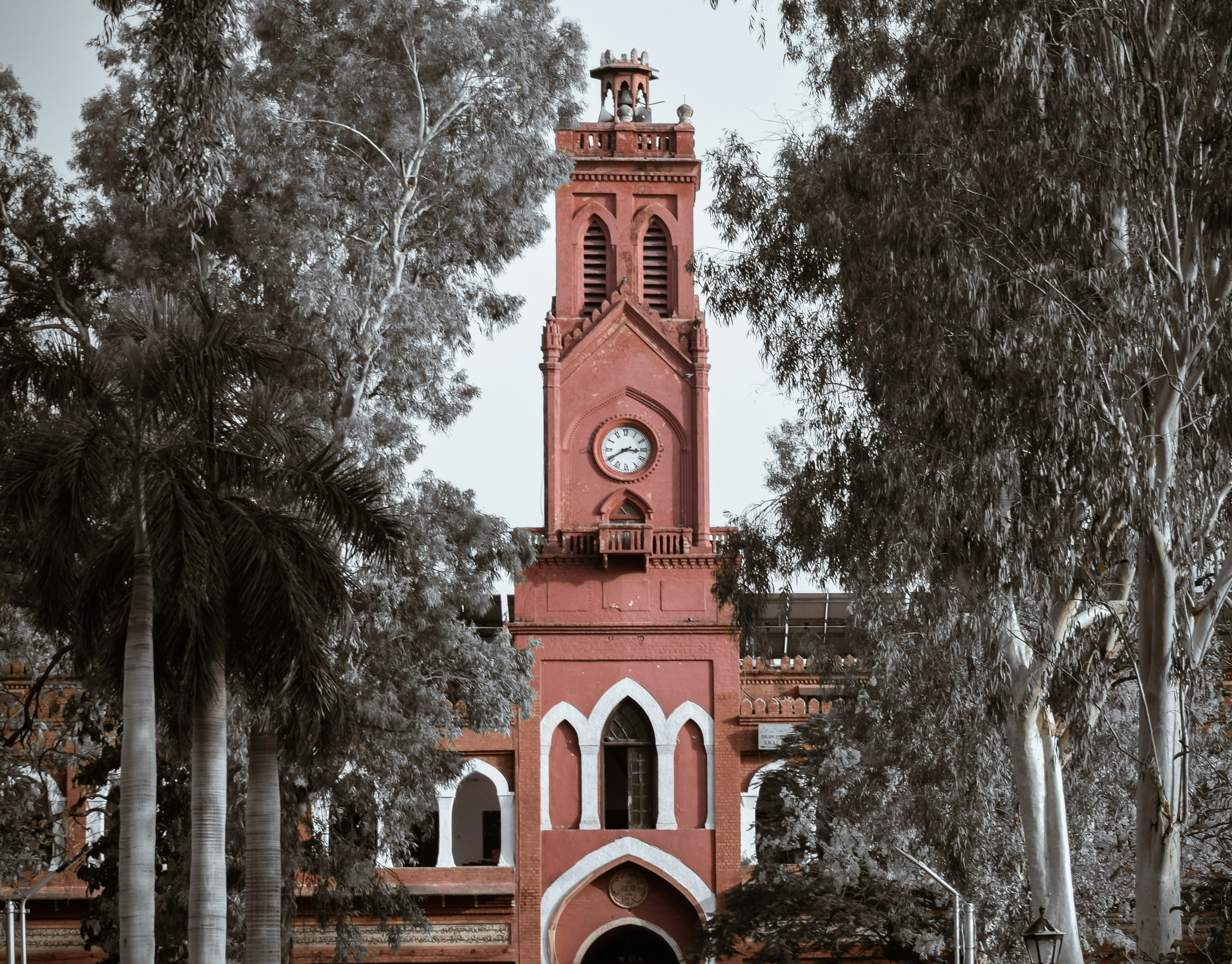
Photo by Ahmad Attari on Unsplash
Disclaimer: Material published by Traversing Tradition is meant to foster scholarly inquiry and rich discussion. The views, opinions, beliefs, or strategies represented in published articles and subsequent comments do not necessarily represent the views of Traversing Tradition or any employee thereof.
- Habermas, J. (1970). The University in a Democracy: Democratization of the university. Beacon Press Boston. [↩]
- Appadurai, A. (2006). Fear of small numbers: An essay on the geography of anger. Duke University Press. [↩]
- Asad, T. (2003). Formations of the secular: Christianity, Islam, modernity. Stanford University Press. [↩]
- Rushdie, S. (1988). The Satanic verses. Viking. [↩]
- Asad, T. (2009). The idea of an anthropology of Islam. Qui Parle. [↩]
Aamir Nazir Shah
Aamir Nazir Shah is a postgraduate student at Jamia Millia Islamia, Delhi. Hailing from Kashmir, he completed his undergraduate studies at the University of Delhi. His academic interests span across Western and Islamic political thought, Islamic epistemology and Intellectual tradition and South Asian politics and history.
Leave a Reply